Unlocking Growth: Mastering Conversion Optimization tips in 2025
Want to transform your website from a digital brochure into a lead-generating machine? This listicle delivers actionable conversion optimization tips to boost your bottom line. We’ll explore key strategies covering design, copywriting, and user experience, providing practical insights you can implement immediately.
Whether you’re a Denver-based startup, an e-commerce brand on Shopify, or a Colorado company seeking growth, these techniques will help you convert more visitors into customers. This article will cover essential elements of conversion optimization including A/B testing, compelling call-to-action development, using social proof, page load speed optimization, and mobile-first design. We’ll also delve into streamlining your checkout process, personalizing content, and optimizing landing pages for maximum impact. Learn how to turn clicks into conversions and maximize your website’s ROI with these powerful conversion optimization tips.
1. A/B Testing and Multivariate Testing
A/B testing and multivariate testing are crucial conversion optimization tips for any business seeking data-driven improvements. These methods provide a systematic way to compare different versions of web pages, emails, or app elements to identify which performs best. A/B testing compares two versions, focusing on a single variable, while multivariate testing analyzes multiple variables simultaneously. This allows you to pinpoint exactly which combination of elements yields the highest conversion rates.
A/B testing isn’t just for tech giants. Even small changes can have a big impact. For instance, Obama’s 2008 presidential campaign saw a 40% increase in donations simply by A/B testing the donation button. Booking.com, a master of optimization, runs over 1,000 A/B tests concurrently. Similarly, HubSpot increased conversions by a staggering 106% by testing different CTA button colors. These real-world examples demonstrate the power of data-driven decision-making for conversion optimization.
Actionable Tips for Effective Testing
Here’s how to get the most out of your A/B and multivariate tests:
Test one variable at a time in A/B tests for clear, interpretable results. This isolates the impact of each change.
Ensure an adequate sample size before drawing conclusions. Statistical significance is key to reliable results.
Run tests for full business cycles to account for weekly or monthly variations in user behavior.
Meticulously document all test results, both successes and failures, for future reference and iterative improvements.
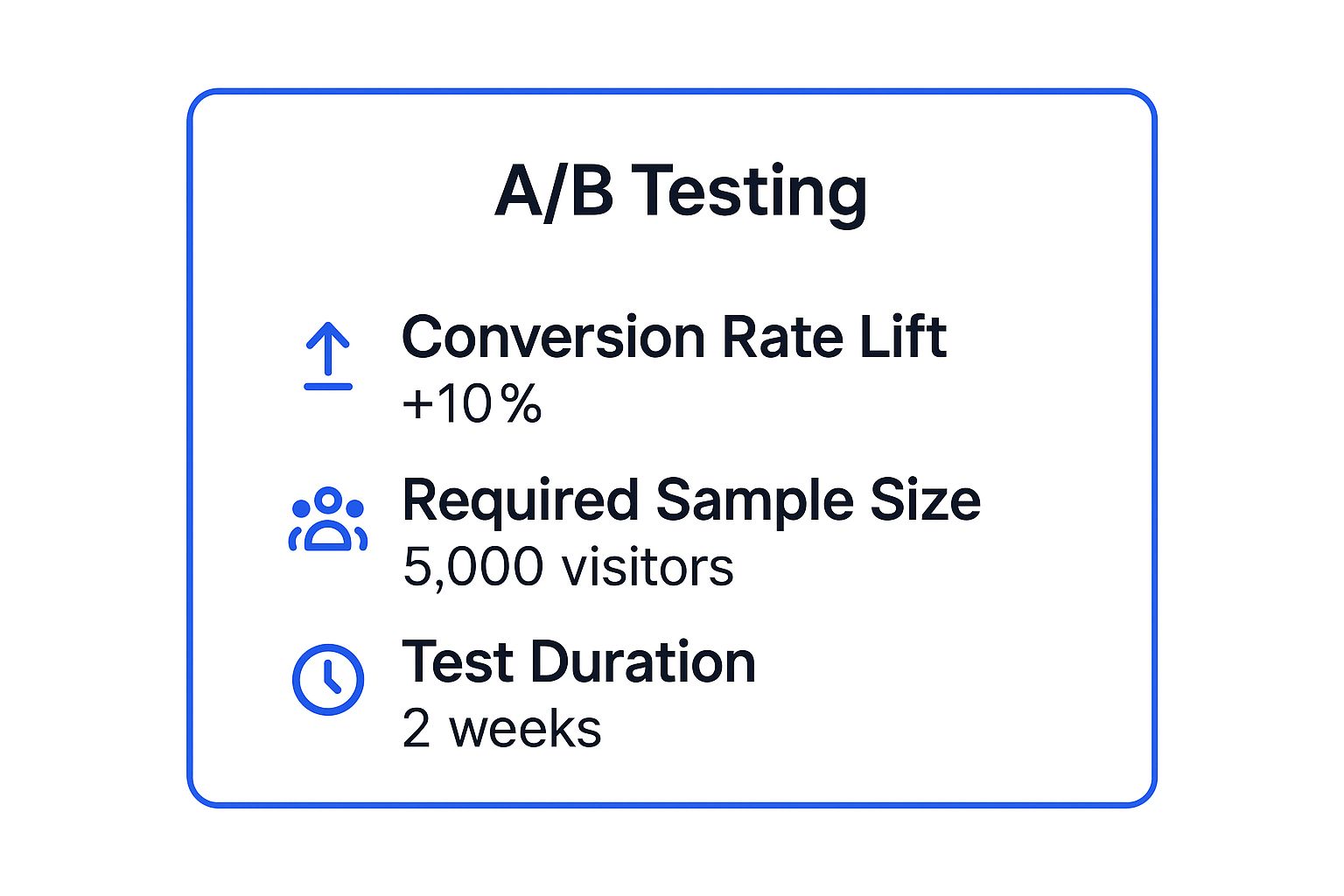
When planning your optimization strategy, consider the infographic below as a quick reference for essential metrics:
This infographic visualizes three key metrics for A/B testing: conversion rate lift, required sample size, and test duration. As the visual suggests, even small lifts in conversion rates can be significant, but require careful attention to sample size and test duration to achieve statistical validity.
Why A/B and Multivariate Testing Matter
A/B and multivariate testing allow you to move beyond guesswork and make data-backed decisions that directly impact your bottom line. These methods empower you to:
Increase Conversion Rates: Identify the elements that resonate most with your audience and drive desired actions.
Improve User Experience: Optimize your website or app for a smoother, more engaging user journey.
Reduce Bounce Rates: Keep visitors on your site longer by presenting them with the most effective content and design.
Maximize ROI: Invest your resources in the changes that deliver the greatest return.
Compelling call-to-action (CTA) optimization is a critical conversion optimization tip focused on strategically designing and placing action-oriented buttons, links, or messages. These elements guide users toward desired conversions, like signing up for a newsletter, making a purchase, or requesting a demo. Effective CTAs combine persuasive copy, visual design, strategic placement, and psychological triggers to maximize click-through and conversion rates.
Even seemingly small changes to your CTA can yield significant improvements. For example, Netflix saw a substantial uptick in subscriptions simply by changing their CTA button copy from “Register” to “Join Free for a Month.” Unbounce increased conversions by 90% by changing their CTA from “Start your free trial” to “Get Started.” ContentVerve achieved a similar 90% conversion lift by changing “Order Information” to “Get My Free Ebook.” These examples highlight the power of well-crafted CTAs.
Actionable Tips for Effective CTAs
Here’s how to optimize your CTAs for maximum impact:
Use First-Person Language: Phrasing your CTA in the first person, such as “Get My Free Trial,” can create a sense of ownership and increase engagement.
Create Urgency (Responsibly): Limited-time offers or scarcity tactics can encourage immediate action, but avoid misleading or manipulative language.
Visual Prominence: Ensure your CTAs stand out visually from the surrounding elements through contrasting colors, size, and whitespace.
Strategic Placement: Test different CTA positions, including above the fold, multiple locations within the content, and at the end of the page.
Why CTA Optimization Matters
Optimizing your CTAs is essential for several key reasons:
Increased Conversions: Well-crafted CTAs directly influence user behavior, guiding them toward the desired actions and boosting conversion rates.
Improved User Experience: Clear and compelling CTAs make it easier for users to navigate your website and find what they’re looking for.
Better Engagement: Strong CTAs encourage interaction and drive user engagement, leading to a more positive overall experience.
Data-Driven Insights: A/B testing different CTA variations provides valuable data on what resonates best with your target audience.
By focusing on CTA optimization, businesses can transform passive visitors into active participants, driving tangible results and achieving their conversion goals. This is a key component of any successful conversion optimization strategy.
3. Social Proof and Trust Signals
Social proof and trust signals are powerful conversion optimization tips that leverage the psychological principle of social influence. This principle states that people are more likely to take an action if they see others doing the same, especially when uncertain. By strategically incorporating testimonials, reviews, certifications, social media mentions, and other credibility indicators, you can reduce visitor anxiety and boost confidence in purchasing decisions. This ultimately leads to higher conversion rates.
Think of Amazon’s review system, a key driver of billions in additional sales. Airbnb’s host and guest reviews fostered the sharing economy. Shopify merchants experience a 270% conversion lift with product reviews. TripAdvisor built its entire business model on social proof. These real-world examples illustrate the potent influence of social proof on consumer behavior.
Actionable Tips for Leveraging Social Proof
Here’s how to effectively integrate social proof into your conversion optimization strategy:
Display recent, specific, and relevant testimonials. Generic praise lacks impact. Focus on testimonials that address specific pain points and highlight tangible benefits.
Include photos and full names for authenticity. This adds credibility and humanizes the testimonials, making them more relatable.
Show real-time activity (e.g., “5 people viewing this item”). This creates a sense of urgency and scarcity, encouraging immediate action.
Place trust signals near conversion points. Strategically position trust badges, security seals, and guarantees near call-to-action buttons to alleviate purchase anxieties.
Why Social Proof and Trust Signals Matter
Social proof and trust signals tap into fundamental human psychology. By showing potential customers that others trust and value your product or service, you can significantly influence their decision-making process. This translates to:
Increased Conversion Rates: Building trust and reducing hesitation leads to more conversions.
Improved Brand Credibility: Demonstrating social acceptance strengthens your brand reputation.
Reduced Customer Acquisition Costs: Increased trust can lead to organic growth and referrals, reducing reliance on expensive advertising.
Enhanced Customer Lifetime Value: Satisfied customers who trust your brand are more likely to become repeat buyers.
By incorporating these techniques, you can create a website that resonates with visitors, builds trust, and ultimately drives more conversions. This helps establish a positive feedback loop, leading to increased customer loyalty and sustained business growth.
4. Page Load Speed Optimization
Page load speed optimization is the technical and strategic process of reducing website loading times. This crucial conversion optimization tip focuses on improving user experience and, consequently, conversion rates. Page speed directly impacts bounce rates, user satisfaction, search rankings, and ultimately, your bottom line. Even a one-second delay can significantly affect revenue.
For e-commerce businesses, especially those on platforms like Shopify or WooCommerce, fast loading times are essential for converting browsers into buyers. A slow website can frustrate potential customers and drive them to competitors. Optimizing for speed ensures a seamless and positive user experience, encouraging visitors to explore your products and complete their purchases.
Real-World Examples of Speed Optimization Success
Several companies have demonstrated the substantial impact of page load speed optimization on their conversion rates:
Amazon: Found that every 100ms delay cost them 1% in sales, highlighting the direct correlation between speed and revenue.
Walmart: Saw a 2% increase in conversions for every 1-second improvement in page load time.
Pinterest: Reduced load times by 40% and saw a 15% increase in SEO traffic, demonstrating the benefit for search visibility.
AutoAnything: Reduced load time by half and saw a 12-13% increase in sales, proving the impact on e-commerce performance.
These examples underscore the significant return on investment that page speed optimization can deliver. For Denver-based businesses and Colorado e-commerce brands, staying competitive in the digital landscape requires prioritizing website performance.
Actionable Tips for Faster Page Loads
Here’s how to optimize your website for speed:
Aim for load times under 3 seconds: This benchmark provides a positive user experience and minimizes bounce rates.
Optimize images without sacrificing quality: Compress images effectively to reduce file size without compromising visual appeal.
Use browser caching and compression: Enable these features to store frequently accessed data and minimize the amount of data transferred.
Monitor performance regularly with tools like PageSpeed Insights: Track your progress and identify areas for improvement.
Why Page Load Speed Matters for Conversions
Page load speed is more than just a technical detail; it’s a crucial factor in user experience and conversion optimization. A fast-loading website:
Reduces Bounce Rates: Keeps visitors engaged and encourages them to explore your content.
Improves User Satisfaction: Creates a positive experience that fosters trust and encourages conversions.
Boosts Search Rankings: Google considers page speed as a ranking factor, impacting your visibility in search results.
Increases Conversions: Leads to higher conversion rates by providing a seamless and enjoyable user experience.
By prioritizing page load speed optimization, businesses can significantly enhance their website’s performance, user experience, and ultimately, their bottom line. This is especially critical for SMEs and entrepreneurs seeking tailored web solutions that deliver tangible results.
5. Mobile-First Responsive Design
Mobile-first responsive design prioritizes the mobile user experience, then scales up for larger screens. With mobile traffic dominating the web, this approach is crucial for conversion optimization. It necessitates touch-friendly interfaces, fast loading speeds, and streamlined user flows tailored for mobile devices. This ensures a positive user experience, leading to higher engagement and conversions.
Many companies have seen remarkable success with mobile-first design. Starbucks saw mobile orders account for 40% of transactions after optimizing their app. ASOS achieved a 50% increase in mobile conversions after a mobile-first redesign. Pinterest’s mobile-first approach resulted in 75% of their traffic coming from mobile devices. Domino’s also benefits, with their mobile ordering platform generating over 65% of their digital sales.
Actionable Tips for Mobile-First Design
These tips will help you optimize your website for mobile users:
Design for thumb navigation zones: Place key elements within easy reach of a user’s thumb.
Simplify forms and checkout processes: Reduce the number of fields and steps required to complete a purchase.
Use large, tappable buttons: Buttons should be at least 44px for easy tapping on touchscreens.
Test on actual devices: Don’t rely solely on browser simulators. Test on a variety of real devices to ensure optimal performance.
Why Mobile-First Matters for Conversion Optimization
Mobile-first responsive design isn’t just a trend; it’s a necessity. Prioritizing the mobile experience improves user satisfaction, reduces bounce rates, and ultimately, drives conversions. It directly addresses the increasing dominance of mobile traffic, making it a key element in any effective conversion optimization strategy. By focusing on mobile users first, businesses can capitalize on this significant segment of their audience and achieve substantial improvements in their bottom line.
6. Streamlined Checkout and Form Optimization
Streamlined checkout and form optimization focuses on reducing friction in forms and checkout processes. This involves minimizing the number of fields, improving the user experience, and removing any barriers to completion. By making it as easy as possible for users to complete desired actions, form optimization can dramatically reduce abandonment rates and increase conversions. This is a crucial aspect of conversion optimization as it directly impacts the final steps of a user’s journey towards a purchase or desired action.
Several businesses have seen significant improvements through form optimization. Expedia famously increased profits by $12 million simply by removing one unnecessary form field. Similarly, Imaginary Landscape boosted conversions by a remarkable 120% by reducing form fields from 11 to just 4. Marketo also saw a 10% increase in conversions by simplifying their demo request form. These real-world examples illustrate the significant impact of even minor adjustments to forms on overall conversion rates.
Actionable Tips for Effective Form Optimization
Implementing effective form optimization involves a few key strategies:
Essential Information First: Only ask for essential information initially. Additional details can be collected later in the process.
Single-Column Layouts: Use single-column layouts for a better mobile experience. This simplifies navigation and reduces user effort.
Progress Indicators: Provide clear progress indicators for multi-step processes. This helps users understand where they are in the process and encourages completion.
Guest Checkout Options: Include guest checkout options for e-commerce platforms. This allows users to purchase quickly without creating an account.
Why Streamlined Checkouts and Forms Matter
Streamlined checkouts and optimized forms are essential for maximizing conversions. They directly impact a user’s final decision, minimizing drop-off at a critical stage. By reducing friction and making it easier for users to complete desired actions, businesses can significantly improve their bottom line. Unbounce, for instance, saw an 11.03% increase in conversions by removing social media icons from their forms, reducing distractions and simplifying the process. Learn more about Streamlined Checkout and Form Optimization for Shopify. This link offers more specific insights into optimizing checkouts for Shopify stores.
This principle directly addresses a common pain point for users – lengthy or complex forms. By streamlining this process, you create a more positive user experience, leading to higher conversion rates and ultimately, greater business success.
7. Personalization and Dynamic Content
Personalization and dynamic content are powerful conversion optimization tips centered around delivering customized experiences. This strategy uses data points like user behavior, demographics, location, and past interactions to tailor content, offers, and the overall user journey. By showing users what’s most relevant to them, you increase engagement and boost the likelihood of conversion.
The effectiveness of personalization is evident in the success stories of industry giants. Amazon’s recommendation engine, a prime example of personalization, drives a remarkable 35% of their purchases. Netflix’s personalized algorithm, another testament to this approach, saves the company an estimated $1 billion annually in customer retention. Similarly, Spotify’s Discover Weekly playlist, a personalized music discovery feature, increased user engagement by 30%. These examples highlight the potential of personalization to drive significant business impact.
Actionable Tips for Effective Personalization
Implementing effective personalization requires a strategic approach. Here are some key tips to get started:
Start Simple: Begin with basic segmentation based on readily available data before venturing into more complex personalization tactics. This allows for a manageable rollout and progressive learning.
Progressive Profiling: Gradually gather more data about your users over time. This respects user privacy while allowing for increasingly refined personalization.
A/B Test: Compare personalized experiences against generic ones to measure the impact and fine-tune your approach. This data-driven approach ensures that personalization efforts are yielding the desired results.
Transparency and Privacy: Be open about your data collection practices and provide users with control over their data. Building trust is essential for long-term success with personalization.
Why Personalization Matters for Conversion Optimization
Personalization elevates the user experience by making interactions more relevant and meaningful. This enhanced relevance leads to a range of benefits:
Increased Engagement: Users are more likely to interact with content tailored to their interests, leading to higher click-through and conversion rates.
Improved Customer Retention: Personalized experiences foster a stronger connection with your brand, making customers more likely to return and stay engaged.
Reduced Bounce Rates: By presenting users with relevant information upfront, you reduce the likelihood of them leaving your site quickly due to irrelevant content.
Enhanced Customer Lifetime Value: By fostering stronger customer relationships and encouraging repeat business, personalization ultimately increases the overall value of each customer.
Personalization and dynamic content move beyond generic marketing and cater to individual preferences. This targeted approach creates a more engaging and rewarding experience for users, ultimately driving conversions and contributing to long-term business growth.
8. Landing Page Optimization and Message Matching
Landing page optimization and message matching is the practice of creating focused, single-purpose landing pages that perfectly align with the traffic source and visitor intent. Effective landing pages maintain message consistency from the initial advertisement all the way through to the landing page itself. They remove distractions and guide visitors toward a specific conversion goal through clear value propositions and compelling design. This targeted approach ensures that the visitor’s expectations are met, increasing the likelihood of conversion.
Companies like Unbounce, HubSpot, Marketo, and Shopify Plus have seen significant improvements in their conversion rates by implementing message matching and targeted landing page optimization. Unbounce’s own landing pages convert at an impressive 16.23%, significantly higher than the industry average of 2.35%. HubSpot saw a 42% increase in leads by creating campaign-specific landing pages. Marketo boosted conversions by 100% with targeted landing page optimization, and Shopify Plus achieved a 30% improvement in conversion rates through similar techniques. These examples showcase the power of aligning landing page messaging with user expectations.
Actionable Tips for Effective Landing Pages
Here’s how to optimize your landing pages for maximum conversions:
Match headline and messaging to the traffic source: Ensure a seamless transition from ad to landing page. If your ad promises a free ebook, the landing page headline should prominently feature the same offer.
Remove main navigation to reduce distractions: Keep visitors focused on the conversion goal by eliminating unnecessary navigation links.
Place primary CTA above the fold: Make it easy for visitors to take the desired action without having to scroll.
Use consistent visual branding with ad campaigns: Maintain a cohesive brand experience across all touchpoints.
Why Landing Page Optimization Matters
Landing page optimization plays a crucial role in conversion optimization because it creates a streamlined and targeted user experience. Generic web pages often fail to address the specific needs and expectations of visitors arriving from different sources. By tailoring the landing page experience to match the user’s intent, you significantly increase the chances of converting them into customers.
Learn more about Landing Page Optimization and Message Matching. By implementing these strategies, you can transform your landing pages into high-converting assets that drive business growth and maximize your marketing ROI. This focused approach ensures that you capture leads effectively and guide them seamlessly through the sales funnel.
Conversion Optimization Tips Comparison
Item
Implementation Complexity 🔄
Resource Requirements ⚡
Expected Outcomes 📊
Ideal Use Cases 💡
Key Advantages ⭐
A/B Testing and Multivariate Testing
Moderate to High – requires setup and statistical analysis
High – needs significant traffic and data tools
Reliable conversion lift and data-driven decisions
Websites/apps with enough traffic to test variations
Elevate Your Conversions: Partnering with Denver Web Design Studio
Mastering conversion optimization is crucial for online success. This article has explored eight key strategies, from A/B testing and compelling call-to-action optimization to personalization and landing page best practices. By implementing these conversion optimization tips, you can transform your website into a powerful engine for growth, driving more leads, sales, and ultimately, revenue.
Key Takeaways for Conversion Optimization
Let’s recap the most impactful takeaways:
Prioritize Speed: A fast-loading website is paramount for user experience and conversions. Optimize images, leverage browser caching, and minimize HTTP requests.
Mobile-First Approach: Design with mobile users in mind first. A responsive design ensures a seamless experience across all devices, maximizing your reach and conversion potential.
Compelling CTAs: Craft clear, action-oriented CTAs that guide users towards desired actions. Experiment with different phrasing, colors, and placement to optimize their effectiveness.
Personalization Matters: Tailor content and offers based on user behavior and preferences. Dynamic content enhances engagement and boosts conversion rates by delivering relevant experiences.
The Power of Optimized Conversions
Why is all of this so important? Optimizing your website for conversions translates directly to improved business outcomes. Higher conversion rates mean more customers, increased sales, and a stronger bottom line. It’s about making every click count and maximizing the return on your marketing investment.
Next Steps for Conversion Success
Start by identifying areas for improvement on your website. Prioritize quick wins, like optimizing page load speed and refining your CTAs. Then, progressively implement more advanced strategies, like personalization and A/B testing. Remember, conversion optimization is an ongoing process, requiring continuous monitoring, testing, and refinement.
Partnering for Conversion Excellence
Implementing these strategies effectively can be complex. That’s where Denver Web Design Studio comes in. We specialize in crafting high-converting websites tailored to your specific business needs. From strategic design to performance-driven marketing, we empower businesses like yours to achieve exceptional results.
Ready to transform your online presence into a lead-generating machine? ContactDenver Web Design Studiotoday to explore how our expertise in conversion optimization tips can help you achieve your business goals. Denver Web Design Studio offers tailored web solutions designed to maximize your conversions and drive sustainable growth.
For more insights on boosting your online performance, explore our guides on landing page best practices, lead-generating websites, and the essential SEO checklist for new sites.
Unveiling Your Competitors’ Secrets Want to outperform your rivals online? This list of top 10 website competitor analysis tools will give you the edge. Discover how these tools help you
Building a website for a small business? The small business website cost 2025 varies widely depending on your goals, features, and who you hire. On average, you can expect to
Master your website migration SEO checklist with proven strategies. Protect rankings, avoid traffic loss, and ensure seamless transitions with expert guidance.
Get started now
Looking for a partner you can trust? We’d love to hear from you — reach out today!


 This infographic visualizes three key metrics for A/B testing: conversion rate lift, required sample size, and test duration. As the visual suggests, even small lifts in conversion rates can be significant, but require careful attention to sample size and test duration to achieve statistical validity.
 Even seemingly small changes to your CTA can yield significant improvements. For example, Netflix saw a substantial uptick in subscriptions simply by changing their CTA button copy from “Register” to “Join Free for a Month.” Unbounce increased conversions by 90% by changing their CTA from “Start your free trial” to “Get Started.” ContentVerve achieved a similar 90% conversion lift by changing “Order Information” to “Get My Free Ebook.” These examples highlight the power of well-crafted CTAs.
 Think of Amazon’s review system, a key driver of billions in additional sales. Airbnb’s host and guest reviews fostered the sharing economy. Shopify merchants experience a 270% conversion lift with product reviews. TripAdvisor built its entire business model on social proof. These real-world examples illustrate the potent influence of social proof on consumer behavior.
 Many companies have seen remarkable success with mobile-first design. Starbucks saw mobile orders account for 40% of transactions after optimizing their app. ASOS achieved a 50% increase in mobile conversions after a mobile-first redesign. Pinterest’s mobile-first approach resulted in 75% of their traffic coming from mobile devices. Domino’s also benefits, with their mobile ordering platform generating over 65% of their digital sales.


