Ready to Rank Higher?
Want more customers finding your business online? This listicle delivers seven actionable SEO tips for small businesses to improve your search engine rankings and attract more organic traffic. Learn how keyword research, local SEO, quality content, technical SEO, link building, user experience, and social media can work together to boost your visibility and drive business growth. Implementing these SEO tips for small businesses is crucial for competing effectively online. Let’s get started!
1. Keyword Research and Optimization
Keyword research and optimization is the foundation of any successful SEO strategy for small businesses. It’s the process of identifying the terms and phrases your target audience uses when searching online for products or services like yours. By strategically incorporating these keywords into your website’s content, meta tags, and URLs, you can improve your visibility on search engine results pages (SERPs) and drive more targeted traffic to your website. This, in turn, leads to increased brand awareness, higher lead generation, and ultimately, more sales. This is a crucial first step for any small business looking to establish a strong online presence, making it a cornerstone of effective SEO.
The infographic visualizes the cyclical process of keyword research and optimization, highlighting key steps such as identifying seed keywords, analyzing competitors, and refining the strategy based on performance data. It emphasizes the ongoing nature of keyword optimization and the importance of continuous refinement.
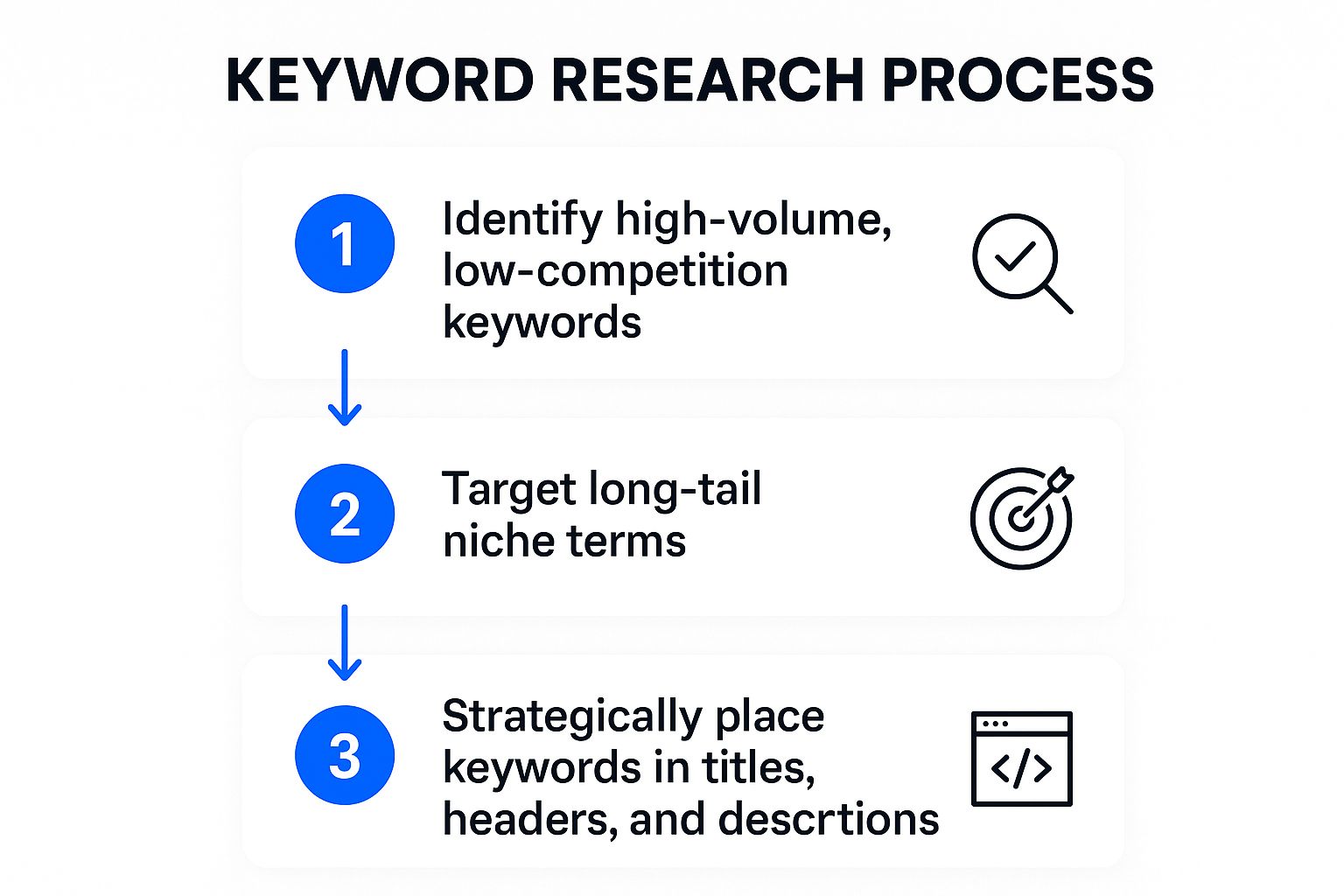
This process helps you understand how potential customers search for your offerings. For example, a Denver-based event organizer might discover that people searching for “corporate event venues Denver” are more likely to convert than those searching for the broader term “event planning.” This level of insight allows you to tailor your content and SEO strategy to attract the most qualified leads. Features of effective keyword optimization include identifying high-volume, low-competition keywords, targeting long-tail keywords for specific niche audiences (like “gluten-free wedding cakes Denver”), strategically placing keywords in your website content, and analyzing competitor keyword strategies.
The following infographic details the keyword research process flow, starting with brainstorming seed keywords related to your business. Then, you analyze search volume and competition for those keywords, expand your list with related long-tail keywords, and finally, implement and track your chosen keywords. The iterative nature of the process is highlighted by the feedback loop, indicating the need to continuously refine your strategy based on performance.
Pros of Keyword Research and Optimization:
- Increased Organic Visibility: Ranking higher in organic search results for relevant queries exposes your business to a wider audience actively searching for what you offer.
- Understanding Customer Intent: Keyword research provides valuable insights into customer language and search intent, helping you tailor your messaging and offerings to better meet their needs.
- Content Creation Direction: Understanding which keywords are relevant to your audience informs your content strategy, ensuring you create content that resonates and ranks well.
- Budget-Friendly: Many effective keyword research tools are free or relatively inexpensive, making this a cost-effective SEO tactic for small businesses.
Cons of Keyword Research and Optimization:
- Ongoing Effort: Keyword research isn’t a one-time task. Search trends and competitor strategies change, requiring ongoing research and adjustments to your keyword strategy.
- Delayed Results: SEO is a long-term strategy, and it takes time to see significant results from keyword optimization efforts.
- Keyword Stuffing Risk: Overusing keywords can negatively impact your rankings and user experience. Focus on natural integration for best results.
Examples of Successful Implementation:
- A local bakery in Portland increased organic traffic by 83% after targeting long-tail keywords like “gluten-free cupcakes Portland” instead of just “bakery.”
- River City Consulting improved lead generation by optimizing for service-specific keywords combined with location modifiers, such as “business consulting Denver.”
Actionable Tips for Small Businesses:
- Use Free Keyword Research Tools: Leverage free tools like Google Keyword Planner, Ubersuggest, or AnswerThePublic to discover relevant keywords.
- Natural Keyword Placement: Include keywords naturally in page titles, headers, meta descriptions, and the first 100 words of your content.
- Focus on Search Intent: Consider what users are looking for when they use a specific keyword, and create content that satisfies their intent.
- Regularly Review and Update: Monitor your keyword performance and update your strategy based on the data. What worked last year might not work today.
Keyword research and optimization is not just a technical SEO task; it’s a crucial business strategy. By understanding how your customers search and tailoring your website accordingly, you can significantly improve your online visibility, attract more qualified leads, and ultimately grow your business. For small businesses, especially those operating in competitive markets like Denver or offering specialized services like e-commerce development, keyword research and optimization is paramount to online success.
2. Local SEO Optimization
For small businesses, especially those serving a specific geographic area, local SEO is a crucial element of a successful SEO strategy. Local SEO focuses on optimizing your online presence to attract more customers from relevant local searches. This means connecting with customers in your vicinity who are actively looking for the products or services you offer. When someone searches for “bakery near me” or “best plumber in Denver,” local SEO helps ensure your business appears at the top of those search results. This is essential for driving foot traffic to physical stores and increasing online visibility for service-area businesses. For small businesses competing against larger corporations, local SEO offers a targeted approach to reach the most qualified leads – those closest to you.

Local SEO encompasses several key features: optimizing your Google Business Profile (formerly Google My Business), targeting location-based keywords (like “Denver florist” or “Chicago coffee shop”), ensuring consistent Name, Address, and Phone number (NAP) information across all online platforms, creating location-specific content, and building local links and citations.
Examples of Successful Local SEO Implementation:
- A family-owned hardware store in Chicago saw a 156% increase in store visits after optimizing their Google Business Profile listing and securing local citations on relevant directories.
- Sunshine Dental Practice increased new patient appointments by 42% through local SEO efforts, including consistent NAP information and actively generating positive reviews.
Actionable Tips for Local SEO:
- Claim and fully optimize your Google Business Profile: Add photos, accurate business hours, a detailed list of services, and post regularly to keep your profile fresh and engaging.
- Encourage satisfied customers to leave positive reviews: Positive reviews build trust and improve your local search ranking.
- Ensure consistent NAP information: Double-check that your business name, address, and phone number are identical across all online directories and your website.
- Create location-specific pages: If your business serves multiple areas, create dedicated pages for each location with tailored content and keywords.
- Participate in local community events: Sponsoring or participating in local events can create opportunities for local backlinks and increased brand visibility.
Pros of Local SEO:
- Increased visibility in local search results and map listings
- Drives foot traffic to physical locations
- Higher conversion rates due to geographic relevance
- Often less competitive than broader search terms
Cons of Local SEO:
- Requires maintaining accurate information across multiple platforms
- Can be challenging for businesses with multiple locations
- May require ongoing management of customer reviews
This approach is particularly effective for brick-and-mortar businesses, service-area businesses, and any small business targeting a specific geographic region. It provides a focused strategy to reach potential customers actively searching for local products and services, resulting in higher conversion rates and increased business growth. Tools like Google Business Profile, Moz Local, and BrightLocal can assist in managing and optimizing your local SEO efforts.
3. Quality Content Creation
Quality content creation is the bedrock of successful SEO for small businesses. It’s more than just stringing words together; it’s about providing valuable, relevant information that resonates with your target audience and addresses their specific needs. This approach allows you to demonstrate your expertise, answer customer questions, and naturally incorporate valuable keywords that search engines use to rank websites. By consistently delivering high-quality content, you build brand authority, foster trust, and establish your business as a leader in your industry. This, in turn, drives organic traffic to your website, enhances your online visibility, and ultimately contributes to business growth.

Quality content takes many forms, including keyword-optimized blog posts and articles, solution-oriented content addressing frequently asked questions, and engaging multimedia content like videos, infographics, and images. Maintaining a regular publishing schedule is crucial for keeping your audience engaged and signaling to search engines that your website is active and relevant. All content should demonstrate expertise, authority, and trustworthiness (E-A-T), which are key factors Google considers when ranking websites.
This approach deserves a place on this list of SEO tips for small businesses because it offers a sustainable, long-term strategy for attracting and retaining customers. Unlike paid advertising, which stops generating traffic the moment you stop paying, quality content continues to attract visitors over time, providing a consistent source of organic traffic.
Examples of Successful Implementation:
- Beardbrand: This grooming company built a multimillion-dollar business by focusing on content marketing. They created a wealth of beard care tips and lifestyle content that resonated with their target audience, establishing them as a leading authority in the men’s grooming space.
- River Pools and Spas: During the recession, this company transformed its business by creating comprehensive, honest content about fiberglass pool costs and comparisons. This transparency and valuable information built trust with potential customers and drove significant business growth.
Actionable Tips for Small Businesses:
- Focus on Solutions: Prioritize content that solves customer problems and answers their questions rather than solely promoting your products or services. This builds trust and positions you as a helpful resource.
- Editorial Calendar: Create an editorial calendar to maintain a consistent publishing schedule and ensure a steady flow of valuable content.
- Repurpose Content: Maximize your content’s reach by repurposing successful pieces into different formats. For example, turn a popular blog post into a video or infographic.
- Update Content: Regularly update high-performing older content to ensure it remains relevant and accurate, further extending its lifespan and SEO value.
- Use SEO Tools: Leverage tools like Google Search Console to identify content opportunities and understand what your audience is searching for.
Pros and Cons:
Pros:
- Builds credibility and authority in your industry
- Creates multiple entry points to your website via search results
- Provides long-term value that continues generating traffic over time
- Supports social media and email marketing efforts
Cons:
- Can be time-consuming to produce consistently
- Requires ongoing investment in creation and updating
- Takes time to see significant SEO results
- May require specialized knowledge or professional writers
By focusing on quality content creation, small businesses can effectively leverage SEO to attract their target audience, build a strong online presence, and achieve sustainable growth. It’s a crucial component of any successful digital marketing strategy for SMEs, entrepreneurs, and established companies alike – particularly those mentioned seeking better UX and sales, custom websites, and a stronger digital presence.
4. Technical SEO Fundamentals
Technical SEO is the backbone of any successful SEO strategy, especially for small businesses. It focuses on optimizing your website’s infrastructure so search engines can easily crawl, index, and understand your content. While it might sound intimidating, getting these fundamentals right sets a strong foundation for all other SEO efforts, like content creation and keyword research, and prevents technical issues from hindering your visibility. For small businesses competing in a crowded digital landscape, neglecting technical SEO is like building a beautiful storefront on a deserted road – no one will find it. This aspect of SEO tips for small businesses is critical for long-term online success.
Technical SEO encompasses several crucial features:
- Mobile-Friendly and Responsive Design: In today’s mobile-first world, your website must adapt seamlessly to different screen sizes. This not only enhances user experience but is also a significant ranking factor for search engines.
- Fast Page Loading Speeds: Slow loading times frustrate users and lead to high bounce rates, signaling to search engines that your site offers a poor user experience. Every second counts!
- Secure Website (HTTPS): HTTPS encrypts data transmitted between your website and users, ensuring security and building trust. It’s a must-have for any website, especially e-commerce sites.
- Proper Site Structure and Navigation: A clear and logical site structure makes it easy for both users and search engines to navigate your website and find the information they need. A well-organized website improves user experience and allows search engines to understand the context and hierarchy of your content.
- Clean URL Structure: Descriptive and user-friendly URLs are easier for search engines to understand and can improve click-through rates from search results.
- XML Sitemap Creation and Submission: A sitemap acts as a roadmap for search engines, guiding them to all the important pages on your website. A crucial step in technical SEO is ensuring search engines can find and index your site. This involves creating sitemaps and submitting your website to search engines like Google and Bing. How to Submit Your Website to Search Engines: The Complete Guide from AliasLinks provides a comprehensive walkthrough of this process.
Pros:
- Improved User Experience, Reducing Bounce Rates: A technically sound website provides a seamless and enjoyable browsing experience, encouraging users to stay longer and explore more.
- Ensures Search Engines Can Properly Crawl and Index Content: By removing technical barriers, you allow search engines to access and understand your content, increasing your chances of ranking higher in search results.
- Provides Competitive Advantage over Technically Deficient Competitors: In the competitive online world, even small technical improvements can give you an edge over rivals who neglect this aspect of SEO.
- Many Fixes are One-Time Implementations with Long-Term Benefits: While some technical SEO tasks require ongoing monitoring, many fixes, such as optimizing site structure or implementing HTTPS, are one-time implementations that provide lasting benefits.
Cons:
- May Require Developer Assistance for Implementation: Some technical SEO tasks may require the expertise of a web developer, adding to the cost.
- Can be Technically Intimidating for Small Business Owners: The technical jargon and complexity can be overwhelming for those without a technical background.
- Some Solutions May Require Investment in Better Hosting or Premium Tools: Improving page speed or implementing advanced SEO features may require upgrading your hosting plan or investing in specialized tools.
Examples:
- An e-commerce boutique saw a 28% increase in mobile conversions after reducing page load speeds from 6 seconds to under 2 seconds.
- A local law firm improved rankings for key service pages after fixing crawl errors and implementing a proper URL structure.
Tips for Small Businesses:
- Use Google’s PageSpeed Insights and Mobile-Friendly Test: These free tools identify areas for improvement in terms of speed and mobile responsiveness.
- Compress Images and Leverage Browser Caching: Optimize your images to reduce file size and improve loading times. Browser caching allows repeat visitors to load your website faster.
- Implement a Logical Site Structure: Ensure important pages are no more than three clicks from the homepage.
- Install an SEO Plugin like Yoast SEO (WordPress): These plugins provide basic technical optimization features and guidance.
- Regularly Audit Your Site: Use tools like Screaming Frog to identify and fix technical issues before they impact your rankings.
Investing in technical SEO is an investment in your small business’s online future. By addressing these fundamentals, you create a robust platform for attracting organic traffic, improving user experience, and achieving sustainable growth.
5. Link Building for Authority
In the competitive digital landscape, small businesses often struggle to gain visibility against larger, more established companies. This is where link building comes into play as a powerful SEO tactic. Link building is the process of acquiring hyperlinks from other websites to your own. For small businesses, these backlinks act as votes of confidence, signaling to search engines that your website is a credible and authoritative source of information within your industry. This, in turn, improves your domain authority – a crucial ranking factor – and drives valuable referral traffic, helping you compete with larger players in search results and ultimately attract more customers. This makes link building a crucial element in any successful SEO strategy for small businesses and earns it a spot on this list.
How it Works: Search engines like Google interpret backlinks as endorsements. The more high-quality links pointing to your website, the higher your authority in Google’s eyes, and the more likely you are to rank well for relevant search terms. This authority building isn’t just about quantity; it’s primarily about quality. A handful of links from highly respected websites within your industry holds significantly more weight than hundreds of links from irrelevant or low-quality sources.
Features of Effective Link Building for Small Businesses:
- Earning links from relevant industry websites: Links from websites within your niche are the most valuable. They demonstrate relevance to both search engines and potential customers.
- Local citation building: Listing your business on relevant online directories (Yelp, Google My Business, industry-specific directories) builds local SEO and can generate backlinks.
- Guest posting on authoritative sites: Contributing high-quality content to relevant blogs and publications in your industry can earn you valuable backlinks and exposure to a wider audience.
- Creating linkable assets (studies, guides, tools): Developing original, high-value content, such as in-depth industry reports, practical guides, or free online tools, naturally attracts links from other websites seeking to provide valuable resources to their audience.
- Relationship-based link acquisition: Building genuine relationships with industry bloggers, journalists, and influencers can lead to natural link opportunities.
Pros:
- Significantly improves search rankings for competitive keywords
- Builds domain authority and credibility
- Generates referral traffic from relevant websites
- Creates valuable industry relationships
Cons:
- Time-intensive process with gradual results
- Quality links are difficult to acquire
- Risk of penalties from low-quality or unnatural links (e.g., buying links)
- Often requires content or resource creation as “link bait”
Examples of Successful Link Building:
- Moz: Founder Rand Fishkin played a key role in building Moz’s authority by creating and promoting the “Beginner’s Guide to SEO,” which attracted thousands of natural backlinks due to its comprehensive and valuable content.
- Buffer: Buffer gained early traction by guest posting on over 150 blogs. This strategy not only built valuable backlinks but also significantly increased brand awareness and reach.
Actionable Tips for Small Businesses:
- Focus on quality over quantity: A few links from respected sites are far more valuable than numerous low-quality links.
- Create comprehensive resources that naturally attract links: Invest in creating high-quality content that others in your industry will find valuable and want to link to.
- Leverage local business associations, chambers of commerce, and sponsorships for relevant links: Engaging with local organizations can create opportunities for backlinks from their websites.
- Build relationships with industry bloggers and journalists before requesting links: Nurturing relationships increases your chances of securing valuable backlinks.
- Monitor competitors’ backlinks to identify link opportunities: Analyze your competitors’ link profiles to discover potential link sources that could also benefit your website.
When and Why to Use This Approach: Link building is a long-term SEO strategy that should be implemented consistently. It’s particularly valuable for small businesses seeking to:
- Improve their search engine rankings for competitive keywords
- Establish themselves as authoritative voices within their industry
- Drive targeted traffic to their website
- Build valuable relationships within their niche
By prioritizing quality link building, small businesses can significantly improve their online visibility, attract more customers, and compete effectively with larger companies.
6. User Experience (UX) Optimization
In today’s competitive digital landscape, User Experience (UX) has become a cornerstone of successful SEO for small businesses. It’s no longer enough to simply have a website; it needs to be a seamless and enjoyable experience for your visitors. Google’s Core Web Vitals and page experience update solidified UX as a critical ranking factor, meaning a positive user experience directly impacts your visibility in search results. For small businesses, this translates to more organic traffic, higher conversion rates, and increased customer satisfaction. By prioritizing UX, you’re not just optimizing for search engines, you’re optimizing for your customers.

UX optimization encompasses various elements, all working together to create a smooth and efficient user journey. This includes complying with Core Web Vitals (Largest Contentful Paint – LCP, First Input Delay – FID, and Cumulative Layout Shift – CLS), which measure page load speed, interactivity, and visual stability. It also involves creating intuitive navigation and site structure, ensuring clear calls to action are readily available, and minimizing bounce rates by providing engaging content. Finally, and critically, your website must be fully optimized for mobile users, who now make up the majority of internet traffic.
Several success stories highlight the impact of UX optimization. Etsy, the popular online marketplace, saw a dramatic 70% improvement in bounce rate and a 150% increase in session duration after focusing on mobile user experience. Similarly, a small e-commerce furniture store reported a 24% increase in conversions after simplifying their checkout process and improving page load speed. These examples demonstrate how prioritizing UX can directly translate to tangible business results.
Why UX Optimization Deserves its Place in Your SEO Strategy:
This approach is essential for small businesses aiming to thrive online because it directly influences Google’s ranking factors, boosts conversion rates and customer satisfaction, reduces bounce rates and increases time spent on your site, and creates a competitive advantage in the increasingly user-centric search landscape. In short, good UX is good for business.
Pros:
- Directly impacts Google’s ranking factors
- Improves conversion rates and customer satisfaction
- Reduces bounce rates and increases time on site
- Creates competitive advantage
Cons:
- May require design and development resources
- Involves ongoing testing and refinement
- Can require balancing aesthetic preferences with optimization
- May present technical challenges for non-developers
Actionable Tips for Small Businesses:
- Use Google’s Core Web Vitals report in Search Console: This free tool identifies areas needing improvement on your website regarding LCP, FID, and CLS.
- Implement lazy loading for images: This technique optimizes page load speed by only loading images when they are visible in the user’s viewport.
- Ensure text is readable without zooming on mobile devices: This improves the mobile user experience and reduces bounce rates.
- Make navigation menus simple and intuitive: A clear and easy-to-use navigation structure helps users find what they need quickly.
- Use heatmap tools like Hotjar: Heatmaps visually represent how users interact with your site, revealing where they click, scroll, and move their mouse, providing valuable insights for optimizing your layout and content placement.
By focusing on UX, you’re investing in a long-term strategy that not only improves your SEO but also enhances your overall online presence, builds customer loyalty, and ultimately drives business growth. This makes UX optimization an indispensable part of any small business SEO strategy.
7. Social Media Integration
Social media integration is a crucial supporting element in a successful SEO strategy for small businesses. While social media signals aren’t a direct Google ranking factor, they contribute significantly to broader online visibility, which indirectly influences your SEO performance. This strategy involves leveraging social media platforms to amplify your content, build brand awareness, engage with your target audience, and ultimately drive traffic back to your website. This deserves a spot on the list of SEO tips for small businesses because it strengthens your overall online presence, creating a synergistic effect with your core SEO efforts.
How it Works: Social media integration works by creating a cohesive online ecosystem. Your website serves as the central hub, offering valuable content and information. Social media platforms act as spokes, distributing this content to a wider audience and attracting them back to the hub. This cross-promotional approach reinforces your brand message and expands your reach beyond the limitations of organic search.
Features of Effective Social Media Integration:
- Content Distribution: Sharing your website’s blog posts, articles, videos, and other content across relevant social media platforms.
- Profile Optimization: Maintaining consistent branding (logos, descriptions, and link to website) across all social profiles.
- Community Building and Engagement: Interacting with followers, responding to comments and messages, and fostering a sense of community around your brand.
- Social Listening: Monitoring social media conversations to identify content ideas, understand customer needs, and address concerns.
- Social Sharing Functionality: Integrating social sharing buttons on your website content to encourage visitors to share it on their own social networks.
Pros:
- Amplified Content Reach: Extends your content’s visibility beyond organic search results, reaching a broader audience.
- Brand Awareness and Recognition: Consistent social media presence builds brand familiarity and trust among potential customers.
- Additional Traffic Sources: Drives traffic directly to your website from social media platforms.
- Valuable Customer Insights: Social media provides a platform for gathering customer feedback and understanding their needs and preferences.
Cons:
- Time Investment: Managing multiple social media platforms effectively requires consistent time and effort.
- Difficult Measurement: The direct impact of social media on SEO can be challenging to quantify.
- Algorithm Changes: Social media platform algorithms are constantly evolving, requiring adjustments to your strategy.
- Potential Distraction: If not managed properly, social media activities can divert resources from core SEO tasks.
Examples of Successful Implementation:
- Blendtec: Their “Will It Blend?” YouTube series became a viral sensation, generating millions of views and significantly increasing both brand awareness and organic search traffic for “Blendtec”.
- Warby Parker: They strategically leveraged Instagram to build their brand, complementing their SEO strategy by driving traffic and building brand recognition that subsequently increased search volume for their brand name.
Actionable Tips for Small Businesses:
- Focus on Relevant Platforms: Prioritize the platforms where your target audience is most active instead of spreading your efforts too thin.
- Platform-Specific Formatting: Adapt your content for each platform’s unique format and audience expectations.
- Social Sharing Buttons: Include prominent social sharing buttons on all website content.
- Consistent NAP Information: Use consistent Name, Address, and Phone Number (NAP) information across social profiles for local SEO benefits.
- Monitor Social Mentions: Track unlinked brand mentions on social media and convert them into valuable backlinks.
Popularized By: Industry leaders like Gary Vaynerchuk, along with social media management platforms like Hootsuite and Buffer, have emphasized the importance of social media integration for business growth.
By effectively integrating social media into your overall marketing strategy, you can create a powerful synergy with your SEO efforts, expanding your online presence, building brand authority, and ultimately driving more traffic and conversions for your small business. This approach is particularly beneficial for small and medium-sized enterprises (SMEs), entrepreneurs, e-commerce brands, and Denver-based businesses seeking to expand their online reach and customer engagement.
7 SEO Tips Comparison Guide
| Tip | Implementation Complexity 🔄 | Resource Requirements ⚡ | Expected Outcomes 📊 | Ideal Use Cases 💡 | Key Advantages ⭐ |
|---|---|---|---|---|---|
| Keyword Research and Optimization | Medium – requires ongoing adjustments | Low – mainly time and free/paid tools | Increased organic visibility; better content direction | Small businesses aiming to improve search rankings organically | Drives targeted traffic; minimal budget needed |
| Local SEO Optimization | Medium – requires consistent info maintenance | Medium – time for listings and reviews management | Higher local visibility and foot traffic | Businesses with physical locations serving local customers | Boosts local search presence; often less competitive |
| Quality Content Creation | High – continuous content production and updates | High – time, expertise or hired writers | Builds authority; long-term inbound traffic | Businesses focusing on brand authority and customer engagement | Creates multiple search entry points; supports marketing |
| Technical SEO Fundamentals | Medium-High – may need developer help | Medium – tools and technical fixes | Improved crawlability and user experience | Sites needing strong SEO foundation and better usability | Long-term benefits; improves rankings and UX |
| Link Building for Authority | High – labor-intensive and relationship-driven | High – content creation and outreach efforts | Increased domain authority and referral traffic | Businesses targeting competitive keywords requiring authority | Significantly boosts rankings; builds industry credibility |
| User Experience (UX) Optimization | Medium-High – ongoing testing and adjustments | Medium – design/development resources | Better rankings, engagement, and conversions | Sites focused on customer satisfaction and Core Web Vitals | Enhances SEO and user satisfaction; reduces bounce rates |
| Social Media Integration | Medium – requires consistent multi-platform activity | Medium – content creation and platform management | Amplified content reach and additional traffic | Brands looking to boost awareness and customer engagement | Expands audience; supports SEO indirectly |
Dominate Local Search with Denver Web Design Studio
From keyword research and optimization to enhancing user experience and leveraging social media, the SEO tips outlined in this article provide a roadmap for small businesses to establish a strong online presence. Mastering these core concepts, from technical SEO fundamentals like site speed optimization to crafting high-quality, engaging content, is paramount for attracting your target audience, driving organic traffic, and ultimately, achieving sustainable business growth. Remember, effective SEO is not a one-time effort but rather an ongoing process of refinement and adaptation. By consistently implementing these strategies, you’ll not only improve your search engine rankings but also cultivate a more valuable and user-friendly online experience for your customers, leading to increased conversions and a stronger brand identity.
Taking these steps will undoubtedly set you on the right path. However, for businesses looking for expert guidance and tailored solutions, Denver Web Design Studio is here to help. We specialize in crafting data-driven SEO strategies designed specifically for small businesses, covering everything from keyword optimization and technical SEO to content creation and link building. Ready to elevate your SEO game and achieve measurable results? Visit Denver Web Design Studio today to learn how we can help your business thrive in the digital landscape.