Understanding the Marketing Landscape
This listicle clarifies the key differences between digital marketing vs traditional marketing, enabling you to choose the best strategies for your business in 2025. We’ll cover cost-effectiveness, targeting, measurability, speed, engagement, reach, content formats, and brand building. Understanding these core elements empowers you to allocate your marketing budget effectively and achieve better results. This knowledge is crucial for success, whether you’re a Denver-based startup, an e-commerce brand, or an established company seeking growth.
1. Cost-Effectiveness and Budget Allocation
One of the most crucial distinctions between digital and traditional marketing lies in their cost structures and the flexibility they offer for budget allocation. This factor significantly influences which approach is best suited for a business, particularly for SMEs and startups with limited resources. Understanding these differences is essential for making informed marketing decisions and maximizing your return on investment (ROI).
Digital marketing generally presents a lower barrier to entry than traditional methods. It offers flexible, scalable budget options, allowing businesses to start small and gradually increase their spending as they see results. This is a stark contrast to traditional marketing, which often necessitates significant upfront investments for campaigns like television or print advertising. While traditional marketing can achieve broad reach, the initial costs can be prohibitive for many businesses.
Digital marketing thrives on pay-per-click (PPC) and performance-based pricing models. This means you only pay when someone interacts with your ad, offering greater control over your spending and allowing for real-time budget adjustments. Traditional marketing, on the other hand, typically involves fixed costs regardless of performance. Whether your print ad generates leads or not, you’ve already committed to the expense. This rigidity can make it difficult to adapt to changing market conditions or optimize campaigns mid-flight.
Features Comparison:
- Digital: Lower startup costs, flexible scaling, pay-per-click and performance-based pricing, real-time budget adjustments.
- Traditional: High upfront costs with economies of scale, fixed costs regardless of performance, committed spend.
Pros and Cons:
| Feature | Digital Marketing Pros | Digital Marketing Cons | Traditional Marketing Pros | Traditional Marketing Cons |
|---|---|---|---|---|
| Accessibility | Accessible for small businesses/startups | Costs can escalate in competitive markets | Predictable costs, established pricing | High barriers to entry for small businesses |
| Budget Control | Better ROI tracking and optimization | Ongoing investment in tools/platforms | Premium brand positioning | Difficult to adjust spending once committed |
Real-World Examples:
- Warby Parker: Launched with a digital-only strategy on a lean $120,000 budget, demonstrating the accessibility of digital marketing for startups.
- Coca-Cola: While heavily invested in digital, Coca-Cola still allocates over $4 billion annually to traditional advertising, leveraging its established brand and broad reach.
- Dollar Shave Club: Achieved viral success with a $4,500 video, contrasting sharply with the millions typically spent on traditional TV campaigns.
- Local Businesses: A local restaurant can run targeted Facebook ads for $50/month, significantly less than a $5,000/month radio sponsorship.
The following infographic summarizes the key cost differences between digital and traditional marketing, focusing on startup investment, pricing models, and budget flexibility.
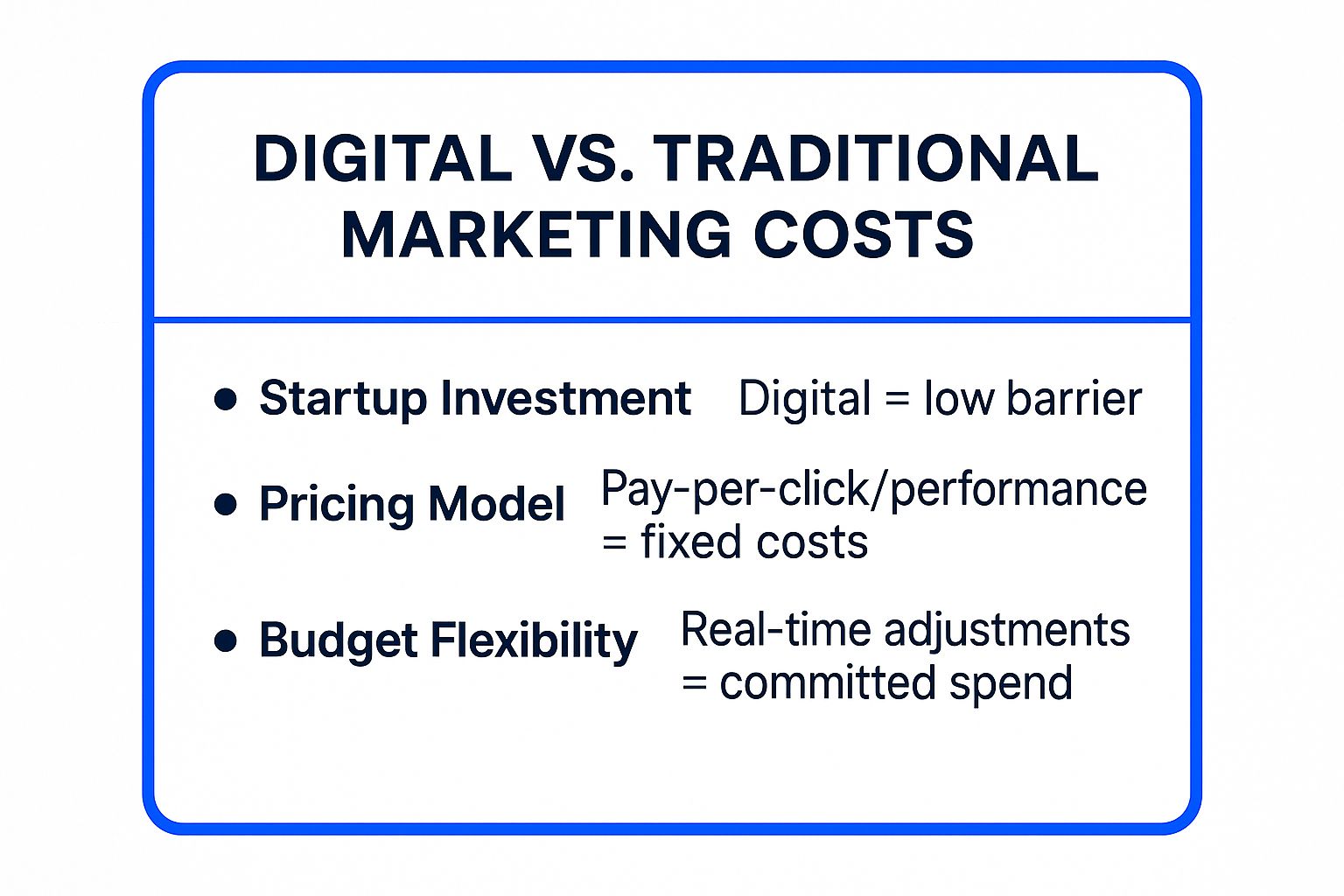
As the infographic highlights, digital marketing offers a more accessible entry point with its lower initial investment and flexible pricing models. The ability to make real-time budget adjustments also provides greater control and adaptability compared to traditional marketing’s fixed costs and committed spends. This makes digital marketing particularly attractive for budget-conscious businesses.
Tips for Effective Budget Allocation:
- Start Digital, Scale to Traditional: Begin with digital marketing for budget-conscious campaigns. As your business grows and budget expands, consider incorporating traditional channels for broader reach and brand building.
- The 70-20-10 Rule: Allocate 70% of your budget to proven marketing channels, 20% to emerging platforms, and 10% to experimental strategies. This allows for both optimization and exploration.
- Calculate Customer Lifetime Value (CLTV): Understanding your CLTV helps determine appropriate acquisition costs and optimize your marketing spend.
- Test Digital Campaigns Before Traditional: The flexibility of digital marketing allows for thorough testing and refinement before committing to larger, less adaptable traditional media buys.
By carefully considering the cost-effectiveness and budgetary implications, businesses can strategically leverage both digital and traditional marketing to achieve their marketing objectives and maximize their ROI. Choosing the right mix depends on factors like your target audience, industry, budget, and overall marketing goals.
2. Targeting and Personalization Capabilities
One of the most significant differences between digital and traditional marketing lies in their targeting and personalization capabilities. This aspect heavily influences the effectiveness and return on investment (ROI) of marketing campaigns. Traditional marketing often relies on a “spray and pray” approach, hoping to reach a broad audience and capture some interested individuals. Digital marketing, on the other hand, allows for laser-focused targeting, ensuring your message reaches the right people at the right time with the right message. This precision translates to less wasted ad spend and higher engagement rates. For SMEs and entrepreneurs especially, the efficient use of marketing budgets is critical, making digital marketing’s targeting capabilities a significant advantage.
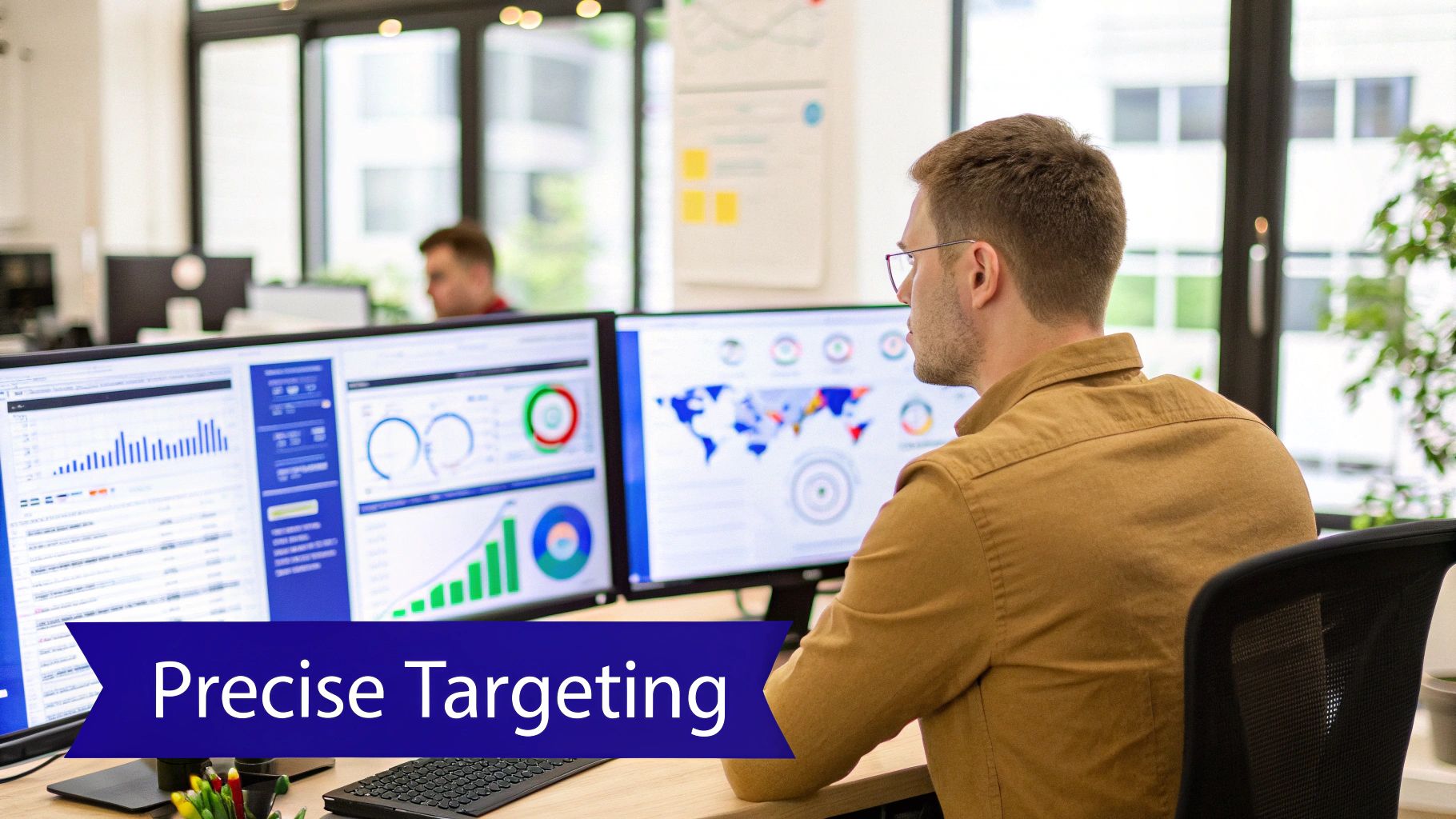
Digital marketing offers a suite of tools for precise audience targeting. Behavioral targeting allows marketers to reach users based on their online activity, such as website visits, search queries, and social media interactions. Lookalike audiences expand your reach by finding users similar to your existing customers. Retargeting keeps your brand in front of users who have previously interacted with your website or ads, encouraging them to return and convert. These tools, readily available through platforms like Google Ads and Facebook’s advertising platform, enable businesses of all sizes to connect with highly qualified prospects. Real-time personalization and dynamic content further enhance the user experience by tailoring messages based on individual preferences and behavior. Imagine an e-commerce brand on Shopify using personalized product recommendations based on past browsing history – this is the power of digital targeting.
Traditional marketing, while effective in building brand awareness on a larger scale, lacks this granularity. It primarily relies on geographic and broad demographic targeting. A Denver-based business might use local newspaper ads or radio spots to reach a wide audience within the city. While this approach can capture unaware prospects, it also leads to significant waste as the message reaches many individuals who are simply not interested in the product or service. Segment-based messaging is possible with traditional methods, but the level of customization is limited. For instance, a company might send different brochures to different customer segments based on age or income, but the messaging is still generic compared to the personalized experiences offered by digital platforms.
The precision of digital targeting reduces waste and increases engagement. Personalized messaging resonates more effectively with consumers, leading to higher conversion rates and improved ROI. However, over-targeting can be a drawback, potentially limiting reach and discovery. Stricter privacy regulations are also impacting data collection and targeting practices, requiring businesses to be more transparent and mindful of user data. Traditional marketing, while less precise, offers a broader reach and can be less intrusive. Super Bowl ads, for example, reach millions of viewers regardless of their individual interests. This broad exposure can be beneficial for building brand awareness and reaching a massive audience.
For SMEs, entrepreneurs, and even established companies, finding the right balance between digital and traditional marketing is crucial. Start by creating detailed buyer personas for digital targeting. Utilize progressive profiling to gather customer data over time, respecting privacy regulations. Combine first-party data with third-party insights to enhance targeting accuracy. A/B test different targeting parameters to optimize reach and engagement. For Denver-based businesses, combining local SEO strategies with targeted digital advertising can be particularly effective. Event organizers in Denver could use targeted Facebook ads to promote their events to specific demographics within the city. E-commerce brands can leverage personalized email campaigns and product recommendations to drive sales. By understanding the strengths and limitations of both digital and traditional marketing, businesses can create integrated marketing strategies that maximize reach, engagement, and ultimately, ROI.
3. Measurability and Analytics
One of the most significant differences between digital marketing and traditional marketing lies in the realm of measurability and analytics. This crucial aspect significantly impacts how businesses understand campaign performance, optimize strategies, and ultimately, achieve their marketing objectives. In the digital vs. traditional marketing debate, measurability offers a clear advantage to the digital side, providing a level of insight previously unimaginable. This granular level of data analysis allows for data-driven decision-making, enabling businesses to adapt and refine their strategies in real-time for optimal results.
Digital marketing provides comprehensive, real-time analytics and attribution, offering a treasure trove of data about customer behavior and campaign performance. From website traffic and conversion rates to email open rates and social media engagement, businesses can track virtually every interaction. This real-time feedback loop enables immediate optimization, allowing marketers to quickly adjust campaigns based on performance data. For instance, if a particular social media ad isn’t generating the desired clicks, marketers can tweak the creative, targeting, or bidding strategy instantly, maximizing their budget and improving ROI. This level of agility is simply not possible with traditional marketing methods.
Traditional marketing, on the other hand, relies on indirect measurement methods and delayed reporting. Think of television advertising, where measuring effectiveness relies on estimated viewership numbers and brand recall surveys conducted weeks after the campaign airs. While these methods can offer some insights into brand awareness and reach, they lack the precision and immediacy of digital analytics. Measuring the direct impact of a print ad or a radio spot on sales can be challenging, making it difficult to calculate ROI accurately.
The difference in data granularity is also stark. Digital marketing offers granular data on engagement, conversion, and even individual customer behavior. Multi-touch attribution models allow marketers to understand the complex customer journey across various touchpoints, from initial awareness to final conversion. This helps identify the most effective channels and allocate resources accordingly. Traditional methods, however, often rely on single-point measurement, making it difficult to understand the full impact of a campaign. Brand awareness studies can provide valuable insights, but they don’t offer the same level of detail as digital analytics regarding customer behavior and conversion paths.
Here’s a breakdown of the key features, pros, and cons of measurability and analytics in both digital and traditional marketing:
Digital Marketing:
- Features: Real-time performance tracking, multi-touch attribution, customer journey mapping, granular data on engagement and conversion.
- Pros: Immediate feedback and optimization, clear ROI calculation, data-driven decision making.
- Cons: Data overload and analysis paralysis, attribution challenges across multiple touchpoints.
Traditional Marketing:
- Features: Delayed reporting, indirect measurement, brand awareness studies, single-point measurement.
- Pros: Focus on long-term brand building, less overwhelming data analysis.
- Cons: Difficult to prove direct impact and ROI, limited ability to optimize during campaigns.
Examples:
- Digital: Google Analytics providing real-time website traffic data, email marketing with open and click-through rate tracking, e-commerce platforms showing conversion rates and average order value.
- Traditional: TV ratings measured days after broadcast, billboard effectiveness measured through brand recall surveys, print ad effectiveness estimated through coupon redemptions.
Tips for Leveraging Digital Marketing Analytics:
- Set up conversion tracking before launching campaigns to measure success effectively.
- Use UTM parameters to track traffic sources accurately and understand which channels are driving the most valuable traffic.
- Implement multi-touch attribution models for complex sales cycles to get a holistic view of the customer journey.
- Create custom dashboards focusing on key performance indicators (KPIs) relevant to your business objectives. Learn more about Measurability and Analytics and how it can benefit your business.
Popular analytics platforms like Google Analytics, Adobe Analytics, HubSpot, and Salesforce provide powerful tools to track and analyze digital marketing performance. These tools empower businesses to understand customer behavior, optimize campaigns, and demonstrate the value of their marketing efforts. While traditional measurement tools like Nielsen provide valuable data for traditional media, the depth and immediacy of digital analytics give businesses a significant edge in today’s fast-paced marketing landscape. In the digital marketing vs traditional marketing landscape, understanding these differences in measurability is key to developing a successful strategy.
4. Speed and Flexibility of Implementation
In the fast-paced world of business, agility is key. This is where a crucial distinction between digital marketing and traditional marketing emerges: speed and flexibility of implementation. This factor can significantly impact a company’s ability to capitalize on market trends, respond to competitive pressures, and ultimately, achieve its marketing objectives. When comparing digital marketing vs traditional marketing, the speed at which campaigns can be launched and adjusted is a defining characteristic. For SMEs, entrepreneurs, and even established companies, understanding this difference is crucial for choosing the right marketing mix.
Digital marketing offers unparalleled speed and flexibility. Campaigns can be launched within hours, sometimes even minutes. Imagine crafting a compelling social media post about a trending topic and publishing it almost instantly. This real-time responsiveness allows businesses to engage with their audience at the precise moment an opportunity arises. Need to tweak ad copy to improve click-through rates? No problem. Changes can be made on the fly, allowing for continuous optimization and improved ROI. A/B testing different versions of landing pages, ads, and email subject lines becomes a seamless process, providing valuable insights into what resonates best with the target audience. Automated bidding and campaign optimization tools further enhance efficiency, freeing up marketers to focus on strategic planning and creative development.
Traditional marketing, on the other hand, operates on a significantly longer timeline. Print ads, television commercials, and direct mail campaigns require weeks or even months of planning and production. Once launched, making changes is often costly and sometimes impossible. Imagine a typo slipping through in a printed brochure – thousands of copies are already distributed, and the error can’t be rectified. This lack of flexibility can be a major disadvantage in dynamic market conditions. While the meticulous planning involved in traditional campaigns can reduce execution risks, it also limits the ability to react quickly to changing market demands or unforeseen circumstances.
Consider the famous example of Oreo’s “Dunk in the Dark” tweet during the 2013 Super Bowl blackout. Within minutes, Oreo capitalized on the unexpected event with a witty, relevant tweet that went viral. This real-time marketing triumph would have been impossible with traditional marketing methods. Contrast this with the lengthy process of producing a traditional TV commercial, which can take anywhere from 6-12 weeks, including scriptwriting, filming, editing, and securing airtime. This rigid timeline prevents rapid responses to timely events and trends.
The differences also extend to crisis management. In the digital realm, a social media crisis can be addressed within minutes, mitigating potential damage to brand reputation. Traditional PR responses, relying on press releases and media outreach, often face delays that can exacerbate the situation. Similarly, e-commerce businesses can launch flash sales within hours, leveraging digital channels to drive immediate sales. Traditional retail promotions, reliant on printed flyers and in-store displays, require significantly more lead time.
Pros and Cons:
Digital:
- Pros: Quick response to market opportunities and trends, continuous optimization improves performance.
- Cons: Rushed campaigns may lack strategic depth, constant monitoring and adjustment required.
Traditional:
- Pros: Thorough planning reduces execution risks, professional production quality and polish.
- Cons: Missed opportunities due to slow response times, expensive to modify once campaigns are live.
Tips for Leveraging Digital Marketing’s Speed and Flexibility:
- Develop agile marketing processes: Embrace a flexible approach to campaign development and execution, allowing for quick pivots based on real-time data and market feedback.
- Create modular content: Design content that can be easily adapted and repurposed across different platforms and formats, maximizing efficiency and reach.
- Establish streamlined approval workflows: Avoid bureaucratic bottlenecks that can slow down digital campaigns. Implement clear approval processes that are fast and efficient.
- Use marketing automation: Leverage automation tools to respond to real-time triggers, personalize messaging, and optimize campaigns based on user behavior.
For SMEs, entrepreneurs, and e-commerce brands, digital marketing’s speed and flexibility are often essential for competing effectively. The ability to launch campaigns rapidly, test different approaches, and optimize performance in real-time provides a significant advantage in today’s dynamic marketplace. While traditional marketing still holds value for certain objectives, integrating digital strategies is crucial for staying agile and responsive to evolving customer needs and market trends. Choosing the right balance between digital marketing vs traditional marketing depends on the specific business goals, target audience, and industry landscape.
5. Audience Engagement and Interaction
One of the most significant distinctions between digital and traditional marketing lies in how audiences engage with the messaging. This interaction, or lack thereof, fundamentally shapes the relationship between a business and its customers, impacting brand loyalty, customer acquisition costs, and overall marketing effectiveness. While traditional marketing largely operates on a one-way broadcast model, digital marketing thrives on two-way communication, fostering deeper relationships and enabling businesses to glean invaluable insights directly from their target audience. This dynamic exchange is crucial for businesses of all sizes, but particularly for SMEs, entrepreneurs, and growing companies striving to connect with their customers on a more personal level.

Digital marketing opens the door to real-time feedback and two-way conversations. This allows brands to respond to customer queries, address concerns, and even solicit input on product development. Traditional methods, like print ads or television commercials, offer limited avenues for direct interaction, primarily relying on passive consumption of the message. Imagine a radio advertisement versus an Instagram Story poll. The former broadcasts a message to a broad audience, while the latter encourages active participation and provides immediate feedback. This fundamental difference highlights the power of digital marketing in fostering a sense of community and building stronger customer relationships. For instance, platforms like Instagram and Facebook allow brands to create groups and forums where customers can connect with each other, share experiences, and engage directly with the brand, fostering a sense of belonging and loyalty. Conversely, traditional marketing methods, while potentially reaching a wider passive audience, struggle to cultivate this level of interactive engagement. Learn more about Audience Engagement and Interaction as it relates to content marketing specifically.
The benefits of two-way communication in digital marketing extend beyond immediate customer interaction. The data gathered from these interactions – from poll responses to comments on social media posts – provides invaluable insights into customer preferences, needs, and pain points. This data can inform future marketing campaigns, product development decisions, and overall business strategy. For Denver-based businesses and Colorado e-commerce brands, understanding the local market nuances is crucial, and digital engagement provides a direct line to this valuable information. E-commerce brands on platforms like Shopify or WooCommerce can leverage interactive elements like quizzes to guide product recommendations and personalize the customer journey.
However, this increased engagement also comes with its challenges. Managing the constant influx of comments, messages, and feedback requires dedicated resources and a well-defined response strategy. The risk of negative public feedback and viral criticism is also amplified in the digital sphere. A single negative review or social media post can quickly escalate, potentially damaging a brand’s reputation. While traditional marketing offers greater control over messaging and brand image, it sacrifices the potential for deeper customer connections and real-time feedback crucial for continuous improvement. Limited feedback loops make it difficult to gauge campaign effectiveness and adapt strategies based on audience response.
Successful implementation of digital engagement strategies requires a thoughtful approach. Wendy’s witty and engaging Twitter presence demonstrates the power of a consistent brand voice and real-time interaction. Instagram Stories polls and Q&A sessions, commonly used by brands, offer easy ways to solicit audience feedback and boost engagement. Even traditional methods can incorporate digital elements, such as print advertisements with QR codes that bridge the gap to online interactive experiences. For event organizers in Denver, incorporating booking and ticketing systems directly into their website provides seamless customer interaction and valuable data capture.
To leverage the power of digital engagement effectively, consider these tips: develop a consistent and engaging brand voice for social media interactions, create content specifically designed for engagement, such as polls, contests, and interactive quizzes; prioritize prompt responses to customer comments and messages, demonstrating attentiveness and building trust; and actively incorporate user-generated content to foster a sense of community and showcase authentic customer experiences. Companies like Starbucks and Airbnb, popularized for their social media and community-driven marketing approaches respectively, exemplify the potential of digital engagement in building strong brand loyalty and driving business growth. Even established companies seeking performance-driven digital advertising can significantly benefit from embracing these interactive strategies. By understanding the nuances of digital engagement and implementing these tips, businesses can foster stronger customer relationships, gather valuable insights, and ultimately achieve greater marketing success in today’s dynamic digital landscape.
6. Geographic Reach and Scalability
When comparing digital marketing vs traditional marketing, geographic reach and scalability are crucial factors for businesses of all sizes, especially SMEs, entrepreneurs, and e-commerce brands looking to expand their market presence. This aspect highlights the contrasting approaches to geographic expansion and market reach between the two methodologies. Understanding these differences is key to developing an effective marketing strategy that aligns with your business goals and budget.
Digital marketing offers the unparalleled advantage of near-instant global reach. Through platforms like Facebook Ads, Google Ads, and social media, businesses can target specific demographics, interests, and even zip codes anywhere in the world. This level of granular control, combined with the ability to translate and localize content through automated tools, allows even small Denver-based businesses to test international markets with minimal investment. Imagine a Colorado e-commerce brand selling handcrafted goods; they can use digital marketing to reach potential customers not just within the state, but across the country, and even overseas, all from their Shopify platform.
Traditional marketing, on the other hand, typically starts with a strong local presence. Think regional newspaper advertising, local radio spots, or community event sponsorships. These methods are excellent for building a strong community presence and local credibility, especially valuable for businesses like event organizers in Denver needing to reach a local audience. However, traditional marketing faces inherent geographic limitations. Expanding to new markets requires significant investment in local partnerships, infrastructure, and often, physical presence. For example, a local radio station effectively serves a specific geographic community but requires a completely separate station and infrastructure to expand its reach to another city or region.
One of the most significant benefits of digital marketing is its scalability. Expanding across markets doesn’t require establishing a physical presence in each location. A Denver-based business needing a modern WordPress or Shopify website can easily scale its digital marketing efforts to target customers in other cities or states without opening new offices. This ease of scaling makes international expansion cost-effective and allows businesses to test new markets with minimal financial risk. Conversely, traditional marketing involves higher costs for multi-market presence due to the need for localized campaigns and infrastructure. This often leads to slower expansion into new geographic markets, a significant disadvantage in today’s fast-paced business environment.
While digital marketing offers exceptional reach and scalability, it’s not without its challenges. One key difficulty is understanding local cultural nuances. Simply translating your website content doesn’t guarantee it will resonate with a different culture. Time zone differences and language barriers can also create challenges for real-time engagement and customer service. A business targeting customers in multiple time zones might need to adjust its customer support hours or social media posting schedule.
Traditional marketing, with its focus on local presence, often provides a better understanding of local market nuances. This localized approach can be incredibly beneficial for businesses reliant on community engagement, such as Denver-based businesses needing tailored web solutions or established companies seeking performance-driven digital advertising. However, the higher costs and slower expansion associated with traditional methods can limit growth potential.
Tips for Leveraging Geographic Reach and Scalability:
- Test International Markets Digitally First: Utilize geo-targeting with digital advertising platforms like Facebook and Google to gauge interest and demand before investing heavily in traditional methods. This allows businesses to identify promising markets with minimal upfront costs.
- Localize Content: Adapt your website content, marketing materials, and social media posts to reflect the specific cultural preferences, language, and time zone of your target market.
- Partner with Local Influencers: Collaborating with influencers in your target market can provide authentic market entry and build trust with local consumers. This is especially effective for businesses seeking to expand their social media presence and customer engagement.
- Combine Digital Reach with Local Traditional Media: For maximum impact, consider integrating digital marketing’s reach with the credibility of local traditional media. For example, a Denver-based business could use targeted digital ads to drive traffic to a landing page promoting a special offer advertised in a local newspaper.
Shopify, a popular e-commerce platform, is a prime example of how digital marketing enables global reach with localized strategies. It empowers businesses to sell their products worldwide and provides tools for localized digital marketing, allowing them to tailor their messaging and reach customers in specific regions effectively. This is particularly useful for e-commerce brands on Shopify or WooCommerce wanting better UX and sales.
Ultimately, the choice between digital and traditional marketing for geographic expansion depends on your business goals, target audience, and budget. While traditional methods can build a strong local foundation, digital marketing provides the scalability and cost-effectiveness essential for businesses aiming for significant growth and broader market reach. By understanding the strengths and weaknesses of each approach, businesses can craft a comprehensive marketing strategy that maximizes their potential for success, regardless of location.
7. Content Format and Creative Possibilities
One of the most significant distinctions between digital marketing and traditional marketing lies in the breadth of content formats and the creative possibilities each offers. This is a critical factor for businesses deciding how to allocate their marketing resources, especially for SMEs, entrepreneurs, and e-commerce brands looking to maximize their impact. Understanding the strengths and weaknesses of each approach in terms of content creation is vital for effective campaign planning.
Digital marketing bursts with interactive multimedia experiences and virtually unlimited format options. From engaging interactive videos and immersive AR/VR experiences to gamified content and live streaming, the possibilities are vast and constantly evolving. Think of IKEA’s AR app, which allows customers to visualize furniture in their own homes before purchasing, offering a level of interaction impossible with traditional catalogs. Or consider the rise of micro-content tailored for platforms like TikTok and Instagram Stories, offering snackable, engaging content perfect for capturing attention in a fast-paced digital world. This flexibility allows businesses, particularly startups and SMEs, to experiment with different formats, find what resonates with their target audience, and tailor their content for specific platforms and demographics. User-generated content also plays a significant role, offering authentic engagement and social proof, especially valuable for e-commerce brands building trust with potential customers.
Traditional marketing, while more limited in its formats, relies on established methods with proven effectiveness. Print ads in magazines, television commercials aired during major sporting events, and radio spots targeting specific demographics have long been staples of advertising. Nike’s cinematic TV commercials, often aired during high-profile events, are a prime example of traditional marketing leveraging high production value and broad reach. These formats often boast a high level of professional polish and production quality, contributing to a sense of brand prestige and authority. High-quality product photography in a glossy magazine spread, for example, can convey a sense of luxury and desirability that’s difficult to replicate in a lower-resolution digital format. This makes traditional marketing particularly appealing to established companies and businesses looking to project a sophisticated brand image.
However, these approaches come with their own set of pros and cons. Digital marketing, while offering immense creative freedom and lower production costs, faces the challenge of content saturation and fierce competition for attention. The constant need for fresh content creation and updates can strain resources, especially for smaller businesses. Traditional marketing, on the other hand, while offering high production value and established formats, suffers from high production costs and limited format options. Standing out in a sea of similar print ads or TV commercials requires significant investment and creativity.
Here’s a breakdown of the advantages and disadvantages:
Digital Marketing:
Pros:
- Unlimited creative possibilities and formats
- Lower production costs for content creation
- Highly targeted and personalized content
- Measurable results and data-driven optimization
Cons:
- Content saturation and attention competition
- Requires constant content creation and updates
- Algorithm changes can impact reach and visibility
Traditional Marketing:
Pros:
- High production value and professional quality
- Proven formats with established effectiveness
- Wide reach for certain channels (e.g., television)
Cons:
- Limited format options and high production costs
- Difficult to stand out in established formats
- Limited ability to track and measure effectiveness
Tips for Leveraging Content Formats:
- Match content format to platform and audience preferences: Understand where your target audience spends their time online and tailor your content accordingly. Short-form video might work well on TikTok, while in-depth blog posts might be more suitable for your website.
- Repurpose traditional content for digital platforms: Transform a print ad into a social media graphic or create a behind-the-scenes video of your TV commercial shoot.
- Invest in mobile-optimized content for digital channels: Ensure your website and digital content are easily accessible and visually appealing on all devices.
- Use storytelling techniques across all formats: Regardless of the medium, compelling storytelling is crucial for engaging your audience and building brand loyalty.
Examples of successful content marketing strategies include Red Bull’s extreme sports content, Apple’s minimalist advertising aesthetic, BuzzFeed’s viral content strategies, and Coca-Cola’s iconic traditional advertising campaigns. By understanding the strengths and weaknesses of each approach and applying these tips, businesses of all sizes, from Denver-based event organizers needing websites with booking systems to Colorado e-commerce brands, can leverage the power of content to achieve their marketing goals.
8. Brand Trust and Credibility Building
In the arena of digital marketing vs traditional marketing, establishing brand trust and credibility is paramount, but the strategies employed differ significantly. This aspect is crucial for any business, especially SMEs, entrepreneurs, and established companies seeking to solidify their market presence. Building trust influences purchasing decisions, customer loyalty, and ultimately, the long-term success of your brand. This section delves into the contrasting approaches and timelines involved in fostering trust through digital and traditional channels.
Traditional marketing often leverages the established authority of media outlets to confer immediate credibility. Think of a Fortune 500 company running an advertisement in The Wall Street Journal. The publication’s reputation for rigorous reporting and business acumen lends an aura of credibility to the advertised brand. Similarly, securing a coveted Super Bowl advertising slot instantly elevates a brand’s perceived status and reach, associating it with a premium image and high production values. This approach relies on professional polish and high-quality production to project an image of trustworthiness. This strategy can be particularly impactful for Denver-based businesses or Colorado e-commerce brands looking to establish a strong local presence by associating themselves with reputable Colorado publications.
Digital marketing, on the other hand, builds trust over time through transparency and authentic interactions. Instead of relying on borrowed authority, digital channels empower brands to build trust directly with their audience. One of the most powerful tools in this arsenal is the readily available platform for customer reviews and ratings. Think Amazon’s product review system. Potential buyers rely heavily on these authentic testimonials, often more so than on the product descriptions provided by the seller. Similarly, Glassdoor reviews significantly impact an employer’s brand perception, affecting recruitment and employee retention. This transparency, although potentially exposing brands to negative reviews and public criticism, ultimately contributes to greater authenticity and stronger relationships with consumers.
Another key element of digital trust-building is the ability to engage in authentic interactions. Social media platforms provide avenues for businesses to respond to customer queries, address concerns, and build a community around their brand. This direct communication fosters a sense of connection and trust that traditional marketing channels often struggle to replicate. Influencer partnerships and peer recommendations further amplify this effect, leveraging the existing trust between influencers and their followers. This strategy can be highly effective for businesses aiming to expand their social media presence and customer engagement, particularly those targeting specific demographics aligned with chosen influencers.
The pros and cons of each approach are distinct. Digital marketing, while requiring consistent effort and time to build trust, allows for authentic relationships through direct communication. Social proof, in the form of user reviews and testimonials, becomes a powerful persuasion tool. Traditional marketing, conversely, offers immediate credibility through media association and projects a professional image through high-quality production. However, it can be perceived as less authentic and more sales-focused, with limited ability to publicly address customer concerns.
For SMEs needing tailored web solutions, entrepreneurs requiring logo designs and brand strategies, or established companies seeking performance-driven digital advertising, finding the right balance between these approaches is crucial. Combining the immediate credibility of traditional media with the long-term trust-building potential of digital channels provides a comprehensive strategy.
Here are some actionable tips for building brand trust and credibility:
- Encourage satisfied customers to leave online reviews: Actively solicit feedback and make it easy for customers to share their positive experiences on platforms like Yelp, Trustpilot, or even directly on your website.
- Respond professionally to negative feedback online: Address criticisms constructively and demonstrate a commitment to customer satisfaction. This shows transparency and a willingness to improve.
- Combine traditional credibility with digital transparency: Leverage the authority of established media placements and complement them with authentic online interactions and customer testimonials.
- Use customer success stories across all marketing channels: Share compelling narratives that demonstrate the value your brand provides. This resonates with audiences and builds trust.
Platforms like Yelp, with its business review platform, the Edelman Trust Barometer research, and Trustpilot’s customer review system, along with the more traditional credibility model of the Better Business Bureau, have popularized and validated the importance of trust in the modern marketplace. Learn more about Brand Trust and Credibility Building to further refine your strategy. This is particularly relevant for e-commerce brands on Shopify or WooCommerce wanting better UX and sales, as well as medium-sized businesses needing custom websites on WordPress or Shopify, helping them establish a trustworthy online presence. Even event organizers in Denver seeking websites with booking and ticketing systems can benefit from these trust-building strategies, assuring attendees of a reliable and professional event experience. By understanding the nuances of digital marketing vs traditional marketing in the context of brand trust, businesses can create a compelling brand narrative that resonates with their target audience and drives long-term success.
8-Point Digital vs Traditional Marketing Comparison
| Concept | Implementation Complexity 🔄 | Resource Requirements ⚡ | Expected Outcomes 📊 | Ideal Use Cases 💡 | Key Advantages ⭐ |
|---|---|---|---|---|---|
| Cost-Effectiveness and Budget Allocation | Medium: Digital requires ongoing tool investments; Traditional demands high upfront capital | Digital: Low startup, flexible; Traditional: High fixed costs | Digital: ROI tracking and optimization; Traditional: Broad reach | Digital: Budget-conscious, scalable campaigns; Traditional: Premium branding | Digital: Flexible budgets, accessible; Traditional: Predictable costs, scale economies |
| Targeting and Personalization Capabilities | High: Digital needs data handling and privacy compliance; Traditional simpler segmentation | Digital: Advanced data platforms; Traditional: Basic media buys | Digital: Precise, personalized engagement; Traditional: Broad audience exposure | Digital: Niche markets, retargeting; Traditional: Mass market and local reach | Digital: Minimizes waste, boosts engagement; Traditional: Less intrusive, broader reach |
| Measurability and Analytics | High: Digital demands sophisticated tracking setup; Traditional relies on surveys/estimates | Digital: Analytics tools and expertise; Traditional: Research and reports | Digital: Real-time insights and ROI clarity; Traditional: Brand awareness trends | Digital: Performance-focused campaigns; Traditional: Long-term brand building | Digital: Immediate feedback, granular data; Traditional: Simpler analysis, brand focus |
| Speed and Flexibility of Implementation | Low-Moderate: Digital campaigns launch quickly; Traditional requires lengthy planning | Digital: Agile teams/software; Traditional: Production resources/time | Digital: Rapid response and optimization; Traditional: High quality, fixed messages | Digital: Time-sensitive promotions; Traditional: High-impact, planned campaigns | Digital: Fast launch, A/B testing; Traditional: Polished output, strategic stability |
| Audience Engagement and Interaction | Medium: Digital needs continuous monitoring and community management; Traditional is one-way | Digital: Social media teams and tools; Traditional: Content production | Digital: Two-way engagement, loyalty; Traditional: Broad passive reach and control | Digital: Relationship building and feedback; Traditional: Brand awareness, mass exposure | Digital: Builds loyalty, rich feedback; Traditional: Controlled messaging, professionalism |
| Geographic Reach and Scalability | Medium: Digital easily scales globally; Traditional limited by local infrastructure | Digital: Automation and platforms; Traditional: Partnerships, physical presence | Digital: Fast, global expansions; Traditional: Strong local credibility | Digital: International market tests; Traditional: Local dominance and trust | Digital: Cost-effective reach, scalable; Traditional: Local expertise, trusted presence |
| Content Format and Creative Possibilities | High: Digital supports diverse formats and constant updates; Traditional uses fixed media | Digital: Content creators, tech tools; Traditional: Production studios | Digital: Variety and interactivity; Traditional: High production quality | Digital: Interactive, multimedia; Traditional: Trusted formats with strong recall | Digital: Creative flexibility, lower costs; Traditional: Professional quality, proven formats |
| Brand Trust and Credibility Building | Medium: Digital builds trust over time, needs management; Traditional grants instant credibility | Digital: Customer service, PR; Traditional: Media buys, polished content | Digital: Authentic relationships; Traditional: Immediate reputation boost | Digital: Long-term trust, transparency; Traditional: Quick authority establishment | Digital: Transparency, social proof; Traditional: Established media authority |
Choosing the Right Mix for Your Business
Navigating the world of marketing requires a keen understanding of both digital and traditional approaches. As we’ve explored, each offers distinct advantages. From the cost-effectiveness of digital marketing vs traditional marketing’s established trust-building capabilities, to the personalized targeting of digital campaigns versus the broad reach of traditional media, finding the right balance is key. Remember the core differences in measurability, speed of implementation, audience engagement, geographic scalability, content format, and brand credibility when devising your strategy. Mastering these concepts empowers you to allocate your budget wisely, connect with your target audience effectively, and ultimately achieve a higher return on investment.
For small and medium-sized enterprises, entrepreneurs, established companies, and e-commerce brands alike, understanding the interplay of digital marketing vs traditional marketing is paramount. Whether you’re a Denver-based business looking to expand your social media presence, a Colorado e-commerce brand seeking better UX and sales, or an event organizer in Denver needing a website with booking and ticketing, a tailored approach is essential for success. By strategically blending both methods, you can create a powerful synergy that amplifies your message, reaches a wider audience, and drives sustainable growth.
Ready to craft a winning marketing strategy that perfectly blends digital and traditional approaches? Denver Web Design Studio specializes in helping businesses like yours navigate the complexities of digital marketing vs traditional marketing. We develop custom solutions, from logo design and branding to performance-driven digital advertising and modern website development on platforms like WordPress and Shopify, to maximize your ROI. Visit Denver Web Design Studio today to discover how we can help you achieve your business goals.