Top Reasons Why Email Marketing Still Works for Small Businesses
Email marketing for small business remains one of the most powerful and cost-effective tools in today’s digital landscape. Why email marketing still dominates for small businesses is simple: it delivers direct access to customers, builds lasting relationships, and consistently drives conversions better than most social platforms. With the right strategy, even a small list can produce big results—making email not just relevant, but essential for growth.

It’s easy to get distracted by the newest social media trends. However, email marketing remains a powerful tool for small business growth. It offers several key advantages that make it essential for entrepreneurs.
Direct Access and Ownership
Unlike social media platforms like Facebook where algorithms control what your audience sees, email marketing gives you direct access. You own your subscriber list. This provides a level of control and security other channels can’t offer.
This means you can communicate directly with your customers without worrying about algorithm changes or platform restrictions. This ownership is a valuable asset, providing stability and independence.
Building Strong Customer Relationships
Email allows for personalized communication, which helps build stronger customer relationships. Through targeted campaigns and segmented lists, you can tailor messages to specific customer needs and preferences.
This personal touch builds trust and loyalty, turning subscribers into repeat customers. For example, a small bakery could send personalized birthday discounts or exclusive offers to their email subscribers. This creates a sense of community and appreciation.
High Return on Investment (ROI)
Email marketing consistently delivers a remarkable ROI. In 2025, there were approximately 4.6 billion global email users. This number is projected to grow to over 4.8 billion by 2027.
This massive user base highlights email’s importance as a communication channel. For small businesses, this large audience represents a significant opportunity. You can engage potential customers directly. Find more detailed statistics here: Email Marketing Statistics. This broad reach combined with the low cost of email campaigns makes it a highly efficient marketing strategy.
Beyond Email: Integrating Other Channels
Email is powerful on its own, but integrating other marketing channels can increase its effectiveness. Consider using SMS marketing to boost sales. Many of the principles that drive sales with SMS also apply to email marketing.
This multi-channel approach creates a synergistic effect. You can reach customers through multiple touchpoints. This strengthens your brand presence and reinforces your message.
Email marketing is more than just a tool. It’s a strategic investment for small businesses. By leveraging its strengths—direct access, relationship building, and high ROI—entrepreneurs can build a loyal customer base, drive sales, and achieve sustainable growth.
Crafting an Email Strategy That Actually Drives Growth
Beyond sending sporadic email blasts, a well-defined email marketing strategy is crucial for small business growth. This involves aligning your email efforts with specific business objectives, creating measurable impact, and nurturing prospects through every stage of their buying journey.
Aligning Email With Business Goals
Start by identifying clear, measurable objectives. Are you aiming to increase brand awareness, drive sales, or boost customer loyalty? Each goal demands a different approach.
For example, if your goal is lead generation, your strategy might focus on building an email list through compelling lead magnets and targeted opt-in forms. However, if your primary aim is to improve customer retention, your strategy might involve personalized email sequences that deliver valuable content and exclusive offers.
Nurturing Prospects Through Targeted Email Sequences
Effective email marketing isn’t about bombarding your subscribers with constant promotions. Instead, it’s about providing value and building genuine relationships. This is where email sequences come into play.
These are automated series of emails triggered by specific actions or timed intervals. Think of it like a guided tour for your prospects, leading them from initial awareness to becoming loyal advocates for your brand. This requires understanding your customer journey and crafting emails that resonate with their needs and interests at each stage.
Balancing Promotion With Value-Driven Content
While promotional emails are essential for driving sales, they shouldn’t be the only type of communication you send. Strive for a healthy balance between promotional content and value-driven messages.
This might include sharing helpful tips, industry insights, exclusive content, or behind-the-scenes glimpses into your business. This builds trust and positions you as an authority in your field.
The infographic below visualizes subscriber growth and acquisition sources over a six-month period. 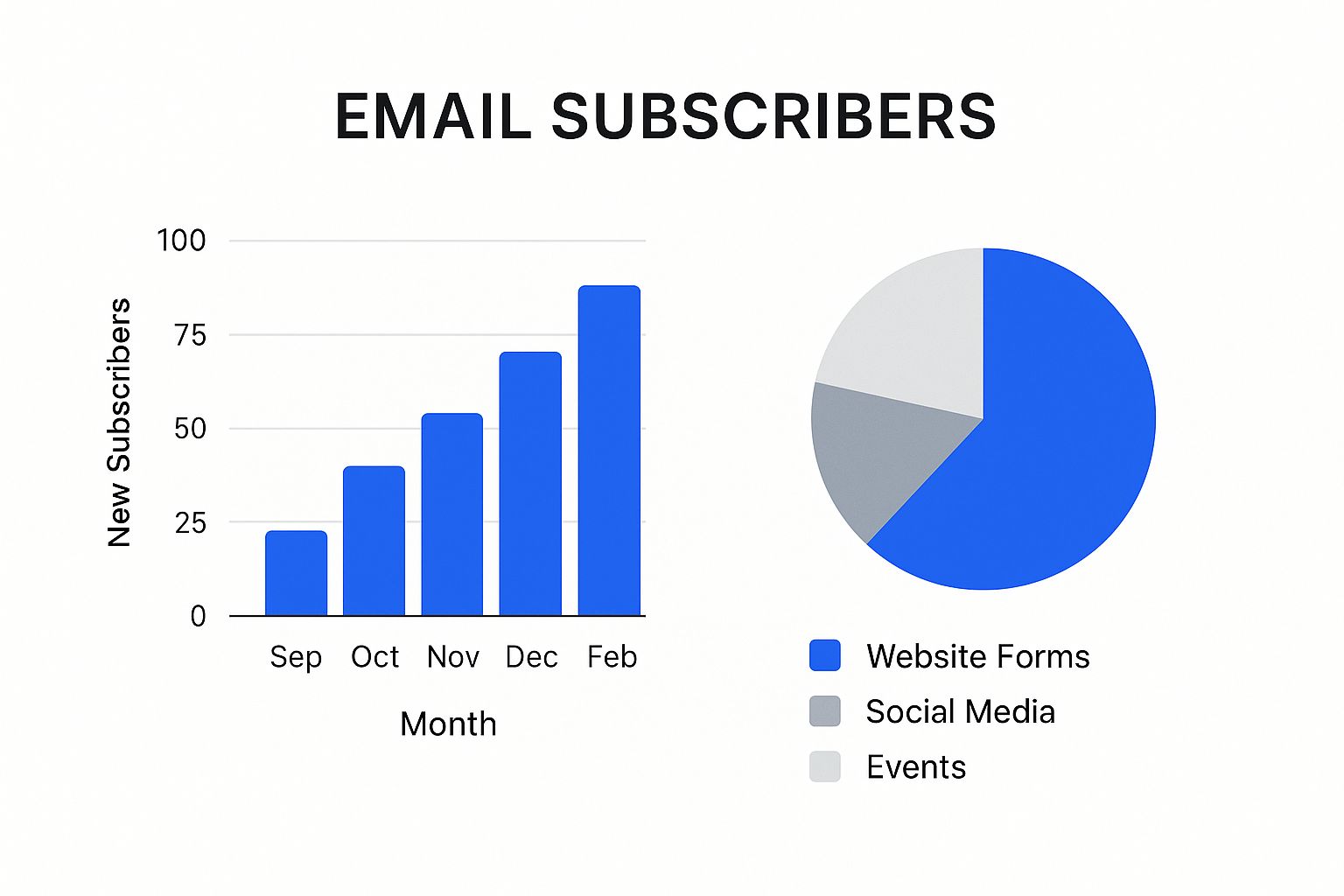 As shown, website forms consistently outperform social media and events in terms of new subscriber acquisition, highlighting the importance of optimizing website conversion points. This also indicates a positive trend of increasing subscriber numbers month over month, suggesting effective list-building strategies.
Furthermore, email marketing provides an exceptional return. Email marketing delivers one of the highest returns on investment (ROI) for small businesses, with some companies achieving more than $70 in revenue for every $1 spent.
This staggering ROI highlights why email marketing remains a cornerstone of small business marketing strategies worldwide. In fact, email marketing campaigns typically see an average open rate of about 25.1% and a click-through rate of 1.5%, with conversion rates around 0.07%. Find more detailed statistics here: 100 Compelling Email Statistics. To underscore why email marketing remains a powerful tool for small businesses, explore email marketing for lead generation.
The following table shows email marketing ROI by industry. This table compares the average ROI, open rates, and click-through rates across different small business industries to help readers benchmark their performance.
| Industry | Average ROI | Average Open Rate | Average Click-Through Rate |
|---|---|---|---|
| Retail | 45:1 | 18% | 2.3% |
| Restaurants | 35:1 | 22% | 1.8% |
| Travel & Hospitality | 50:1 | 15% | 2.1% |
Key insights from this table include the high ROI across various industries, with Travel & Hospitality leading at 50:1. While Retail has a slightly lower open rate, its click-through rate is notably higher. This suggests that while fewer retail emails are opened, those that are opened lead to more clicks, potentially indicating more targeted and effective email content.
Real-World Examples of Successful Email Strategies
Small businesses often achieve impressive results with limited resources by focusing on targeted, personalized campaigns. For instance, a local bookstore might segment its list by genre preference and send curated recommendations to each group.
This personalized approach is far more effective than sending generic blasts to the entire list. Another example is a small restaurant that uses email to promote special events or limited-time offers, creating a sense of exclusivity and urgency.
By aligning your email strategy with your business goals, nurturing prospects with targeted sequences, and balancing promotional content with valuable information, you can create email campaigns that drive significant growth for your small business.
Building a Subscriber List That Actually Converts
Forget vanity metrics like follower counts. This section focuses on building an email list of engaged subscribers genuinely interested in your small business. We’ll explore practical techniques successful small business owners use to attract high-quality subscribers who are more likely to become customers.
Creating Irresistible Lead Magnets
A lead magnet is a valuable piece of free content offered in exchange for an email address. This could be an ebook, checklist, template, discount code, or access to exclusive content. The key is offering something valuable to your target audience while also identifying them as potential customers.
For example, a web design studio might offer a free website audit checklist as a lead magnet. This provides value to small businesses looking to improve their online presence and identifies businesses that might need the studio’s services.
Here are some tips for creating compelling lead magnets:
- Solve a specific problem: Address a pain point your target audience experiences.
- Offer immediate value: Make the benefit of downloading clear and concise.
- Keep it concise and easy to consume: Don’t overwhelm your audience with too much information.
- Make it relevant to your products or services: Ensure the lead magnet naturally leads into your offerings.
Optimizing Every Touchpoint for List Growth
Every interaction with your business, online and offline, is a chance to grow your email list. This means optimizing your website, social media profiles, and even in-person interactions to encourage sign-ups.
Here are some key touchpoints to consider:
- Website: Include prominent opt-in forms on your homepage, landing pages, and blog posts.
- Social Media: Use call-to-actions in your bios and posts to direct followers to your signup forms.
- In-Person Transactions: Offer incentives for customers to join your email list at checkout.
- Content Marketing: Promote valuable lead magnets within your blog posts and other content.
Ethical List-Building Practices
Building trust with your audience is crucial. Employing ethical list-building practices, like permission marketing, is essential. This means getting explicit consent before sending marketing emails.
Avoid buying email lists, as this can damage your sender reputation and lead to low engagement. Instead, focus on attracting subscribers who genuinely want to hear from you. This builds a strong foundation for long-term success.
This includes providing clear opt-in checkboxes and avoiding pre-checked boxes. Make it easy for subscribers to unsubscribe at any time. These practices ensure compliance with regulations like the CAN-SPAM Act and build trust with your audience. By prioritizing quality over quantity, you can create a thriving email list that contributes to your business’s overall success.
Creating Email Content Your Subscribers Actually Read
Most small business emails go unread. This section explores what makes some emails stand out and drive action, while others are quickly forgotten. We’ll look at the psychology behind opening an email and how to craft compelling subject lines that cut through the clutter.
The Psychology of Opening an Email
Think about your own inbox. What makes you open an email? Usually, it comes down to two things: curiosity and relevance. Subject lines that pique interest or offer something valuable tend to get the best results.
Instead of a generic subject line like “Monthly Newsletter,” try something more specific, such as “3 Simple Tips to Boost Your Website Traffic This Month.” This immediately tells the subscriber what they’ll gain. Personalizing subject lines with the subscriber’s name or mentioning past interactions can also boost open rates.
Writing Engaging Email Copy That Converts
Once you’ve grabbed their attention, your email copy has to deliver. Keep it concise, focused, and easy to read. Use short paragraphs, bullet points, and bolded text to highlight key takeaways.
People are busy. They won’t wade through dense paragraphs. Get to the point quickly and make it clear what you want the reader to do. A clear call to action (CTA) is crucial. Tell your subscribers what you want them to do, whether it’s visiting your website, downloading a resource, or making a purchase.
Different Email Types for Different Goals
Not all emails are the same. Different types of emails serve different purposes in your email marketing strategy.
- Welcome Emails: Greet new subscribers and set expectations.
- Newsletters: Share valuable content, company updates, and industry insights.
- Promotional Emails: Announce sales, discounts, and new products.
- Transactional Emails: Confirm orders, provide shipping updates, and handle password resets.
Each email type should be tailored to its specific purpose and audience. A welcome email should be warm and welcoming, while a promotional email should be concise and action-oriented. The following table compares these email types and their effectiveness:
Email Content Types and Their Effectiveness
This table compares different types of email content, their typical performance metrics, and best situations for small businesses to use each type.
| Email Type | Average Open Rate | Average CTR | Best Use Case | Frequency |
|---|---|---|---|---|
| Welcome Email | 82% | 14.4% | Onboarding new subscribers | Automated upon signup |
| Newsletter | 20-40% | 2-4% | Building relationships and sharing valuable content | Weekly or monthly |
| Promotional Email | 15-25% | 1-3% | Driving sales and promoting offers | As needed, avoid overuse |
| Transactional Email | 85% | 26.6% | Essential business operations | Automated based on customer actions |
This table shows the importance of using the right email type for the right purpose. Transactional emails have the highest open rates, but they aren’t for marketing. Newsletters, despite lower open rates, are crucial for building long-term relationships.
Crafting Customer Journeys Through Email
Think of email marketing as a series of conversations, not isolated messages. Customer journeys—pre-planned email sequences triggered by specific actions—can nurture leads and turn them into loyal customers.
For example, a customer who downloads a lead magnet about website design might receive a series of emails offering further advice, showcasing case studies, and eventually inviting them to schedule a consultation. This provides value at every step and builds a relationship that goes beyond a single transaction. This strategic approach lets you connect with your audience more deeply and tailor your message to their needs at each stage of their journey. This creates a personalized experience that feels more like a guided conversation than a generic marketing blast.
Mobile Optimization: Where Small Businesses Win or Lose
Crafting engaging email content is only the first step. If your emails aren’t optimized for mobile devices, you could be missing out on a significant portion of your audience. This section explores the critical components of mobile optimization that can determine the success of your email marketing campaigns.
The Mobile-First Mindset
Think about this: 85% of users access their email on mobile devices. This makes mobile optimization essential for small business email marketing success. Ignoring mobile optimization means potentially alienating a large segment of your audience, as 42.3% of users will delete emails that aren’t mobile-friendly. What’s more, mobile email views are up to three times higher than desktop views. For a deeper dive into these statistics, find more detailed information here.
This data highlights the need for a mobile-first approach to email design. This means designing your emails first for mobile devices, then adapting them for larger screens. This ensures your core audience enjoys the best possible experience.
Key Elements of Mobile Optimization
Several key factors contribute to a positive mobile email experience. These factors influence how users view and interact with your emails. Proper implementation can greatly increase engagement and, ultimately, conversions.
- Responsive Design: Responsive design allows your emails to adapt seamlessly to any screen size, from smartphones and tablets to desktops. Picture a single email that automatically adjusts its layout and text size for perfect viewing on any device. That’s the power of responsive design, ensuring a consistent, visually appealing experience regardless of how your subscribers check their inboxes.
- Concise Content: Mobile users are often busy and on the go. Keep your emails brief, focused, and easy to understand. Employ bullet points, short paragraphs, and clear headings to make your content digestible on smaller screens. This respects your readers’ time and makes them more likely to engage with your message.
- Large Font Sizes: Small text can be challenging to read on a mobile device. Ensure your font size is large enough for comfortable reading without zooming. A good starting point is a minimum font size of 14px for body text. This enhances accessibility and improves the overall user experience.
- Thumb-Friendly Navigation: Place buttons and links in locations that are easy to tap with a thumb. Consider your own phone usage habits. Large, clearly defined buttons simplify user interaction with your calls to action.
- Fast Load Times: Mobile users are less tolerant of slow-loading emails. Optimize your images and code to ensure fast loading times. This prevents frustration and ensures recipients see your complete message.
From Theory to Practice: Real-World Impact
At Denver Web Design Studio, we’ve witnessed firsthand the positive impact of mobile optimization on email campaign performance. For one local bakery, optimizing their emails for mobile resulted in a 20% increase in click-through rates and a 15% boost in conversions.
These results showcase the real benefits of mobile-first thinking. By prioritizing the mobile experience, you can expand your audience reach, increase engagement, and achieve better results from your email marketing. This creates a win-win: a better user experience for your subscribers and greater success for your business.
Automation and Personalization That Doesn’t Feel Robotic
Personalization in email marketing for small businesses is more than just using a subscriber’s first name. It’s about crafting targeted campaigns that speak directly to individual needs and interests. Automation makes this process significantly more efficient.
Segmentation: The Foundation of Personalized Email Marketing
Segmentation involves dividing your email list into smaller groups based on shared characteristics. These characteristics can include demographics, purchase history, website activity, or engagement with previous emails.
Think of it like organizing your closet. Instead of one overwhelming pile, you categorize clothes by type, season, or occasion. This makes it much easier to find what you’re looking for. Segmentation allows you to send the right message to the right customer at the right time. For example, a small business could segment customers by past purchases to send targeted product recommendations.
Behavioral Targeting: Sending the Right Message at the Right Moment
Behavioral targeting takes personalization further by triggering automated emails based on specific customer actions. Examples include abandoned cart emails, welcome emails for new subscribers, or post-purchase follow-ups.
Imagine a customer adds items to their cart but doesn’t complete the purchase. A timely automated abandoned cart email reminding them of their items, perhaps with a small discount, can be very effective. This proactive approach demonstrates attention to detail and can positively impact your bottom line.
Affordable Tools for Small Business Automation
Many affordable email marketing platforms offer powerful automation features previously only available to large enterprises. These tools empower small businesses to implement sophisticated email marketing strategies efficiently.
Here at Denver Web Design Studio, we help small businesses select and implement the right email marketing tools. We focus on solutions that are both powerful and user-friendly, allowing you to automate your email marketing effectively.
Balancing Automation and the Human Touch
While automation is key for efficiency, maintaining a human touch is vital for strong customer relationships. This means writing emails that feel personal and authentic, even if automated.
One way to achieve this is to use a conversational tone in your emails. Avoid overly formal language; instead, write as you would speak to a customer in person. Personalized emails see a 26% increase in open rates compared to generic messages. Automated campaigns achieve average open rates of 42.1% and click rates of 5.4%. For more insights, explore: 100 Compelling Email Statistics. This data highlights the power of combining automation with personalized messaging.
By blending automation with a personalized approach, small businesses can create resonant email campaigns that build strong relationships and drive significant growth. This strategic combination allows you to deliver timely messages while maintaining a genuine connection with your subscribers.
Measuring What Actually Matters in Email Performance
Beyond simple open rates and click-throughs, the true power of email marketing lies in metrics that demonstrate tangible business growth. This section explores the key performance indicators (KPIs) that truly matter for small businesses. We’ll cover setting up effective measurement systems, implementing A/B testing, and troubleshooting common email marketing challenges.
Identifying KPIs That Drive Business Growth
While vanity metrics like open rates offer a surface-level view of campaign performance, they don’t tell the whole story. Instead, focus on KPIs that directly impact your bottom line.
- Conversion Rate: This measures the percentage of email recipients who complete a desired action, like making a purchase or filling out a form. A high conversion rate indicates your emails are effectively driving desired customer behavior.
- Customer Lifetime Value (CLTV): This metric predicts the total revenue a customer will generate throughout their relationship with your business. Email marketing can significantly boost CLTV by nurturing customer loyalty and encouraging repeat purchases.
- Return on Investment (ROI): This vital metric helps you understand the profitability of your email campaigns. By tracking the revenue generated against the cost of your email marketing efforts, you can assess campaign effectiveness and make informed, data-driven decisions.
Setting Up a Measurement System
Implementing a robust measurement system is essential for understanding your email marketing performance. This involves tracking the entire customer journey, from initial email engagement to final purchase.
- Use UTM Parameters: These short text codes added to your email links allow you to track the source of your website traffic. This provides valuable data on which email campaigns are driving the most conversions.
- Integrate Your Email Platform with Analytics Tools: Connecting your email marketing platform with website analytics tools like Google Analytics provides a comprehensive view of campaign performance. This integration offers deeper insights into user behavior after clicking through from your emails.
- Set Up Conversion Tracking: Define specific conversion goals, such as purchases or form submissions, and track them within your analytics platform. This lets you measure the direct impact of your email campaigns on your business objectives.
A/B Testing for Actionable Insights
A/B testing, also known as split testing, involves comparing two versions of an email to see which performs better. This process allows you to optimize your campaigns based on real data.
- Test Subject Lines: Experiment with different subject lines to see which ones generate higher open rates. A compelling subject line is crucial for capturing a recipient’s attention.
- Test Email Content: Compare different versions of your email copy, calls to action, and visuals to determine what resonates best with your audience. This helps refine your messaging and improve engagement.
- Test Sending Times: Experiment with sending emails at different times of the day or week to identify when your audience is most responsive. Timing can significantly impact open and click-through rates.
Troubleshooting Common Email Marketing Challenges
Even with a well-defined strategy, challenges can occur. A proactive approach to troubleshooting keeps your email marketing efforts on track.
- Low Deliverability: If your emails are landing in spam folders, check your sender reputation and ensure you’re following email best practices. This will help ensure your messages reach their intended recipients.
- Declining Engagement: If your open and click-through rates are dropping, refresh your email content, segment your list, or try re-engaging inactive subscribers. Addressing declining engagement can revitalize your campaigns.
Incorporating mobile-responsive designs can increase unique mobile clicks by 15%, demonstrating a tangible ROI for small businesses. Given these trends, email marketing’s continued growth and relevance make it an essential tool for small businesses aiming to reach and retain customers. Explore this topic further. By focusing on the right metrics, continually testing, and adapting your strategy, you can unlock the true potential of email marketing for small business growth.
Ready to transform your email marketing results? Denver Web Design Studio can help you craft a data-driven strategy that drives measurable growth. Contact us today to learn more.