Why Smart Small Businesses Embrace Marketing Automation

Running a small business can feel like a constant juggling act. Between sales, marketing, customer service, and the countless other responsibilities, strategic thinking often takes a backseat. Especially when competing with larger businesses that have dedicated marketing teams. Marketing automation is changing the game, giving small businesses the tools they need to compete and grow. It’s no longer a luxury, but an essential element for success.
Efficiency and Time Savings
Imagine spending hours each week on repetitive tasks like sending emails, updating social media, and tracking customer interactions. Marketing automation eliminates these manual tasks, freeing up valuable time. This allows you to focus on higher-level strategic initiatives and creative projects that move your business forward. Less administrative work means more time to focus on growth. Plus, automation minimizes the potential for human error, ensuring consistent messaging across all your platforms.
Consistent Customer Engagement
Building strong customer relationships is vital for any small business. But providing personalized communication at scale can be a challenge without a large team. Marketing automation solves this by enabling targeted messaging based on customer behavior and preferences.
For instance, automated email sequences can nurture leads, welcome new customers, and re-engage inactive ones. This cultivates loyalty and encourages repeat business. Consistent engagement strengthens brand perception and builds deeper customer connections.
As of 2024, about 45% of small businesses use marketing automation tools. This is a significant jump from previous years, highlighting the growing recognition of automation’s power to reduce manual labor and boost productivity. Find more detailed statistics here.
Data-Driven Insights
Another major advantage of marketing automation is the wealth of data it provides. By tracking customer interactions and campaign performance, you gain valuable insights into what strategies are working and what needs adjustment.
This data-driven approach allows for continuous optimization of your marketing efforts, ensuring maximum return on investment (ROI). For example, 50% of small businesses use marketing automation for email drip campaigns. This not only maintains consistent communication but also gathers data to further refine their approach. This analytical capability allows small businesses to make informed decisions, personalize campaigns, and achieve better results. Marketing automation provides the tools and insights needed to transform marketing from a cost center into a revenue generator.
The Real ROI: What Marketing Automation Actually Delivers
For small businesses, the attraction of marketing automation is often centered around saving time and money. However, the real advantage lies in the return on investment (ROI) it generates. This means thinking beyond the initial setup costs and concentrating on how automation affects your bottom line.
Measuring the Financial Impact
One of the most immediate advantages is the reduction in operational costs. Consider the hours spent on repetitive tasks like sending emails or managing social media. Marketing automation streamlines these tasks, freeing up your team to focus on strategy. This translates to reclaimed staff time and fewer errors, directly improving your budget.
Additionally, automation facilitates precise measurement of marketing activities, highlighting which channels deliver the best results. This data-driven insight ensures you’re allocating resources effectively. For small businesses aiming to enhance search engine visibility, consider exploring various SEO Services.
Revenue Gains and Increased Efficiency
Beyond cost savings, marketing automation contributes to increased revenue. By personalizing the customer journey and nurturing leads effectively, automation boosts conversion rates and improves customer lifetime value. This targeted approach cultivates stronger customer relationships, leading to greater profitability.
Moreover, automation empowers small businesses to scale their marketing efforts without increasing staff, maximizing existing resources. This creates further cost efficiencies and accelerates growth. The infographic below visualizes data on automation adoption rates, weekly time saved, and conversion rate increases for small businesses.
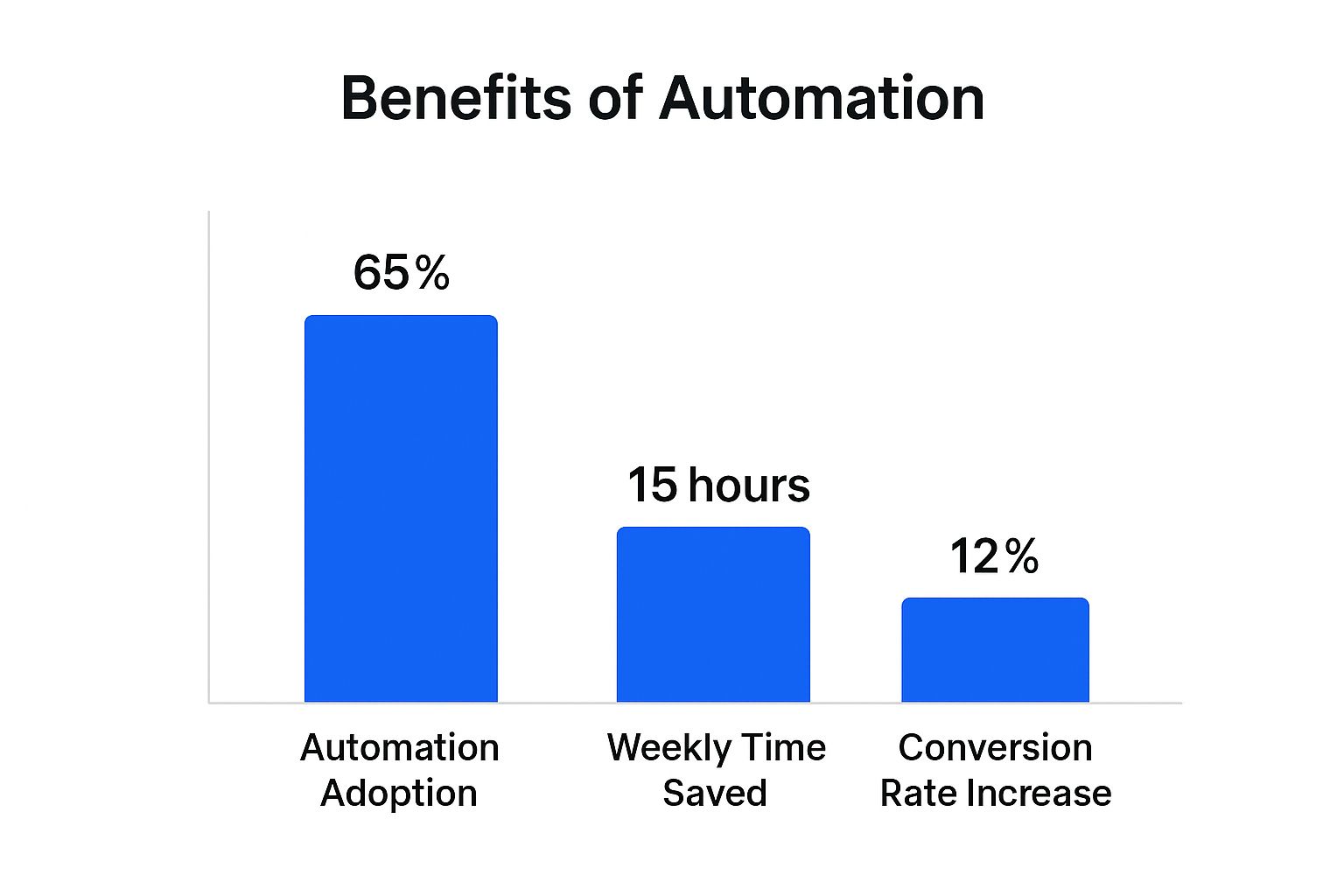
The data shows a clear correlation between greater automation adoption, time saved, and higher conversion rates. This highlights the power of marketing automation to dramatically enhance small business performance.
Speaking of performance, studies suggest small businesses often see a 25% increase in marketing ROI with automation tools. This is largely due to optimized marketing activities, reduced costs, and improved customer engagement through personalized experiences.
Furthermore, 56% of marketers use automation for audience segmentation. This results in more relevant campaigns and higher conversion rates. Learn more about marketing automation ROI here. This reinforces that automation is not just about efficiency; it’s about creating a more impactful and profitable marketing strategy.
To further illustrate the ROI potential, let’s examine the impact on different business sizes:
The following table provides a comparison of typical ROI metrics for small businesses implementing marketing automation.
Marketing Automation ROI by Business Size
| Business Size | Average ROI Increase | Time to Positive ROI | Key Benefits |
|---|---|---|---|
| Small (1-10 employees) | 20-30% | 6-12 months | Improved efficiency, personalized marketing, cost reduction |
| Medium (11-50 employees) | 25-35% | 3-6 months | Scalability, enhanced lead nurturing, data-driven insights |
| Large (51-250 employees) | 30-40% | <3 months | Advanced analytics, multi-channel integration, revenue growth |
This table highlights how businesses of all sizes can benefit from marketing automation, albeit with varying ROI and timeframes. Smaller businesses may experience a longer time to positive ROI, while larger businesses with more resources can see faster returns. However, across the board, key benefits include improved efficiency, personalized marketing, and data-driven decision-making.
Automation Tools That Actually Work for Small Businesses

The world of marketing technology can feel overwhelming. This guide cuts through the complexity, offering practical advice on marketing automation tools that bring real value to small businesses. We’ll explore tools based on their core functions, highlighting the strengths and weaknesses of each. This helps you identify the features you actually need for your current growth stage.
Core Marketing Automation Functions
For small businesses, focusing on a few key automation functions can yield significant returns. Instead of investing in a large, expensive platform, consider prioritizing these areas:
- Email Nurturing: Automate welcome emails, follow-ups, and personalized promotions based on customer behavior. This builds strong customer relationships and encourages repeat business.
- Social Media Management: Scheduling posts, tracking engagement, and automating responses frees up valuable time and maintains a consistent online presence. Tools like Buffer can be helpful for this.
- Lead Scoring: Automating lead ranking based on engagement levels helps your sales team focus on the most promising prospects. Think of it as an efficient triage system for your sales pipeline.
- Landing Page Optimization: Automating A/B testing on landing pages can improve conversion rates without manual effort, ensuring continuous improvement.
This focused approach ensures you’re only paying for the features you need, maximizing your return on investment.
Integration and Scalability
Two often-overlooked factors are integration and scalability. How well does the tool integrate with your existing systems, like your CRM or e-commerce platform? Smooth integration prevents data silos and streamlines your workflow.
Scalability is also important. As your business grows, so will your automation needs. Choosing scalable tools prevents costly migrations later on, allowing you to adopt more complex automations as you expand.
Avoiding Common Pitfalls
Choosing the right tools is only the beginning. Effective implementation is key to success. Experienced small business owners recommend starting with a small, focused campaign, such as an abandoned cart recovery email sequence. This builds confidence and demonstrates automation’s value.
Clearly defined metrics are also essential. From the start, define what success means for your automation efforts. Is it higher conversion rates? Increased customer lifetime value? These metrics help you measure campaign effectiveness and ensure they align with your overall business goals. This allows you to adjust your automation strategy and maximize its impact.
To help you choose the right tool, we’ve compiled a comparison of popular options:
Top Marketing Automation Tools Comparison
Detailed comparison of the most popular marketing automation tools for small businesses based on features, pricing, and use cases
| Tool Name | Best For | Starting Price | Key Features | Limitations | Ideal User |
|---|---|---|---|---|---|
| Mailchimp | Email marketing & automation | Free | Email templates, automation workflows, landing pages | Limited CRM features | Businesses focused on email marketing |
| HubSpot | All-in-one marketing platform | Free | CRM, email marketing, social media management, landing pages | Can be expensive for advanced features | Businesses needing a comprehensive solution |
| ActiveCampaign | Advanced automation & CRM | $29/month | Sophisticated automation workflows, CRM, email marketing | Steeper learning curve | Businesses needing powerful automation capabilities |
This table provides a quick overview of some popular choices. Consider your budget and specific needs when making a decision. Remember, the best tool is the one that best fits your business.
Your First Campaign: From Concept to Execution
Putting your marketing automation plans into action begins with a well-structured first campaign. This section will guide you step-by-step, from initial brainstorming to a successful launch. A solid understanding of your ideal marketing automation workflow is key to setting up your first campaign effectively.
Defining Your Objectives
Before getting into the technical details, it’s essential to clearly define your campaign goals. What are you hoping to accomplish? Is your focus on increasing brand awareness, generating new leads, or driving sales? Having a specific, measurable objective provides a clear benchmark for measuring success.
For example, a concrete goal might be to increase website sign-ups by 20% within the first month. This gives you a tangible target to work towards.
Choosing the Right Channel
Next, figure out the best channel to connect with your target audience. Will you use email marketing, focus on social media engagement, or perhaps use a combination of channels? Your channel choice should align with both your objective and your audience’s preferences.
A welcome email series, for example, is a great way to onboard new customers. Social media promotions, on the other hand, are generally better for reaching a wider audience.
Crafting Engaging Content
Once you’ve selected your channel, it’s time to create compelling content that resonates with your target audience. This could involve writing a series of informative emails, designing visually appealing social media posts, or developing a targeted landing page.
Remember, high-quality, engaging content is crucial for attracting and converting your audience.
Designing Your Workflow
Now you’re ready to design the automation workflow itself. This involves configuring triggers, actions, and delays within your chosen marketing automation platform.
For a welcome email series, the trigger could be a new customer signing up. This trigger then initiates a series of automated emails delivered over a set period.
Testing and Refinement
Before launching your campaign, thorough testing is essential. This ensures your automation runs smoothly and delivers the desired user experience. Test different scenarios, look for any errors, and refine your workflow accordingly.
This proactive approach helps prevent technical hiccups and maximizes your campaign’s impact.
Measuring Your Success
Finally, set up key performance indicators (KPIs) to track your campaign’s performance. Monitor metrics such as open rates, click-through rates, and conversion rates. This data provides valuable insights you can use to optimize future campaigns.
Tracking these metrics demonstrates the ROI of marketing automation for small businesses. Regular analysis allows you to fine-tune your automation strategy and achieve even better results. Starting with a small, focused campaign, like a welcome sequence or abandoned cart recovery, helps you build confidence and demonstrate the value of automation before tackling more complex projects.
Scaling Your Automation: Beyond the Basics
Once your initial marketing automation campaigns are up and running, it’s time to amplify their impact. This involves strategically expanding your automation capabilities without overcomplicating things. Think about adding more advanced sequences, integrating various channels, and personalizing messages based on individual customer behavior.
Advanced Automation Sequences
Beyond simple welcome emails and abandoned cart reminders lies a world of multi-stage nurture campaigns. These campaigns deliver targeted content over a period of time, guiding potential customers through your sales funnel.
For example, a nurture campaign might begin by offering helpful educational resources. Then, it could transition into providing product-specific information, and finally, culminate in a promotional offer. This builds trust and positions your business as a valuable resource for customers.
Behavioral triggers offer another layer of personalization. Instead of generic blasts, you can trigger emails based on specific customer actions. This could be a targeted product recommendation after a website visit or a discount offer after an abandoned cart.
Multi-Channel Integration
Integrating your automation across various channels maximizes reach and impact. By connecting your email marketing platform with your social media accounts, CRM, and other marketing tools, you create a unified customer experience.
This allows for consistent messaging and tracks customer interactions across all touchpoints. For example, trigger a social media follow-up message after a customer subscribes to your email list.
This integration not only streamlines marketing efforts but also gives you a holistic view of customer behavior, allowing for further message tailoring. This omnichannel approach strengthens customer relationships and improves overall marketing ROI.
Addressing Complexity and Data Management
As automation scales, managing complexity becomes crucial. Implement clear governance procedures, such as documentation and approval workflows, to ensure consistency and prevent errors. Maintaining accurate and up-to-date customer data, often referred to as data hygiene, is also vital for effective personalization.
Avoid automation overload. Bombarding customers with irrelevant messages can lead to unsubscribes and damage your brand. Prioritize quality over quantity, focusing on valuable, personalized experiences. This mindful approach ensures your automation strengthens, rather than alienates, customer relationships.
This strategic approach, combined with prioritizing automation opportunities based on potential impact and implementation difficulty, creates a sustainable growth roadmap. The growth of the marketing automation market, projected to reach $14.55 billion by 2031 with a CAGR of 12.55% from $5.65 billion in 2024, highlights the increasing importance of automation. This growth demonstrates the accessibility of these powerful tools, even for small businesses. Explore this topic further. As your automation matures, incorporate more advanced capabilities like behavioral triggers and predictive analytics to create a truly automated and personalized marketing machine for your small business.
Measuring What Matters: Performance Metrics That Drive Growth
Stop getting lost in a sea of meaningless data and start focusing on the metrics that truly matter. This section builds a practical measurement framework for marketing automation for small businesses, separating vanity metrics from genuine performance indicators. We’ll explore how to set up easy-to-understand tracking, create insightful dashboards, and develop a reporting rhythm that fuels improvement.
Beyond Vanity Metrics: Identifying Key Performance Indicators (KPIs)
It’s easy to get caught up in superficial metrics. While likes and shares can feel rewarding, they don’t always translate into business growth. Instead of focusing on vanity metrics, prioritize Key Performance Indicators (KPIs) that have a direct impact on your bottom line.
For marketing automation for small businesses, some of the most critical KPIs include:
- Conversion Rate: The percentage of visitors who complete a desired action, like making a purchase or filling out a form. A higher conversion rate indicates your automation is effectively guiding customers through the sales funnel.
- Customer Lifetime Value (CLTV): The total revenue generated by a customer throughout their relationship with your business. Automation can increase CLTV by nurturing customers and encouraging repeat business.
- Return on Investment (ROI): The profit generated for every dollar spent on marketing automation. This vital metric demonstrates the financial effectiveness of your automation efforts.
- Lead Generation: The number of qualified leads captured through automated processes. This shows how effective your lead magnets and automated lead nurturing sequences are.
By focusing on these KPIs, you get a clear picture of how marketing automation contributes to your overall business goals.
Building Your Tracking System
You don’t need a data science degree to track your marketing automation performance. Most platforms offer built-in analytics dashboards that provide valuable data on key metrics.
Here’s how to establish an effective tracking system:
- Integrate Your Tools: Connect your marketing automation platform with your CRM and analytics tools like Google Analytics to consolidate data into a single view.
- Set Up Conversion Tracking: Configure your platform to track conversions across different channels, from email clicks to website purchases.
- Use UTM Parameters: These small additions to your URLs allow you to track the source of your website traffic, giving you deeper insights into campaign performance.
With a properly configured tracking system, you gain access to the data you need to make informed decisions.
Creating Actionable Dashboards and Reports
Data is only useful if it’s presented in a way that’s easy to understand and act upon. Create insightful dashboards that visualize your KPIs and highlight trends.
Here are some tips for effective dashboard design:
- Focus on Your Key Metrics: Don’t clutter your dashboard with unnecessary data. Highlight the KPIs that are most important to your business objectives.
- Use Visual Representations: Charts and graphs make it easier to spot trends and patterns.
- Set Up Automated Reports: Regular reports keep you informed of your progress and alert you to any potential problems.
A well-designed dashboard provides at-a-glance insights that prompt action and drive continuous improvement. For example, if your conversion rate for a specific campaign is low, you can quickly identify areas for improvement, like adjusting your messaging or targeting.
By focusing on measurable results, your marketing automation efforts become a strategic engine for sustainable business growth. This allows you to demonstrate a tangible ROI to stakeholders and ensure your automation strategies align with your business goals.
Ready to transform your small business marketing with powerful, results-driven web design and digital marketing? Denver Web Studio offers tailored solutions to help your business thrive. Contact us today to learn more about our services.