Understanding What Actually Moves Your Conversion Needle
Before diving into the specifics of how to optimize your Shopify store’s conversion rate, it’s important to define what success actually looks like for your business. Don’t get caught in the trap of comparing your performance to general averages. Instead, concentrate on the metrics that truly matter for your specific business model and product category. This means understanding the difference between vanity metrics (like page views, which don’t necessarily translate to sales) and true performance indicators (like conversions and average order value).
Key Metrics for Shopify Conversion Rate Optimization
At the heart of conversion rate optimization (CRO) is understanding your baseline. You need a clear picture of where you currently stand with key metrics like conversion rate, cart abandonment rate, and bounce rate. The infographic below provides a visual representation of average benchmarks for Shopify stores.
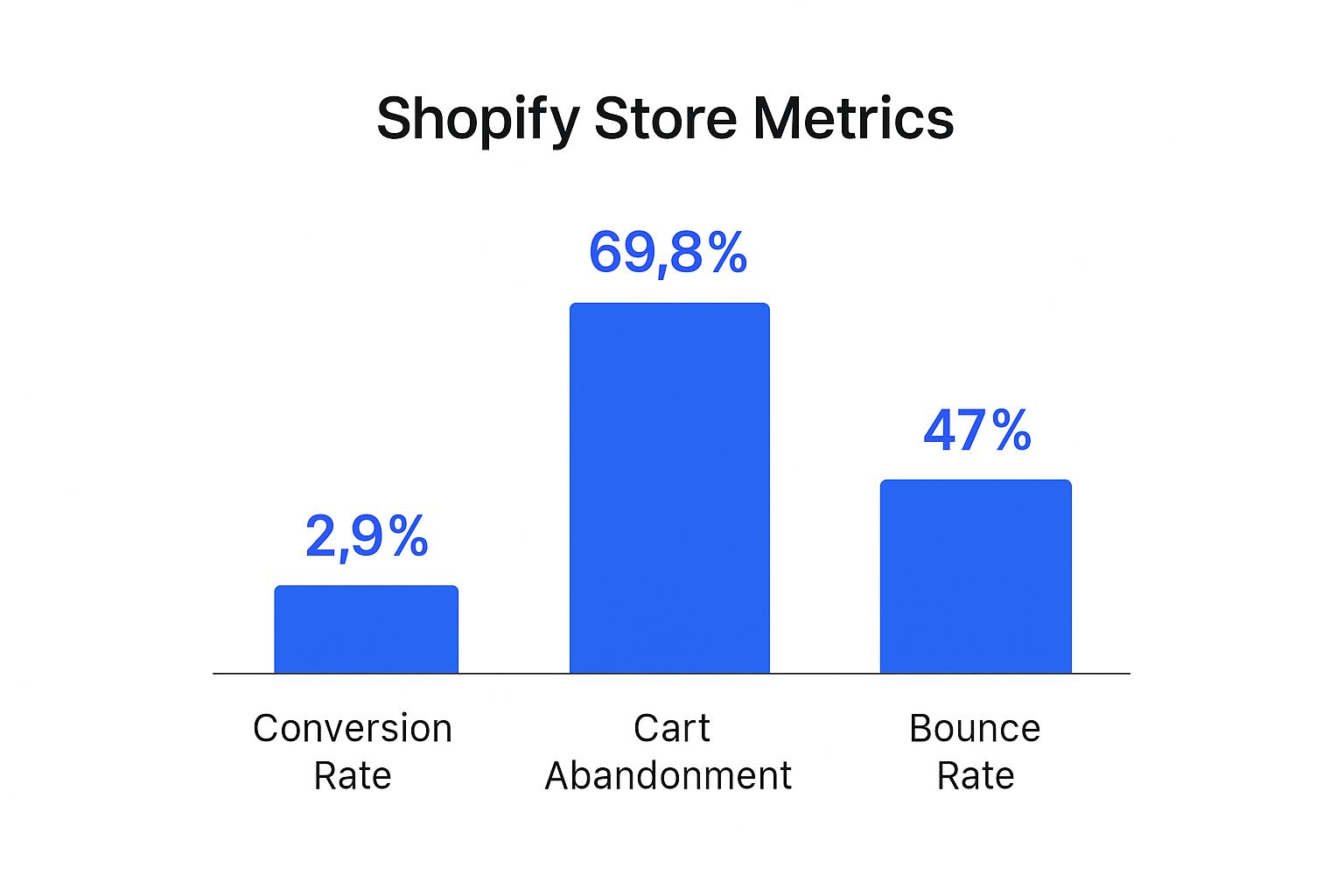
As the infographic shows, the average Shopify store converts around 2.9% of visitors, deals with a 69.8% cart abandonment rate, and has a 47% bounce rate. These averages offer some context, but remember that your target should align with your specific niche and business objectives.
Setting Realistic Conversion Rate Targets
Setting achievable goals is essential for staying motivated and focusing your optimization efforts. While aiming high is commendable, setting unrealistic targets can be discouraging. Understanding industry benchmarks is crucial. The average conversion rate for Shopify stores typically falls between 1% and 3%, fluctuating based on the source. Surpassing 3.2% puts a store in the top 20% of Shopify stores – an excellent position. High-performing stores often achieve rates of 4% or higher. For more detailed information, check out this resource: Learn more about conversion rates. It’s also important to remember that even small improvements can yield significant returns. For instance, increasing your conversion rate from 1.4% to 2.8% effectively doubles your sales without increasing traffic.
To help you understand where you stand and set realistic goals, let’s look at some industry benchmarks.
Shopify Conversion Rate Benchmarks by Industry:
A comparison of average conversion rates across different e-commerce niches on Shopify.
| Industry | Average Conversion Rate | Top Performer Rate | Improvement Potential |
|---|---|---|---|
| Apparel | 2.5% | 4.0% | 1.5% |
| Beauty | 2.8% | 4.5% | 1.7% |
| Electronics | 1.8% | 3.0% | 1.2% |
| Home & Garden | 2.2% | 3.5% | 1.3% |
| Jewelry | 2.0% | 3.2% | 1.2% |
As you can see, while the average conversion rate hovers around 2-3%, top performers in each industry can achieve significantly higher rates. By identifying your industry and comparing your current rate to these benchmarks, you can pinpoint areas for potential improvement.
Focusing on Strategic Improvements
This highlights a powerful principle of Shopify CRO: small, strategic improvements can compound over time and create impressive revenue gains. Optimizing product page layouts, for example, can lead to a higher add-to-cart rate. Streamlining the checkout process can reduce cart abandonment. These seemingly minor changes can significantly impact your bottom line when combined. Focus on identifying and addressing friction points in the customer journey to unlock your store’s growth potential.
Speed Optimization That Actually Drives Sales
Site speed is more than just a technical detail; it’s a critical factor for success on Shopify. A slow website can lead to frustrated customers and, ultimately, lost sales. Think of it like this: would you wait in a long line at a physical store? Probably not. Your online customers feel the same way. This section explores how speed improvements directly impact your profits.
Identifying Speed Bottlenecks
Several factors can contribute to a slow Shopify store. Large image files, too many apps, and clunky themes can all negatively affect performance. Identifying these bottlenecks is the first step toward a faster, more efficient online store. For example, a homepage loaded with images might take a long time to load, especially on a mobile phone. This can increase your bounce rate, the percentage of visitors who leave after viewing only one page.
- Large Images: While high-quality images are important for showcasing products, overly large files can significantly slow down loading times. Optimizing images is a key area for improvement.
- Unnecessary Apps: Shopify apps provide valuable functionality, but too many can overload your store. Each app adds more code that needs to be loaded, impacting overall performance.
- Bulky Themes: Some themes, particularly those with complex designs and animations, are naturally slower. Choosing a lightweight, performance-optimized theme is essential.
Prioritizing Speed Optimizations for Conversions
Not all speed optimizations are equally important. Some will have a greater impact on conversions than others. Prioritize the changes that will make the biggest difference for your customers. Focus on the elements of your site most crucial for driving sales.
One key aspect of Shopify conversion rate optimization is site speed and performance. Studies show that over 40% of shoppers abandon a website if it takes more than 3 seconds to load. This highlights the importance of fast loading times for retaining customers and driving purchases. Even a one-second delay can negatively affect conversion rates. Explore this topic further. Focus on areas directly affecting the customer’s path to purchase, such as product pages and the checkout process.
- Product Page Optimization: Ensure product pages load quickly, since slow loading times can lead to abandoned carts. Optimize images and streamline the page design.
- Checkout Optimization: A slow checkout process can be incredibly frustrating. Prioritize this area to minimize friction and encourage completed purchases.
- Mobile Optimization: Since a significant portion of online traffic comes from mobile devices, ensuring your store is mobile-friendly is essential. Optimize images and streamline the design for smaller screens.
Monitoring and Measuring Speed Improvements
Regularly monitoring site speed is crucial for maintaining optimal performance. Tools like Google PageSpeed Insights and GTmetrix provide valuable data and recommendations. These tools analyze your site and offer specific suggestions for improvement. This lets you track the effectiveness of your optimization efforts and identify any new issues.
By focusing on these key areas, you can create a faster, more efficient Shopify store. This provides a better user experience and ultimately drives higher conversions, leading to increased sales and a stronger bottom line. A fast, responsive site isn’t just a technical advantage—it’s a crucial driver of business growth.
Crafting Product Pages That Actually Convert
Beyond simple site speed, the core of your online store lies in your product pages. This is where the real action happens, transforming casual browsers into paying customers. Let’s explore how to create product pages that truly connect with your audience and boost those all-important conversions.
The Psychology of Persuasion on Product Pages
High-converting Shopify product pages don’t simply present product information; they tell a compelling story. They engage the psychology of persuasion, leading customers on a journey of discovery and ultimately, desire. Think of your product page as your best salesperson, actively engaging the customer and highlighting the product’s unique benefits.
- Image Sequences that Build Confidence: The order of your product images is crucial. Begin with a captivating hero shot, followed by images showcasing various angles, important details, and even lifestyle shots. This thorough visual presentation builds trust and minimizes any potential buyer hesitation.
- Descriptions that Overcome Objections: Proactively address typical customer concerns within your product descriptions. If sizing is a potential issue, incorporate a detailed size chart. If durability is a concern, highlight the quality of materials and construction. Anticipating and addressing these objections can dramatically improve add-to-cart rates.
- Social Proof Placements for Maximum Impact: Strategically place customer testimonials, reviews, and social media mentions to enhance trust and credibility. Positioning these trust signals near the “Add to Cart” button can be the final encouragement a customer needs to make a purchase.
Balancing Information with Simplicity
Providing detailed product information is vital, but excessive clutter can overwhelm customers. Successful Shopify merchants achieve a careful balance. A cluttered product page is like a restaurant menu with too many choices – it can lead to decision paralysis.
- Focused Simplicity: Highlight the most essential information and present it clearly and concisely. Use bullet points, headings, and plenty of white space to make the text easily digestible and scannable.
- Mobile-First Design: With most online traffic originating from mobile devices, optimizing your product pages for smaller screens is crucial for Shopify conversion rate optimization. Ensure images scale correctly, text is readable, and the layout is user-friendly across all devices.
- Anticipating Customer Questions: Design product experiences that preemptively answer common questions. This proactive strategy streamlines the buying process and builds confidence, ultimately boosting conversions.
Evaluating and Prioritizing Improvements
Continuous evaluation and improvement are key to effective Shopify conversion rate optimization. Use data and analytics to track vital metrics like add-to-cart rate, conversion rate, and bounce rate. This data provides valuable insights into areas that are performing well and those needing refinement.
- Practical Frameworks: Implement a system for prioritizing improvements. Concentrate on changes that will yield the greatest impact on your conversion rate. Even small adjustments, like tweaking the call-to-action button, can make a substantial difference.
- Iterative Testing: Don’t hesitate to experiment. A/B test different image sequences, product descriptions, and page layouts to determine what resonates most effectively with your target audience. This ongoing optimization is essential for maximizing your Shopify conversion rate and transforming your product pages into powerful drivers of sales and business growth.
Testing Pricing Strategies That Maximize Value
Stop guessing about your ideal price point. Instead, use data-driven methods to find out what your customers are willing to pay. This will maximize your Shopify conversion rate optimization efforts. Intuition can be deceptive, so relying on hard data is the key to sustainable growth. This section explores proven pricing optimization strategies.
Data-Driven Pricing vs. Intuition
Many business owners rely on gut feelings to set prices. However, data-driven approaches often deliver much better results. Imagine baking a cake without a recipe, randomly adding ingredients. You might get lucky, but the cake probably won’t turn out as planned. Pricing is similar—data provides the recipe for success. A/B testing lets you experiment with different prices and see what connects with your customers.
For example, testing $39 against $41 might seem minor, but the results can be surprising. One version might significantly increase conversions. This is because pricing psychology plays a crucial role in consumer behavior. Sometimes, a slightly higher price suggests higher quality, increasing perceived value. This can boost Shopify conversion rates.
When it comes to pricing optimization, A/B testing helps determine the best price points for products. This involves split testing various prices to see which one generates the highest revenue. For example, rather than assuming a single price works best, trying options like $39 versus $41 can reveal surprising insights into customer behavior. Implementing strategic offers like buy-one-get-a-discount deals can also incentivize larger purchases, boosting sales volume and overall revenue. For further reading on increasing your Shopify conversion rate, explore this topic further. Personalization and improving site search and navigation are also crucial for enhancing the shopping experience and boosting conversions. Combining these tactics can dramatically improve conversion rates and customer retention for Shopify store owners.
Structuring Offers to Increase Perceived Value
Beyond the base price, think about how you structure your offers. Bundling products, offering discounts, or adding value-added services can greatly influence buying decisions. For example, a free gift with purchase or a discounted bundle deal can raise your average order value. This boosts revenue and gives customers a sense of a good deal. This increased perceived value strengthens customer relationships and encourages repeat purchases.
Psychological Pricing Techniques: Effective or Not?
Charm pricing, using prices ending in .99, is a common tactic. While sometimes effective, it’s crucial to understand when it works and when it doesn’t. Depending on your brand and target audience, a round number might be better. A/B test various methods to determine the pricing strategy that best resonates with your customer base. Testing is essential for optimizing Shopify conversion rate optimization.
Identifying Price Sensitivity and Tiered Pricing
Understanding your customers’ price sensitivity is crucial. This means finding the price point where customers start to resist buying. This knowledge allows you to create pricing strategies that maximize conversions. Tiered pricing, offering different product versions at varying price points, is another useful tactic. This caters to different customer budgets and preferences, ultimately maximizing revenue. Offering a range of options helps capture a broader market segment.
The following table shows how A/B testing various price points can significantly affect conversions, revenue, and profit.
A/B Testing Results: Price Point Impact on Conversion
| Original Price | Test Price | Conversion Rate Change | Revenue Impact | Profit Change |
|---|---|---|---|---|
| $50 | $45 | +15% | +10% | +8% |
| $100 | $95 | +5% | +3% | +2% |
| $200 | $180 | +12% | +8% | +6% |
As you can see, seemingly small price adjustments can have a significant impact on key metrics. Testing and optimizing your pricing is vital for maximizing profitability.
By continually analyzing data, testing various approaches, and understanding pricing psychology, you can significantly impact your bottom line. This ultimately leads to higher Shopify conversion rate optimization, more profit, and a more successful online store.
Building a Checkout Experience That Closes the Deal
The checkout process is the final step in converting a browser into a buyer. This crucial stage can truly make or break a sale. By carefully examining what contributes to a smooth and successful checkout, we can pinpoint the key elements that minimize abandoned carts and maximize completed purchases. This, in turn, leads to a more effective Shopify conversion rate optimization strategy.
Reducing Friction While Maintaining Trust
While a simplified checkout is generally the goal, oversimplification can sometimes backfire. Customers need a certain level of reassurance during the purchase process. It’s a delicate balance between minimizing friction and maximizing customer confidence. Think about buying a car without any paperwork–it would feel strange and unsettling. Similarly, online shoppers need to feel secure when providing their personal and financial information.
- Transparent Shipping Costs: Never surprise shoppers with unexpected shipping fees at the last minute. Clearly displaying shipping costs early in the process helps avoid sticker shock and reduces the chance of abandoned carts.
- Clear Delivery Expectations: Provide accurate delivery timeframes upfront. Knowing when to expect their purchases eases customer anxiety and contributes to a positive overall experience.
- Secure Payment Gateways: Displaying security badges and using trusted payment processors like PayPal or Stripe builds trust and encourages customers to complete their purchases.
The Psychology of Closing the Deal
Understanding the psychological factors that influence purchasing decisions is vital for optimizing your checkout. Addressing any last-minute hesitations can often be the difference between a successful sale and an abandoned cart.
- Highlighting Security Measures: Prominently display security badges to reassure customers about the safety of their transactions. This builds trust and encourages them to proceed with confidence.
- Offering Guest Checkout: While creating an account offers benefits for repeat customers, providing a guest checkout option caters to those who prefer a faster, less complicated process.
- Limited-Time Offers: Introduce a sense of urgency with limited-time discounts or free shipping offers to motivate customers to finalize their purchase.
Mobile Checkout Optimization
With the significant increase in mobile shopping, optimizing the checkout experience for mobile users is essential for a successful Shopify conversion rate optimization strategy. A cumbersome mobile checkout can lead to frustration and ultimately, lost sales.
- Streamlined Form Design: Minimize the number of required fields and ensure forms are easy to navigate and fill out on smaller screens.
- Thumb-Friendly Buttons: Make sure buttons are large enough for easy tapping with a thumb to avoid accidental clicks and frustration.
- Progress Indicators: A clear progress bar keeps customers informed about where they are in the checkout process, reducing anxiety and encouraging them to complete the purchase.
Cart Recovery Tactics
Even with a perfectly optimized checkout, some cart abandonment is unavoidable. Implementing effective cart recovery strategies can help bring those customers back and recover potentially lost sales.
- Abandoned Cart Emails: Automated emails reminding customers about items left in their cart, often sweetened with incentives like discounts or free shipping, can be very effective.
- Retargeting Ads: Strategically displaying targeted ads to customers who have abandoned their carts serves as a gentle reminder of their intended purchases and encourages them to return to your site.
By focusing on these crucial elements, you can create a checkout experience that effectively converts potential customers into loyal buyers and strengthens your Shopify conversion rate optimization strategy. Remember, the checkout process isn’t just a transaction; it’s the culmination of the entire customer journey.
Leveraging Trust Signals That Actually Work

Not all social proof is created equal when it comes to Shopify conversion rate optimization. While many stores add trust badges and testimonials, understanding which signals truly resonate with customers and influence their buying decisions is crucial. This section explores how to effectively use trust signals to boost your conversions.
Review Formats That Drive Conversion
Customer reviews are powerful trust signals. But how those reviews are presented matters. A wall of text reviews isn’t enough. Consider incorporating visual elements like star ratings and highlighting key snippets from positive reviews. This allows customers to quickly grasp the product’s value and builds confidence.
- Star Ratings: These offer a quick visual summary of customer satisfaction.
- Visual Reviews: Encourage customers to share photos or videos of themselves using your product.
- Review Excerpts: Highlight key phrases from positive reviews to quickly communicate product benefits.
Strategically Collecting and Displaying Customer Feedback
Actively seek customer feedback. Make it easy and convenient for customers to leave reviews. Offer incentives, such as a discount on their next purchase, to encourage participation. This not only generates valuable reviews but also builds stronger customer relationships.
- Post-Purchase Emails: Request reviews a few days after delivery, allowing customers time to experience the product.
- Incentivize Feedback: Offer small discounts or rewards to encourage reviews.
- Diversify Platforms: Collect feedback on multiple platforms, including social media, dedicated review sites like Trustpilot, and directly on your Shopify store.
Turning Negative Experiences into Trust-Building Opportunities
Negative reviews are inevitable. Instead of fearing them, see them as chances to demonstrate excellent customer service. Publicly responding to negative reviews, acknowledging the issue, and offering solutions shows your commitment to customer satisfaction.
This builds trust and shows potential customers that you value their experience. Offering a refund or replacement to an unhappy customer can turn a negative experience into a positive one. This strengthens your brand reputation and ultimately boosts your Shopify conversion rate optimization.
Authentic Social Validation: Beyond Basic Reviews
Go beyond standard reviews with more authentic forms of social validation.
- User-Generated Content (UGC): Encourage customers to share photos and videos of themselves using your products on social media platforms like Instagram. Reposting this UGC on your website provides genuine social proof.
- Certifications and Awards: Display relevant certifications, such as security badges or industry awards, to reinforce credibility and build trust.
- Social Media Integration: Integrate your social media feeds on your website to showcase real-time engagement and social activity.
By implementing these strategies, you can elevate social proof from mere decoration to a powerful driver for Shopify conversion rate optimization. Authentic trust signals resonate deeply with customers, fostering confidence and driving sales. Building trust takes time and consistent effort, but the payoff is a worthwhile investment in long-term growth and sustainable success on Shopify.
Implementing Analytics That Reveal Hidden Opportunities
Moving beyond basic pageview counts is essential for true Shopify conversion rate optimization. Think of pageviews like counting how many people walk past your storefront. It’s a start, but it doesn’t tell you how many actually come inside and make a purchase. This section explores how successful Shopify merchants use advanced analytics to uncover hidden opportunities for improvement.
Identifying Your Critical Conversion Pathways
First, you need to identify the key steps a customer takes to complete a purchase. These steps form your critical conversion pathways. For an online clothing store, this might be: Homepage -> Category Page -> Product Page -> Cart -> Checkout -> Purchase Confirmation. Each step in this pathway represents a potential area for improvement—or a point where customers might abandon their purchase.
Imagine your conversion pathway as a pipe. Each step represents a section of that pipe, and any leaks represent lost revenue. Analytics tools help you find and fix those leaks.
- Funnel Visualization: Tools like Google Analytics offer funnel visualizations, clearly showing where customers drop off in the conversion process.
- Event Tracking: Track specific customer actions, like adding items to their cart or clicking a particular button. This provides granular insights into user behavior.
- User Segmentation: Divide your audience into segments based on demographics, behavior, or other criteria. This helps identify unique conversion patterns within specific customer groups.
Tracking Meaningful Engagement Signals
Not all engagement is created equal. Clicks and likes are good, but they don’t always translate to sales. Focus on meaningful engagement signals that directly correlate with conversions.
This might involve tracking how long customers spend on product pages, how many product images they view, or if they interact with customer reviews. These actions indicate genuine interest and potential buying intent.
- Time on Page: More time spent on a product page often suggests a higher level of interest.
- Scroll Depth: How far a customer scrolls down a page can reveal how engaged they are with the content.
- Interaction Tracking: Measure clicks on key elements like “Add to Cart” buttons, size charts, or product videos to gauge interest levels.
Combining Quantitative and Qualitative Insights
Analytics provide the numbers, but the “why” often lies in qualitative data. Combining both creates a comprehensive understanding of customer behavior.
For example, a high bounce rate on a product page warrants further investigation. Consider surveying customers to understand their reasons for leaving. Was the product description unclear? Were there not enough images? Was the pricing confusing?
- Customer Surveys: Gather direct feedback to understand customer needs and preferences.
- User Testing: Observe customers interacting with your website to identify usability issues and areas of friction.
- Heatmaps: Visualize where customers click and scroll to pinpoint areas of interest or confusion.
Avoiding Analysis Paralysis and Focusing on Action
While analytics provides valuable insights, too much data can be overwhelming. Avoid analysis paralysis by focusing on key metrics and setting clear, actionable goals.
If your conversion rate drops, resist making sweeping changes immediately. Instead, form a hypothesis based on the data and test it with A/B testing.
- A/B Testing: Compare different versions of web pages to see which performs better in terms of conversions.
- Multivariate Testing: Test multiple variations of different elements simultaneously to find the best combination.
- Prioritization Matrix: Use a matrix to rank potential improvements based on their potential impact and ease of implementation.
By implementing a robust analytics system that balances quantitative and qualitative insights, you can uncover hidden opportunities for improvement, optimize your Shopify store for conversions, and drive meaningful growth. Data isn’t just about numbers; it’s about understanding your customers and using that knowledge to make informed decisions. Ready to transform your Shopify store? Denver Web Design Studio can help. Our team specializes in Shopify conversion rate optimization, crafting data-driven strategies that deliver results. Contact us today to learn more.