What is Rich Snippets?
It’s one of the most powerful tools in modern SEO for improving visibility and click-through rates. When users perform a search on Google, they’re more likely to engage with listings that display ratings, images, prices, and other rich details. Rich snippets transform ordinary search results into compelling visual summaries that grab attention instantly.
By understanding what is rich snippets and how they function, businesses can take full advantage of enhanced search previews. These snippets don’t just look better—they offer more value, helping searchers decide if a page is relevant before even clicking. This leads to higher engagement and better SEO performance overall.
Think back to your last Google search. You were likely greeted with a familiar list of blue links. But imagine those results amplified with images, star ratings, prices, and other vital details displayed directly on the search results page. This is the impact of rich snippets.
Rich snippets elevate ordinary search results, transforming them into engaging, information-rich previews. They give users a concise overview of a webpage’s content, empowering them to determine its relevance before clicking. This preview leads to a more informed and satisfying search experience.
For businesses, this translates to higher click-through rates, increased visibility, and a more robust online presence. Rich snippets help your website stand out from the competition.
Understanding the Evolution of Rich Snippets
Initially, rich snippets were fairly basic, often just showcasing star ratings for reviews. Over time, they’ve evolved significantly, becoming more sophisticated and interactive.
Now, they incorporate a diverse range of elements, including images, videos, FAQs, product details, and even event information. This evolution reflects Google’s continuous efforts to provide users with the most relevant and useful information.
Why Rich Snippets Matter
Rich snippets are more than just visually appealing; they profoundly impact user behavior. Acting as visual cues, they draw the user’s eye and provide crucial information upfront.
Imagine searching for a recipe and seeing a snippet with an enticing image, cooking time, and a five-star rating. You’re far more likely to click that result than a plain text listing. This is because rich snippets cater to our need for quick and easy access to information.
Rich snippets, also known as rich results, have been integrated into Google search results since 2017. These enhanced results incorporate extra details like ratings, images, and prices, extracted from structured data markup within the webpage’s HTML. The presence of rich snippets can significantly boost a webpage’s click-through rate (CTR).
Studies show that rich snippets consistently achieve higher CTRs than standard snippets, leading to more targeted traffic and longer dwell times on the website. Learn more about the impact of rich snippets on Backlinko. This makes them a vital component of any successful SEO strategy.
The Benefits for Your Business
Implementing rich snippets offers a variety of advantages for your business:
- Increased Click-Through Rates (CTR): Rich snippets make search results more visually appealing and informative, significantly boosting your CTR.
- Improved Visibility: Rich snippets help your website stand out in search results, attracting user attention and driving more traffic.
- Enhanced User Experience: By delivering information quickly and efficiently, rich snippets create a positive search experience.
- Better Brand Perception: Rich snippets contribute to a more professional and trustworthy online presence, ultimately strengthening your brand image.
By understanding and implementing rich snippets, businesses can significantly enhance their online visibility and attract more targeted traffic to their websites.
The Rich Snippet Ecosystem: Finding Your Perfect Match
Not all rich snippets are created equal. Just like a well-stocked toolbox, the rich snippet ecosystem offers a variety of tools, each designed for a specific purpose. Choosing the right tool—the right rich snippet—is crucial for maximizing your search visibility. This section will help you identify the perfect rich snippets to boost your specific content.
Matching Snippets to Your Content
Different industries benefit from different types of rich snippets. For example, e-commerce sites often leverage product snippets to showcase pricing and availability directly in search results. This allows potential customers to quickly compare options and make informed purchasing decisions. For an e-commerce business, showcasing price and availability can significantly impact conversions.
Publishers frequently use article snippets to stand out in crowded news results. These snippets often include eye-catching images and publication dates, making them more enticing to click. This can be especially beneficial in competitive industries like news and media.
Service businesses, however, might find review snippets more effective for capturing attention and building trust. Displaying star ratings and customer testimonials can instantly boost credibility and encourage potential clients to choose your services.
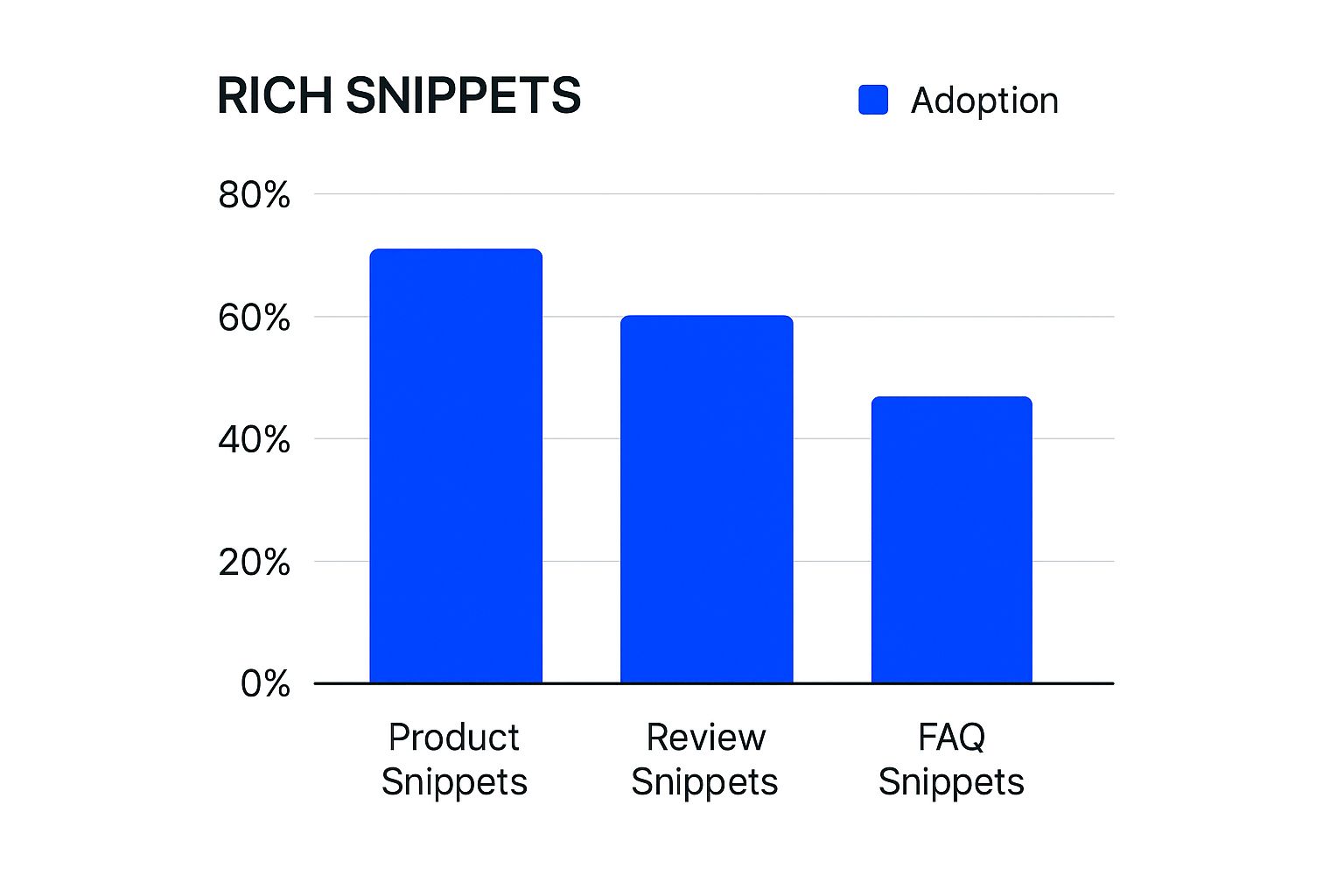
The infographic above visualizes the adoption rate of different rich snippets, showcasing Product Snippets at 70%, Review Snippets at 60%, and FAQ Snippets at 45%. This data indicates that while Product and Review snippets are widely adopted, there’s still potential for businesses to leverage FAQ snippets. Addressing user queries directly in search results can be a powerful tool.
To help illustrate the various rich snippet types, their requirements, and their impact, let’s take a look at the following comparison table. It provides a detailed overview of how each snippet can be used to enhance your search presence.
Rich Snippet Performance Comparison
| Rich Snippet Type | Required Schema | Visual Elements | Best For | Implementation Difficulty |
|---|---|---|---|---|
| Product | Product | Price, Availability, Image | E-commerce | Easy |
| Review | Review | Star Rating, Testimonial | Service Businesses, Products | Easy |
| Article | Article | Headline, Image, Publication Date | Publishers, Bloggers | Medium |
| FAQ | FAQPage | Question & Answer | Informational Content | Medium |
The table above highlights the importance of choosing the right rich snippet based on your content and target audience. While some, like Product and Review, are relatively straightforward to implement, understanding the nuances of each can maximize their effectiveness.
Visual Elements and Technical Requirements
The visual elements within a rich snippet play a crucial role in attracting user engagement. High-quality images, compelling titles, and clear descriptions can significantly increase click-through rates. Optimizing these elements is just as important as implementing the structured data itself.
While the visual aspects are crucial, the underlying technical implementation is equally vital. Each snippet type has specific schema markup requirements. This structured data tells search engines like Google what your content is about and how it should be displayed. For those looking to improve their overall site visibility, understanding fundamental SEO principles is recommended. Here are some helpful SEO tips to boost website traffic.
Real-World Implementation and Multiple Snippet Types
Businesses that successfully implement multiple snippet types across their content often see significant improvements in their overall search performance. This is because they are catering to a wider range of user intents and providing more comprehensive information directly in the search results.
For instance, a recipe website might use recipe snippets to showcase cooking times and ratings, while also incorporating review snippets to display user testimonials. By combining different snippet types strategically, businesses can create a more engaging search experience. This comprehensive approach ultimately leads to increased traffic and better brand visibility. Understanding the nuances of each rich snippet type and implementing them correctly can significantly impact your website’s search performance.
Rich Snippets and Your Bottom Line: The Real Impact

We’ve discussed what rich snippets are and how they enhance search results. But how do they affect your profits? How do these visual enhancements translate into real business growth? Let’s explore the measurable impact of rich snippets.
Measuring the Impact of Rich Snippets
Rich snippets influence key performance indicators (KPIs). These aren’t just superficial metrics; they demonstrate real business growth. Think of rich snippets as magnets, attracting users and encouraging clicks to your website.
- Click-Through Rate (CTR): CTR measures how often users click your search result versus how often it appears. A higher CTR means your snippet effectively grabs user attention.
- Bounce Rate: This shows the percentage of visitors leaving your site after viewing only one page. Rich snippets can decrease bounce rate by ensuring click-throughs come from genuinely interested users.
- Conversion Rate: This is the percentage of visitors completing a desired action, like buying a product or completing a form. By attracting more qualified traffic, rich snippets contribute to a higher conversion rate.
These metrics are interconnected. Higher CTR can decrease bounce rate, contributing to more conversions and, ultimately, more revenue.
Real-World Examples and Timelines
Rich snippets offer clear benefits, but it’s important to have realistic expectations. They aren’t a quick fix; they’re a strategic move requiring proper implementation and ongoing monitoring.
Statistically, rich snippets dramatically improve webpage visibility and engagement. They can increase CTR by as much as 20-30% compared to standard results by giving users more context. This increased visibility drives more targeted traffic. Since their introduction, Google has continuously expanded available rich snippet types, including product details, event information, and reviews. They are now crucial for SEO strategies worldwide. Learn more on SEMrush.
Business Models and Snippet Types
Different business models benefit from different rich snippet types. E-commerce businesses might profit from product snippets, while service businesses could benefit from review snippets. The key is choosing the type that best aligns with your business goals and target audience.
This requires understanding your audience’s search habits and the information they need to make decisions. By providing this upfront in rich snippets, you’ll attract more qualified leads. Ultimately, rich snippets enhance the user experience, positively impacting your business.
From Code to Clicks: Implementing Structured Data
We’ve explored the impact of rich snippets. Now, let’s dive into implementing the code that brings these snippets to life. This involves structuring your data in a way Google can understand, allowing them to extract key information and display it as a rich snippet. This section breaks down the process, making it accessible for everyone, regardless of technical expertise.
JSON-LD: The Preferred Method
Several methods exist for implementing structured data, but JSON-LD (JavaScript Object Notation for Linked Data) stands out as the preferred choice. This is largely due to its ease of implementation and maintenance. Existing as a separate JavaScript script within your HTML, it avoids disrupting your site’s existing code. Plus, JSON-LD is Google’s recommended format, making it the most reliable option for ensuring your rich snippets display correctly. It’s like speaking Google’s language.
Implementing JSON-LD: A Simple Guide
Implementing JSON-LD doesn’t require advanced coding knowledge. Here’s a simplified breakdown:
- Identify the Schema: Figure out the type of rich snippet you want (product, review, article, etc.). Each type corresponds to a specific schema vocabulary.
- Use a Generator: Online tools can generate the JSON-LD code for you. Simply input your content information.
- Add the Code: Paste the generated JSON-LD code into the
<head>section of your webpage’s HTML. This makes it easily accessible to search engines. - Test and Validate: Use Google’s Rich Results Test to verify your implementation and fix any errors.
Diagnosing Issues With Google’s Tools
Google offers powerful tools for troubleshooting structured data issues. The Rich Results Test is essential for finding errors in your JSON-LD and ensuring Google can understand the information.
Google Search Console provides further insights into how Google interprets your structured data across your entire website. You can spot pages with missing or invalid data, fix issues, and improve your rich snippet chances. This offers a broader perspective on your implementation, helping maintain consistency across all pages.
Let’s take a look at different implementation methods in more detail:
To help you choose the right method for your needs, the following table compares several structured data implementation approaches:
Structured Data Implementation Methods
Comprehensive comparison of implementation approaches with practical insights for different technical capabilities
| Method | Complexity | Maintenance | SEO Impact | Best For | Limitations |
|---|---|---|---|---|---|
| JSON-LD | Low | Easy | High | All websites | Few, generally preferred |
| Microdata | Medium | Moderate | High | Websites with existing semantic HTML | Can be more complex to implement and maintain than JSON-LD |
| RDFa | Medium | Moderate | High | Websites with complex data structures | Steeper learning curve |
This table highlights the advantages of JSON-LD, especially its low complexity and easy maintenance, making it a good choice for most website owners. Other methods like Microdata and RDFa are also effective but may present more challenges for those less comfortable with code.
CMS Platforms and Scaling Implementation
Many WordPress and other content management systems (CMS) offer plugins that simplify adding structured data. These often provide user-friendly interfaces for inputting information, removing the need to write JSON-LD manually.
For larger websites, scaling effectively involves using automated tools and workflows. This ensures consistency and accuracy across many pages, maximizing the benefits of rich snippets. Automating this process allows for more effective scaling and improves site-wide visibility and user engagement.
Maintaining Data Through Site Updates
As your website changes, maintaining accurate structured data is essential. When updating content or structure, always review and update your structured data to match. This prevents inconsistencies and ensures your rich snippets remain accurate. Regular audits and updates are vital for long-term rich snippet effectiveness.
Rich Snippets vs. Featured Snippets: Strategic Differences
Rich snippets and featured snippets are both valuable for increasing your website’s visibility in search results. However, they achieve this in different ways, requiring distinct strategies. Understanding these differences is crucial for maximizing their potential. This section clarifies the distinctions between rich snippets, which enhance organic search results, and featured snippets, which occupy the highly desirable “position zero.”
Understanding the Core Difference
Rich snippets enhance your standard organic search results. They provide additional details at a glance, such as images, ratings, and prices. This makes your listing stand out and provides more information directly in the search results. Think of rich snippets as a way to make your search result more enticing and informative, increasing the chances a user will click.
Featured snippets, on the other hand, aim to directly answer the user’s query right at the top of the search results page. Content is pulled from a webpage and displayed in a prominent box above the other results, often called “position zero.” This prime real estate offers significant visibility and establishes your website as an authority. Featured snippets provide quick answers, sometimes without even requiring the user to click through to your website.
Content Types and Optimization
Different content works better with different snippet strategies. When implementing rich snippets, understanding how to use structured data is key. Product pages, for instance, benefit from rich snippets showing price and availability. Blog posts can use rich snippets to highlight author information and publishing dates. The goal is to give users the most pertinent information upfront.
Featured snippets, conversely, are often triggered by question-based searches. Content that provides clear, concise answers to common questions has a higher chance of being featured. Using structured formats like lists or tables can also increase your chances. This involves anticipating user questions and creating content designed to answer them directly.
Prioritization and Measurement
Ideally, your website would benefit from both rich snippets and featured snippets. However, you might need to prioritize. For e-commerce websites, rich snippets on product pages might be more valuable for driving sales. For informational websites, targeting featured snippets could be more effective for establishing authority and generating traffic.
The impact of rich snippets on SEO and user experience is significant. By offering precise information, rich snippets communicate the value of your webpage to both search engines and users. This can improve your SEO as users are more likely to click on enriched search results. For example, a recipe with rich snippets displaying cooking time, ratings, and an image is more likely to attract clicks. Many rich snippets also qualify for featured snippets, giving them even more prominence on the Search Engine Results Page (SERP). Learn more about the strategic advantages of rich snippets here.
Measuring the effectiveness of each snippet type involves different approaches. For rich snippets, track click-through rates to assess their impact on attracting clicks. For featured snippets, monitor impressions and click-through rates to gauge their influence on visibility and traffic. Analyzing this data can help refine your content strategy and optimize your content for maximum impact. A data-driven approach lets you understand what works best and adapt accordingly.
When Rich Snippets Don’t Appear: Troubleshooting Guide
You’ve meticulously implemented the code and validated it with Google’s tools, but your rich snippets are missing in action. This can be incredibly frustrating. This section explores common reasons why your rich snippets might not be showing up, even with seemingly perfect markup, and offers practical solutions.
Common Reasons for Rich Snippet Absence
Several factors can prevent Google from displaying your rich snippets. One possibility is that your content doesn’t meet Google’s quality thresholds. Rich snippets are designed to enhance the user experience. If your content is thin, inaccurate, or misleading, Google might not consider it worthy of a rich snippet.
Another factor is competition. In highly competitive search results, Google may only display a limited number of rich snippets. Even with flawless markup, competitors might have slightly more relevant or authoritative content.
Technical conflicts can also be a culprit. Sometimes, other elements on your page, such as conflicting structured data or JavaScript errors, can interfere with how Google parses and displays your rich snippets.
Diagnosing the Problem
How can you identify the specific roadblock preventing your rich snippets from appearing? A systematic diagnostic approach is key. Start by examining Search Console data patterns. Look for errors or warnings related to your structured data within Google Search Console. These messages can offer valuable clues about what needs fixing.
Next, re-test your implementation using the Rich Results Test. This tool can pinpoint errors in your markup that might be preventing your snippets from displaying. It’s a crucial debugging tool for refining your structured data.
Finally, analyze your competitors. Check if they are using rich snippets for similar keywords. If so, examine their markup and content quality. This can highlight areas where you can improve your own implementation to gain a competitive edge.
Practical Strategies for Improving Snippet Eligibility
There are several practical steps you can take to increase the chances of your rich snippets appearing. Focus on content quality enhancements. Ensure your content is accurate, comprehensive, and provides genuine value to users. Consider what information users seek when searching for your target keywords, and provide it clearly and concisely.
Address any technical refinements identified during your diagnosis. Fix structured data errors and resolve any JavaScript conflicts. This will ensure clean and accessible markup for search engines. Often, minor technical glitches can be the reason snippets aren’t showing.
Finally, remember patience and testing. Google doesn’t always display rich snippets immediately. It sometimes takes time for their algorithms to process and index your structured data. Regularly monitor your search results, and continue to test and refine your implementation. Consistently providing high-quality content with accurate markup will increase your chances of success.
Future-Proofing Your Rich Snippet Strategy
As search engines evolve, so must your approach to rich snippets. This section explores emerging trends and best practices to ensure your rich snippet strategy remains effective and adaptable, keeping you ahead of the curve in the search landscape.
Emerging Trends in Structured Data
The world of structured data is constantly changing. New rich result types are always being developed, offering exciting opportunities for businesses to enhance their search presence.
- FAQ Snippets: These snippets provide quick answers directly in search results.
- How-to Snippets: These offer step-by-step instructions within the search results page.
These rich snippets cater to user intent by providing easily digestible information.
Voice search is also influencing how rich snippets are displayed. With the growing use of voice assistants, clear and concise information is even more critical. Optimizing your rich snippets for voice search means focusing on structured data that can be easily interpreted and read aloud.
Certain industries are experiencing more rapid innovation in rich snippet types than others. The e-commerce sector, for example, is seeing new structured data options for product details, availability, and pricing, giving online businesses more ways to showcase their products directly in search results. Staying updated on industry-specific trends is crucial for maximizing the impact of your rich snippets.
Monitoring Competitors and Staying Current
Analyzing your competitors’ structured data implementation can provide valuable insights. By observing how they utilize rich snippets, you can identify opportunities to improve your own strategy. Tools like SEMrush can help you analyze competitor structured data and pinpoint areas for improvement.
Keeping up with Google’s requirements for structured data is essential. Google regularly updates its guidelines, so ensuring your implementation stays compliant is key. Google’s Rich Results Test can help you identify and fix any errors.
Building a Flexible and Adaptable Strategy
A future-proof rich snippet strategy requires flexibility. The search landscape is always changing, so your approach should adapt to new trends and updates. This involves building a foundation of high-quality content and accurate structured data that can be easily modified.
By monitoring industry trends, analyzing competitors, and staying informed about Google’s requirements, you can ensure your rich snippet strategy delivers consistent results. This proactive approach will maximize your search visibility in the constantly evolving world of SEO. Remember, a robust rich snippet strategy is an ongoing process of optimization and refinement.
What is Rich Snippets? It’s more than a visual upgrade—it’s a strategic advantage. When implemented correctly, rich snippets increase trust, improve user experience, and drive qualified traffic. They bridge the gap between your content and your audience by displaying key information directly in the search results.
Whether you’re running an e-commerce site, blog, or service business, understanding what is rich snippets and applying them properly can significantly boost your online presence. Make them part of your SEO foundation, and you’ll stay ahead of competitors in both visibility and user engagement.
Visual elements play a crucial role in enhancing the impact of rich snippets, especially when paired with high-quality images that align with user intent. If you’re looking to improve how visuals support your overall SEO and user experience, be sure to check out our detailed guide on using images effectively in web design. It explores how thoughtful image selection and optimization can amplify both engagement and conversion rates.
Ready to implement rich snippets on your website but not sure where to start? At Denver Web Studio, we specialize in structured data, SEO, and web design that gets results. Contact us today for a personalized consultation and discover how we can help boost your search visibility and turn clicks into customers.