Navigating the Digital Landscape as a Small Business

The digital world presents incredible opportunities for small businesses to connect with customers and cultivate brand growth. However, it’s a fast-paced and sometimes overwhelming environment, especially for those with limited resources. A robust online marketing strategy is no longer optional, but essential.
This means adapting to rapid changes and shifting traditional marketing approaches. Small businesses must find ways to use their inherent agility to compete effectively with larger corporations.
Embracing the Digital Shift
Adaptability is key to navigating the digital world. The online landscape is constantly evolving, with new platforms, algorithms, and consumer behaviors emerging regularly.
For example, the rise of short-form video content has required businesses to adapt their content strategies. This ability to quickly adjust is a significant advantage for small businesses. They can experiment with new approaches and capitalize on emerging trends faster than larger, less nimble competitors.
Understanding Your Online Audience
A deep understanding of your target audience is crucial for any small business online marketing strategy. This goes beyond basic demographics and digs into online behavior, preferences, and pain points.
Where do they spend their time online? What motivates them? What challenges do they face that your business can solve? Answering these questions allows you to tailor your marketing efforts, creating more effective campaigns that resonate with your ideal customers.
A growing number of small businesses recognize the value of digital marketing. In fact, nearly half (49%) plan to increase their marketing budgets in 2025, emphasizing the importance of online presence for reaching new customers and staying competitive.
However, many are still missing out on key opportunities. Surprisingly, 60% of small businesses aren’t investing in search advertising, and 61% aren’t investing in SEO, hindering their ability to connect with potential customers actively searching for their products or services online. Find more detailed statistics here: Learn more about small business marketing trends.
Building a Strategic Foundation
Your understanding of your audience should inform the development of a clear and concise online marketing strategy. This strategy acts as a roadmap, guiding your efforts and ensuring all activities work towards a common goal.
This involves identifying key performance indicators (KPIs) to measure success and track progress. These KPIs might include website traffic, lead generation, conversion rates, or social media engagement.
By monitoring these metrics, you can refine your strategy over time and optimize your return on investment. Finally, recognizing and playing to your strengths as a small business, such as personalized customer service and community engagement, can create a significant competitive edge in the digital marketplace.
Building Your Digital Marketing Plan Without Breaking The Bank
A successful online marketing strategy for a small business doesn’t require a huge budget. Instead, it relies on a smart, well-defined plan. Instead of spreading your resources thin across various tactics, concentrate on a strategic framework designed to maximize your return on investment (ROI). This involves understanding your unique value, setting clear objectives, and allocating your budget efficiently.
Identifying Your Unique Value Proposition
What sets your business apart? Why should customers choose you over the competition? Figuring out your unique value proposition is essential for any successful online marketing strategy. This could be anything from outstanding customer service to specialized products or a strong commitment to sustainability. Clearly defining this value will shape your marketing messages and resonate with your target audience.
Setting Measurable Objectives
A broad goal like “increase brand awareness” is difficult to track and even harder to achieve. Instead, focus on SMART goals: Specific, Measurable, Achievable, Relevant, and Time-bound. A SMART goal like “increase website traffic by 15% in the next quarter” is measurable and trackable, providing a clear direction for your marketing efforts and a benchmark for progress assessment.
Conducting Competitor Analysis
Understanding your competitors is crucial. Analyze their online presence, marketing strategies, and target audience. You don’t need expensive tools for this. Start by looking at their websites, social media activity, and online reviews. By understanding their strengths and weaknesses, you can uncover opportunities where your business can thrive.
Developing Detailed Customer Personas
Who are your ideal customers? Developing customer personas helps tailor your marketing to resonate with your target audience. These fictional, yet realistic, representations of your ideal customers should include demographics, online behavior, motivations, and pain points. These insights allow you to personalize messaging and select the most effective marketing channels.
Allocating Your Budget Wisely
With limited resources, strategic budget allocation is essential. Consider which marketing channels will deliver the highest ROI for your target audience. If your audience primarily uses social media, for example, concentrate your efforts there. As you build your digital presence, protecting your brand image is vital; learn about practical online reputation management strategies.
Content Marketing on a Budget
Creating engaging content is key to attracting and retaining customers, but it doesn’t have to be costly. Prioritize quality over quantity. Repurposing content across different channels can also maximize reach and impact. For instance, a single blog post can be transformed into social media updates, an infographic, or even a short video. The following infographic illustrates the average engagement rates of various content types:
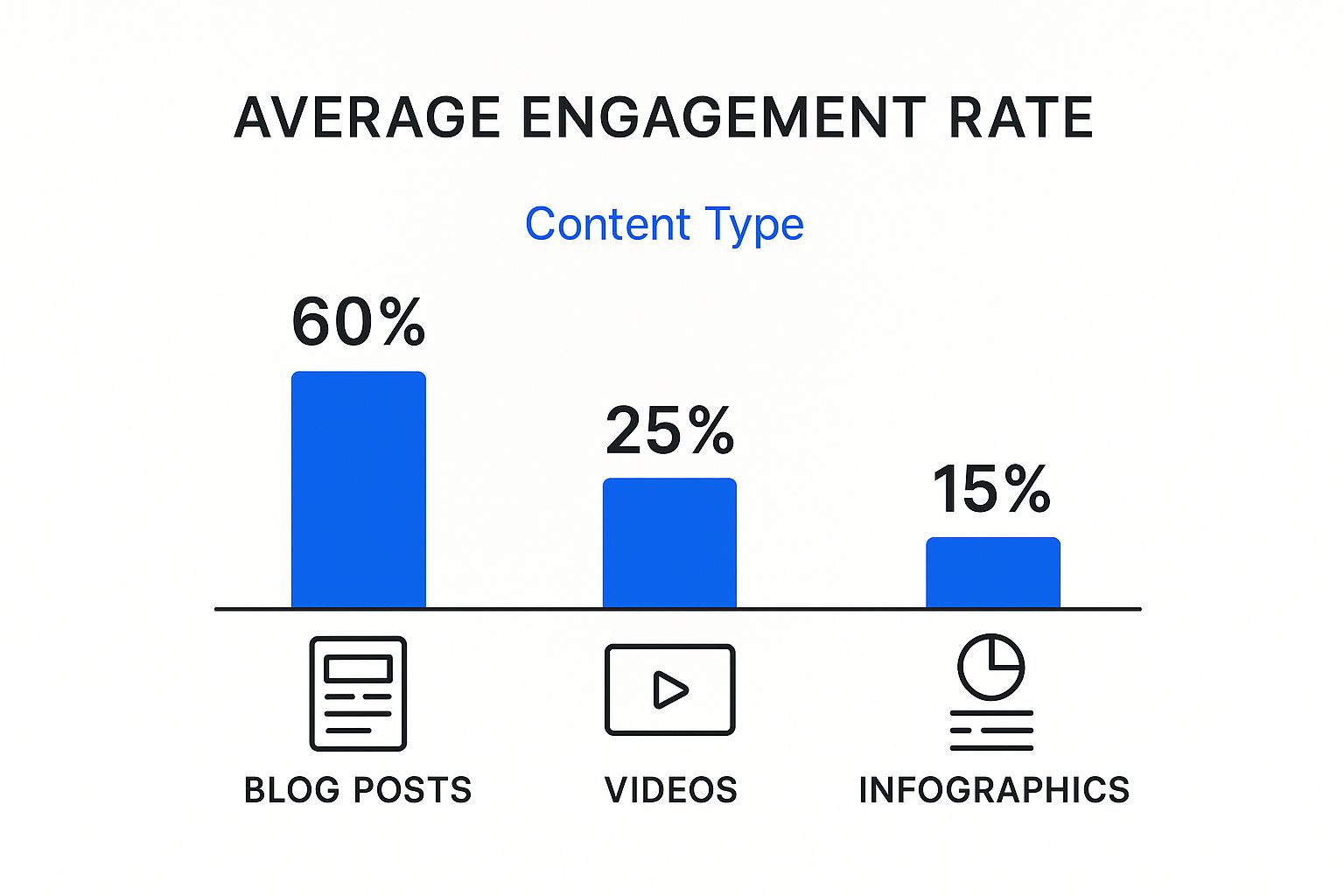
As the infographic demonstrates, blog posts typically have the highest engagement, followed by videos and then infographics. This underscores the importance of a diversified content strategy that prioritizes high-engagement formats. Many small business owners manage their own marketing; in fact, 47% handle it themselves, demonstrating a hands-on approach to online presence. Moreover, 58% of business owners use digital marketing strategies, highlighting the significance of digital channels for growth. You can find more insights on small business marketing statistics here.
Measuring Your Results
Regularly track and analyze your marketing performance using free or low-cost analytics tools to monitor website traffic, conversion rates, and social media engagement. This data provides valuable insights into what’s working and what needs adjusting, allowing you to optimize your online marketing strategy. By continually refining your approach based on this data, you ensure your marketing efforts drive tangible results.
To help guide your decision-making, see the table below comparing various marketing channels:
Small Business Marketing Channel Comparison
Comparison of different digital marketing channels by cost, effort required, and typical ROI for small businesses.
| Marketing Channel | Average Cost | Time Investment | Technical Difficulty | Typical ROI | Best For |
|---|---|---|---|---|---|
| Social Media Marketing | Low | Medium | Low | Medium | Brand building, community engagement |
| Email Marketing | Low | Medium | Low | High | Nurturing leads, driving sales |
| Search Engine Optimization (SEO) | Medium | High | Medium | High | Long-term organic growth |
| Pay-Per-Click (PPC) Advertising | Medium | Medium | Medium | Medium-High | Targeted advertising, quick results |
| Content Marketing | Medium | High | Medium | High | Establishing expertise, attracting organic traffic |
Key takeaways from this comparison include the relatively low cost and technical difficulty of social media and email marketing, balanced by the higher time investment required. Conversely, SEO and content marketing require greater time and technical skill but offer the potential for higher long-term ROI. PPC advertising offers a middle ground with moderate cost, time investment, and technical complexity, suitable for targeted campaigns and faster results. Choosing the right mix of channels depends on your specific business goals and resources.
Transforming Your Website into a 24/7 Sales Machine

Your website is more than just an online presence. It’s your most powerful sales tool, working 24/7 to attract and convert potential customers. This section explores how small businesses can optimize their websites to drive both visibility and conversions without needing a huge budget. We’ll cover practical SEO techniques, content strategies, and user experience improvements that translate directly to more leads and sales.
Optimizing Your Website for Search Engines (SEO)
Search Engine Optimization (SEO) is a core component of any small business online marketing strategy. It’s all about making your website easily discoverable by search engines like Google. For local businesses, local SEO is paramount. This means optimizing your site for location-based searches, like “Denver web design.”
One effective tactic is incorporating relevant keywords into your website content. But simply stuffing keywords won’t work. Focus on using keywords naturally within high-quality content that addresses your customer’s needs and pain points. For example, imagine you’re a bakery in Denver. Instead of repeating “Denver bakery,” create content around topics like “best birthday cakes in Denver” or “custom wedding cakes Denver.” This attracts customers actively looking for your services.
Creating Content That Converts
Your website content shouldn’t just attract visitors; it should convert them into customers. This means understanding your audience and crafting content that resonates with their needs.
For example, if you’re a web design studio, consider creating blog posts, case studies, or even videos showcasing your expertise and the value you provide. Content that addresses common customer questions and concerns builds trust and positions you as a reliable resource. This could be as simple as explaining the different types of web design services you offer or providing tips on how to improve website performance.
Enhancing User Experience for Better Conversions
A positive user experience (UX) is essential for turning website visitors into paying customers. A well-designed website is easy to navigate, visually appealing, and provides a seamless experience across all devices. This means ensuring your website is mobile-friendly, as more and more people browse on their smartphones.
Consider the placement of your call-to-actions (CTAs). These are prompts that encourage visitors to take a specific action, such as “Get a Free Quote” or “Book a Consultation.” Strategically placing CTAs can significantly impact conversion rates.
Furthermore, optimizing your website forms, making them short and easy to fill out, can encourage more leads. A long, complicated form can deter potential customers. These seemingly small UX adjustments can significantly improve your website’s ability to generate leads and sales, contributing to a more effective small business online marketing strategy.
The Power of Analytics
Tracking your website’s performance is vital to any small business online marketing strategy. Use analytics tools (many are free) to monitor key metrics like website traffic, bounce rate, and conversion rates. This data provides invaluable insights into what’s working and where you can improve. Analyzing this data allows you to refine your strategy and optimize your website for better performance, ultimately transforming your website into a true 24/7 sales machine. This consistent monitoring and adaptation is crucial for long-term success.
Content and Social Media Strategies That Actually Work
Creating engaging content and managing social media effectively are crucial for any small business’s online marketing strategy. Randomly posting and hoping for the best just won’t work. This section explores how successful small businesses develop sustainable approaches that drive real results. It’s about building a system for consistent content and audience engagement that contributes to meaningful growth.
Choosing the Right Social Media Platforms
Not all social media platforms are the same. It’s important to identify the platforms where your target audience spends their time. If you’re targeting businesses, LinkedIn might be your primary focus. For visual brands, Instagram or Pinterest could be more effective. Concentrating your efforts on the most relevant platforms maximizes reach and impact without overextending your resources.
Creating Engaging Content Efficiently
Time is valuable for small business owners. Repurposing existing content across multiple channels is a highly effective strategy. For example, a blog post can become social media updates, short videos, or even infographics. This maximizes your content’s reach and impact while saving time.
Building a Content Calendar
Consistency is key to successful social media marketing. A content calendar helps maintain a regular posting schedule and a consistent brand voice. It doesn’t need to be complex. A simple spreadsheet outlining planned posts for each platform can be a powerful tool. This will help you stay organized and maintain a steady flow of engaging content.
Encouraging Genuine User Engagement
Social media is about building relationships, not just broadcasting messages. Respond to comments, answer questions, and participate in relevant conversations. Encourage user-generated content through contests or by asking for feedback. This builds community around your brand and increases customer loyalty. Actively engaging with your audience transforms passive followers into active participants.
Measuring What Matters: Beyond Vanity Metrics
While likes and followers are nice, they don’t always translate into business results. Focus on metrics that directly impact your bottom line, such as website traffic, leads generated, and conversions. Use analytics tools to track these metrics and gain insights into what’s working and what needs adjustment. Many of these tools are free. This data-driven approach ensures your social media efforts contribute meaningfully to your overall online marketing strategy.
Maximizing ROI With Strategic Paid Advertising

For small businesses, squeezing the most out of every marketing dollar is paramount. Paid advertising, when approached strategically, can be a powerful growth driver, even when facing larger competitors with deeper pockets. This section explores practical ways to set up effective paid campaigns, optimize your budget, and develop creative strategies that deliver tangible results.
Targeting High-Intent Prospects
The cornerstone of any successful paid advertising campaign is precise targeting. Rather than adopting a broad approach, concentrate on reaching high-intent prospects. These are the individuals actively searching for products or services like yours.
This means understanding your ideal customer profile and utilizing the targeting features offered by various advertising platforms like Google Ads and Microsoft Advertising. These platforms enable you to target based on demographics, interests, online behavior, and even specific keywords. By concentrating your budget on those most likely to convert, you’ll maximize your ROI.
Budget Optimization for Maximum Exposure
Effective budget management is crucial for small businesses. Begin with a realistic budget and allocate it strategically across different platforms and campaigns. Experiment with various bidding strategies, such as cost-per-click (CPC) or cost-per-acquisition (CPA), to determine the most effective approach for your business.
Regularly monitor campaign performance and adjust your budget allocation based on what’s working. This adaptable approach ensures efficient spending and maximizes your advertising reach.
Creative Strategies That Drive Conversions
Eye-catching ad creatives are essential for grabbing attention and generating clicks. Your ads should clearly communicate your unique value proposition and motivate users to take action.
Experiment with different ad formats, including text ads, image ads, and video ads, to find what resonates with your audience. A/B testing different headlines, images, and calls to action can help optimize your click-through rates (CTR) and conversion rates. Consider the impact of your content on social media, a topic discussed further in this Social Media Essay.
Tracking, Analyzing, and Scaling For Success
Implementing robust conversion tracking is essential for evaluating the effectiveness of your paid advertising efforts. This enables you to pinpoint which campaigns are generating leads and sales, providing valuable data to inform your optimization decisions.
Regularly analyze performance data and use the insights gained to refine your targeting, bidding strategies, and ad creatives. Once you’ve identified successful campaigns, strategically scale them to reach a broader audience while maintaining a positive ROI.
Avoiding Common Pitfalls
Even with a well-defined small business online marketing strategy, paid advertising has its challenges. One common mistake is spreading your budget too thinly across numerous platforms. Instead, focus on the platforms where your target audience is most active. Another pitfall is neglecting ongoing optimization. Regularly analyze your campaign performance and adjust accordingly. Finally, avoid unrealistic expectations. Paid advertising takes time and experimentation to yield optimal results. Be patient, persistent, and consistently analyze your data to optimize your campaigns over time.
To help you get started, let’s look at some key statistics for popular paid advertising platforms:
The following table provides insights into small business adoption rates, average costs, and effectiveness metrics for various paid advertising platforms. This information can assist in making informed decisions about where to allocate your advertising budget.
Small Business Paid Advertising Platforms Statistics
| Advertising Platform | SMB Adoption Rate | Average Cost Per Click | Average Conversion Rate | Recommended Starting Budget |
|---|---|---|---|---|
| Google Ads | High | Varies widely by industry | 2-5% (average) | $500 – $1000 per month |
| Microsoft Advertising | Medium | Generally lower than Google Ads | 2-3% (average) | $250 – $500 per month |
| Social Media Advertising (Facebook/Instagram) | High | Varies widely by industry and targeting | 1-2% (average) | $250 – $500 per month |
This data offers a general overview. Actual results can vary significantly based on industry, targeting, and campaign quality. It’s crucial to continuously monitor and adjust your campaigns based on your specific performance data.
This proactive, data-driven approach to paid advertising ensures your resources are used effectively, driving growth and contributing significantly to your overall small business online marketing strategy.
Building Customer Relationships That Last
Acquiring new customers can be a significant investment for any business. For small businesses especially, nurturing existing customer relationships is a cornerstone of a smart online marketing strategy. It’s much more cost-effective to retain current customers than to constantly seek new ones. This section explores practical ways to build lasting customer connections, transforming one-time buyers into loyal advocates for your brand.
The Power of Email Marketing
Email marketing remains a powerful tool for small businesses. You don’t need to be an expert to create effective email campaigns. Begin by organically building an email list. Offer valuable content, such as free guides or exclusive discounts, in exchange for email addresses.
Segment your list to personalize your messaging. For example, a Denver web design studio could segment its list by industry or service needed. This allows for targeted email campaigns that speak directly to specific customer needs, increasing engagement and driving conversions.
Automating Personalized Experiences
Marketing automation can save small businesses valuable time and resources. Automated email sequences are a prime example. Welcome new subscribers with a series of emails introducing your services and offering helpful information.
Another valuable application is sending personalized product recommendations based on past purchases. This thoughtful personalization enhances the customer experience and encourages repeat business, all while operating automatically. This frees up your time to focus on other essential aspects of your small business online marketing strategy.
Loyalty Programs and Referral Incentives
Loyalty programs reward repeat customers, strengthening relationships and increasing customer lifetime value. These programs don’t have to be complex. A simple points-based system with rewards for purchases or referrals can be extremely effective.
Referral incentives are another excellent way to encourage existing customers to bring in new business. Offer discounts or other perks for successful referrals. This taps into the power of word-of-mouth marketing, organically expanding your reach through trusted recommendations.
Following Up For Lasting Impact
A simple follow-up can have a significant impact. After a purchase, send a thank you email or a personalized message. Check in with customers to see if they have questions or require any assistance.
These small gestures demonstrate to customers that you appreciate their business and are invested in their success. This builds trust and reinforces the customer relationship, encouraging repeat business and turning satisfied customers into enthusiastic brand advocates. This proactive approach is an essential element of a successful small business online marketing strategy.
Measuring What Matters and Scaling What Works
After launching your small business online marketing strategy, how do you gauge its effectiveness and identify areas for improvement? It’s not about superficial metrics like likes or follower counts. It’s about pinpointing and monitoring the measurements that directly impact your bottom line. This section explores how successful small businesses leverage analytics to make data-driven decisions, continually improve, and amplify their winning strategies.
Utilizing Affordable Analytics Tools
Gaining valuable insights doesn’t require expensive software. Free tools like Google Analytics and social media platform analytics offer a wealth of information on website traffic, audience demographics, and content performance. Google Analytics, for instance, reveals your most popular pages, visitor duration, and traffic sources. This data helps you understand what content resonates with your audience and pinpoint areas for improvement.
Establishing Realistic Benchmarks
Comparing your performance to industry averages and competitors helps you set realistic goals and understand your market position. Remember, each business is unique. Your benchmarks should reflect your specific industry, business size, and target audience. A small bakery in Denver shouldn’t compare its website traffic to a national chain. Comparing their performance to other local bakeries offers a more relevant benchmark.
Creating Actionable Reports
Raw data is useless without informing decisions. Transform data into actionable insights with reports that focus on key metrics. Don’t just track website traffic; analyze the sources driving the most valuable traffic. Don’t simply monitor social media engagement; identify posts leading to conversions. This analysis allows you to prioritize activities with the highest return.
Frameworks for Continuous Improvement
Even with a well-defined small business online marketing strategy, continuous improvement is crucial. Regularly review your analytics, identify areas for optimization, and implement changes. It’s like perfecting a recipe. You start with a basic recipe and continually refine it until you achieve the perfect flavor. Similarly, continually refine your marketing strategy to achieve optimal results. This iterative process is fundamental to long-term success.
Identifying High-ROI Tactics
Not all marketing tactics are created equal. Some deliver a higher return on investment (ROI) than others. Analyze your data to identify tactics generating the most leads, sales, and customer engagement. Perhaps your email marketing campaigns outperform your social media efforts. This insight allows you to allocate resources to the most effective strategies, maximizing your overall ROI.
Scaling What Works
As your business grows, so should your marketing efforts. Identify your most successful strategies and explore ways to scale them. If your blog posts attract significant organic traffic, consider increasing content production. If paid advertising campaigns generate strong leads, gradually increase your budget. Scale strategically, ensuring a positive ROI as you expand. This controlled growth is crucial for sustainable success.
Ready to boost your digital marketing efforts? Check out our guides on email marketing for small businesses, marketing automation, and the differences between traditional vs digital marketing. You’ll also want to read about improving social media engagement and managing social media for small businesses.
Building a strong online presence takes time and effort. By consistently measuring what matters, analyzing the data, and adapting your approach, you can build a small business online marketing strategy that drives growth and achieves long-term success. Contact Denver Web Design Studio today for a free consultation. We’ll help you craft a custom online marketing strategy to drive growth and position your business for success. Learn more about how we can help.