How to Optimize Google My Business for Maximum Results
Knowing how to optimize Google My Business is essential for standing out in local search results and earning customer trust. Optimization goes beyond filling in basic details—it involves strategic updates, compelling visuals, timely responses to reviews, and posting regular updates. By taking full advantage of each feature within your Google Business Profile, you not only increase your visibility but also improve your chances of turning searchers into loyal customers. Whether you run a local café, dental clinic, or home service business, mastering GMB optimization can directly influence your bottom line.
Why Google My Business Mastery Matters Now
Your Google Business Profile (GBP) is a powerful, yet often underutilized tool. It’s the foundation of local business discovery, connecting you with potential customers searching for services like yours. Businesses actively optimizing their GBP often see a direct correlation between their efforts and increased revenue. But why is this free platform so vital today?
The rise of mobile and “near me” searches has made GBP indispensable. Consider your own habits – how often do you search on your phone for a nearby restaurant, coffee shop, or plumber? This behavior is booming, with “near me” searches growing by over 200% in just two years. Local businesses must be visible where their customers are searching.
Moreover, a Google Business Profile is more than just a listing; it’s a crucial driver of customer engagement. Surprisingly, as of early 2025, only 44% of local businesses have claimed their Google Business listings. This presents a significant opportunity for businesses that prioritize GBP optimization. Claiming and updating profiles with accurate information, including hours, photos, categories, and reviews, can significantly boost online visibility, foot traffic, and ultimately, revenue. There are approximately 1 billion monthly “near me” searches in the U.S. alone, and 72% of local searchers visit a business within five miles of their location. Find more detailed statistics here: Learn more about Google My Business statistics.
The Real Impact of a Well-Optimized GBP
Optimizing your GBP isn’t just about appearing in search results; it’s about converting searches into customers. A well-optimized profile acts as a digital storefront, giving potential customers the information they need to choose your business. This includes details like business hours, contact information, photos, and customer reviews.
Imagine searching for a “bakery near me” and finding two options. One has blurry photos, outdated hours, and no reviews. The other showcases professional photos of enticing pastries, updated hours, special offers, and numerous positive reviews. Which are you more likely to choose?
Avoiding Common GBP Mistakes
Many businesses make the mistake of creating a GBP listing and then neglecting it. This can have costly consequences. Inaccurate or incomplete information can confuse customers, harm your online reputation, and even lead to lost sales. For instance, incorrect business hours can lead to frustrated customers arriving at a closed business, creating a negative first impression.
Furthermore, failing to respond to customer reviews can signal a lack of engagement and damage your credibility. Responding to both positive and negative reviews shows that you value feedback and strive to provide excellent service. Actively managing your online presence is crucial for building trust and attracting new customers.
Setting Up Your Profile for Immediate Impact

Optimizing your Google My Business (GBP) profile involves more than just filling in the required fields. It’s about strategically transforming your listing into a powerful tool for generating leads. This begins with a smooth verification process, which can sometimes seem complicated. However, the right approach makes it straightforward, laying the foundation for a successful GBP strategy.
Verification: The First Step to Success
The verification process confirms you are the business owner and allows you to manage its online presence. Google uses several verification methods, each with its own advantages and disadvantages.
Postcard verification is the standard method for most businesses. Google mails a postcard containing a unique verification code to your business address. Though reliable, this can take several days.
For businesses requiring faster verification, options like phone or email verification might be available, depending on the business category.
For service-area businesses without a physical address, verification differs. Google provides specific instructions, often involving video verification or documentation. Multi-location businesses also have a streamlined process for verifying multiple locations at once. Understanding the best verification method for your business type is crucial for a smooth and efficient setup. This lets you quickly optimize your profile for maximum impact.
Essential Elements for Ranking High
Google uses several factors to rank GBP profiles in local search results. Prioritizing the most impactful elements helps achieve quick wins.
- Accurate Business Information: Your NAP (Name, Address, and Phone number) must be consistent across all online platforms. This ensures accuracy and builds trust with Google and customers.
- Relevant Categories: Choosing the right categories is essential for showing up in relevant searches. Focus on what your business does, not just what it is. Being too broad can lessen your relevance.
- Compelling Business Description: Your description should highlight your unique value proposition and use relevant keywords.
Supplementary Fields That Make a Difference
Beyond the essentials, supplementary fields can distinguish your business from the competition.
- Attributes: These are specific features, like “outdoor seating” or “wheelchair accessible,” that help customers understand what you offer.
- Photos and Videos: Visual content enhances your profile’s appeal and encourages customer engagement. High-quality images of your products, services, and location create a strong impression.
- Products and Services: Listing specific products and services allows potential customers to easily see your offerings on your GBP profile.
The following table summarizes these key elements:
GBP Setup Checklist: Essential vs. Optional Fields
This table will show which profile fields are critical for ranking and which provide supplementary benefits
| Profile Element | Impact Level | Optimization Tips |
|---|---|---|
| Business Name, Address, Phone Number (NAP) | Essential | Ensure consistency across all platforms |
| Categories | Essential | Choose specific, relevant categories |
| Business Description | Essential | Highlight your unique value proposition and target keywords |
| Attributes | Supplementary | Select relevant attributes that showcase your business features |
| Photos and Videos | Supplementary | Use high-quality visuals to showcase your offerings |
| Products and Services | Supplementary | List specific products and services with descriptions and pricing (if applicable) |
By focusing on these elements, you can create a compelling GBP profile that attracts customers and helps your business grow. This strong base allows you to implement more advanced optimization strategies, maximizing the power of your Google My Business profile.
Crafting Business Information That Converts
The difference between simply showing up in Google search results and actually turning potential customers into paying clients often depends on the quality of your Google My Business (GMB) profile. This section explores how to optimize your core business details to transform views into valuable leads and customers.
Category Selection: A Critical First Step
Choosing the right primary and secondary categories is essential for optimizing your GMB profile. Your primary category should accurately reflect your core business offering. Think of it as the main label Google uses to understand your business’s purpose. For example, if you own a bakery specializing in custom cakes, your primary category should be “Bakery.”
Secondary categories allow you to refine your business type and target specific searches, such as “Cake Shop” or “Wedding Cake Baker.” Selecting overly broad or irrelevant categories can decrease your visibility in relevant searches.
NAP Consistency: Building Trust and Visibility
Maintaining consistent Name, Address, and Phone Number (NAP) information across all online platforms is crucial. This consistency builds trust with both Google and potential customers. Inconsistent NAP information can confuse search engines and customers, potentially leading to missed opportunities.
Think of it like giving directions – if the address is wrong, no one will arrive. Similarly, if your NAP information is inconsistent, customers might have trouble finding your business online or offline. This fundamental aspect of GMB optimization is often overlooked.
Attributes and Special Hours: Capturing Customer Attention
Attributes are detailed features that provide additional context about your business. They can highlight amenities like “outdoor seating,” “wheelchair accessible,” or “accepts credit cards.” These details can significantly influence customer decisions.
For instance, a parent searching for a family-friendly restaurant might specifically look for attributes like “high chairs available” or “kid-friendly menu.” Using special hours for holidays or seasonal promotions allows you to capitalize on specific opportunities. A well-timed promotion advertised through special hours on your GMB can attract customers actively seeking those services.
Optimized GMB profiles are a vital connection between online discovery and offline action for local businesses. An optimized GMB can generate between 80 and 300 clicks per month, meaning local businesses have the potential to be discovered and contacted by dozens or even hundreds of potential customers. Over 60% of consumers use the phone number listed in GMB to contact a business. Find more detailed statistics here: Explore this topic further.
Service Details and Customer Perception
Clearly outlining your service offerings on your GMB profile provides essential information to potential customers. Think of your profile as a digital storefront – you want to clearly display what you offer. This includes details about the specific services you provide, service areas, and any relevant pricing information.
This transparency builds trust and sets clear expectations, increasing the likelihood of conversions. Highlighting unique services or specializations can differentiate you from competitors, attracting customers seeking those specific offerings. By carefully crafting your business information, you can effectively convert profile views into engaged customers. This creates a strong foundation for implementing other optimization strategies, maximizing your online presence, and achieving sustainable business growth.
Visual Storytelling That Captures Attention
Images on your Google My Business profile are more than just pretty pictures. They’re powerful tools that can significantly impact how customers interact with your business and ultimately drive sales. This section explores how successful businesses use visual strategies to shine in local search results, and how you can apply these techniques to improve your own Google My Business listing.
Image Types and Customer Engagement
Different types of images connect with customers in different ways. Studies show that high-quality images of your products or services in action tend to perform very well. For example, a restaurant might post mouth-watering photos of their signature dishes or a picture of their lively dining room. A retail store could showcase new arrivals or attractive product displays.
Showing images of your team members can also add a personal touch and build trust. This helps potential customers connect with the people behind the business, fostering a more personal connection. Behind-the-scenes photos of your workspace or operations can also boost transparency and build customer confidence.
Practical Tips for Creating Compelling Visuals
Creating visually appealing content for your Google My Business profile doesn’t require a huge budget. Start with high-resolution images that are correctly sized and optimized for online viewing. Google provides recommended image specifications for the best presentation.
It’s also important to post regularly to keep your content fresh and engaging. Regularly updated images show an active and thriving business. This is key for attracting and keeping customers. When you post images, use descriptive captions and relevant keywords to improve your search visibility.

Advanced Visual Tactics: Virtual Tours and Video Integration
Virtual tours offer an immersive experience, allowing potential customers to virtually explore your business. This is especially helpful for businesses with physical locations like restaurants, retail stores, or hotels. A virtual tour can give a realistic preview of what customers can expect, encouraging them to visit in person.
Adding video content to your Google My Business profile can also make a big difference. Videos are a dynamic way to showcase your products, services, and brand personality. They can explain complex ideas, feature customer testimonials, and offer a look behind the scenes. These engaging formats tend to keep viewers watching longer and encourage more interaction.
Think about showcasing what makes your business special through visuals. For instance, if you pride yourself on excellent customer service, show images of happy customers interacting with your team. If you use high-quality ingredients, post detailed photos of your products that highlight their freshness and appeal.
By focusing on visual storytelling and using these advanced tactics, you can improve your Google My Business profile, attract new customers, and stand out from the competition. This will not only boost your visibility but also drive sales and contribute to your overall business success. Remember that optimizing your Google My Business profile is an ongoing process. Keep experimenting with different image types, posting schedules, and visual approaches to see what works best for your target audience and gets the most customer engagement.
Mastering the Review Ecosystem
Reviews are today’s word-of-mouth, impacting far more than just your star rating. They influence customer trust, search engine rankings, and your bottom line. This section offers a framework for shifting your review strategy from reactive to proactive, optimizing your Google My Business (GMB) profile to attract positive feedback and address negative reviews effectively.
Building a Foundation of Authentic Reviews
Earning positive reviews isn’t about tricks; it’s about providing excellent service and making it easy for satisfied customers to share their experiences. Identify key touchpoints in the customer journey where requesting a review feels natural. This could be after a purchase, project completion, or a positive interaction with your team.
When asking for reviews, be genuine and specific. Instead of a generic “Please leave us a review,” try something like, “We’re so glad you enjoyed your experience! Sharing your feedback on Google would help others discover our bakery.” Generating positive Google reviews is vital. Learn practical tips for getting more Google reviews for your business.
Customer behavior emphasizes the importance of GMB optimization for building trust. 97% of consumers research local businesses online, with 32% relying on a business’s GMB profile. Keeping your profile updated boosts rankings and conversion rates, leading to more potential sales. Further, 78% of smartphone users who search locally visit a business within 24 hours. Discover more insights about Google My Business statistics.
Responding to Reviews: Turning Feedback into Opportunities
Every review, positive or negative, is a chance to engage with your customers and build trust. Respond promptly and professionally to all reviews, showing you value customer feedback.
For positive reviews, express gratitude and personalize your response. A simple “Thank you for your kind words, [customer name]! We’re thrilled you enjoyed [specific product/service]” is effective.
Negative reviews require a different approach. Acknowledge the issue, apologize sincerely, and offer a solution or follow-up. Taking the conversation offline shows commitment to resolving the problem. For example: “We appreciate your feedback, [customer name]. We’re sorry about your experience with [issue]. Please contact us at [phone number/email] so we can make things right.”
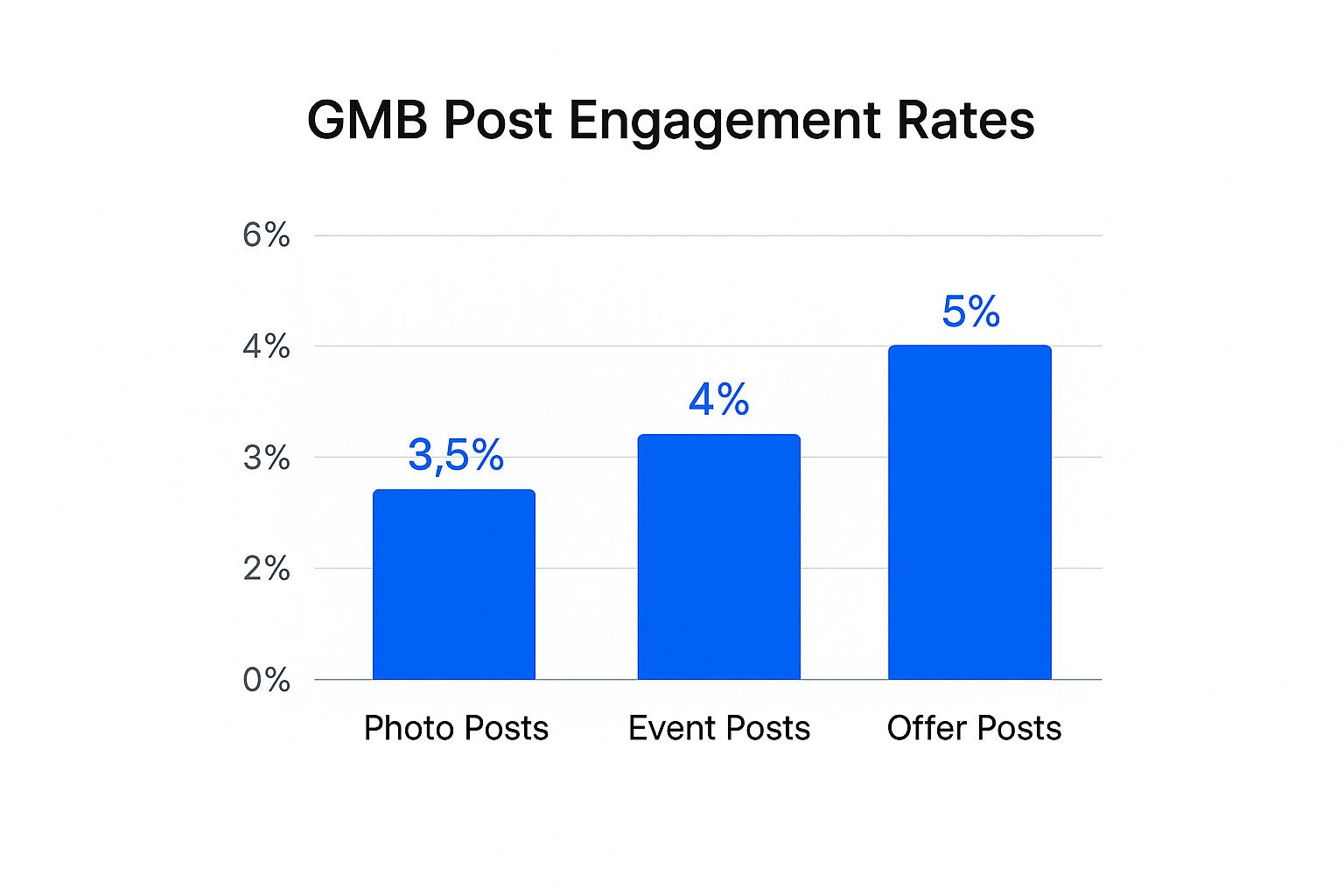
The infographic above shows GMB post engagement rates. Offer Posts receive the highest engagement at 5%, followed by Event Posts at 4%, and Photo Posts at 3.5%. This suggests that using offers and events in your GMB strategy can boost customer interaction.
The following table provides a framework for responding to reviews based on sentiment. It outlines strategies, response time goals, and key elements to include in your responses.
| Review Type | Response Strategy | Response Time Goal | Key Elements to Include |
|---|---|---|---|
| Positive | Express gratitude, personalize response | Within 24-48 hours | Thank you, customer name, specific product/service mentioned |
| Negative | Acknowledge issue, apologize, offer solution/follow-up | Within 24 hours | Apology, empathy, contact information for direct resolution |
| Neutral | Acknowledge feedback, offer additional information if relevant | Within 48 hours | Thank you, offer to answer questions, relevant information |
This table helps businesses develop a consistent and effective approach to review management. By tailoring responses to the specific sentiment expressed in each review, businesses can maximize the positive impact of customer feedback.
Monitoring and Managing Your Review Ecosystem
Actively monitoring your reviews is crucial. Use Google Alerts or review management tools to stay informed. Address inappropriate content, like spam, by flagging it to Google. Analyzing competitor reviews offers insights into their strengths and weaknesses, revealing opportunities for you to improve. Mastering the review ecosystem transforms customer feedback into a powerful engine for growth, building a strong online reputation that attracts new customers and fosters loyalty.
Creating Posts That Drive Engagement
Your Google Business Profile (GBP) is more than a simple online listing; it’s a powerful tool for connecting with your customers. Many businesses underutilize the posting features, missing out on a prime opportunity to boost engagement and drive traffic. This section explains how to strategically use different post types for maximum impact.
Understanding GBP Post Types and Their Uses
GBP provides a variety of post types, each with a distinct purpose:
- What’s New: Use this for general updates, announcements about new products, or company news. It’s your everyday communication channel.
- Events: Promote upcoming events, workshops, or special occasions. Be sure to include dates, times, and links for registration or ticket purchases.
- Offers: Entice customers with limited-time discounts, promotions, and special deals. Emphasize the value and create a sense of urgency.
- Products: Showcase individual products or services directly on your profile. Include detailed descriptions, pricing, and appealing images.
Think about using a “What’s New” post to announce a new seasonal item at your restaurant, an “Event” post for a weekend workshop at your art studio, and an “Offer” post to provide a discount for first-time customers. This varied approach will keep your profile fresh and engaging.
Crafting Compelling Content and Calls to Action
Effective GBP posts need both engaging content and clear calls to action. Keep your message concise and to the point, emphasizing key details that resonate with your audience. Use high-quality images or videos to grab attention and make your posts visually appealing. A captivating photo of a new product or a short video demonstrating a service can be significantly more effective than text alone.

A strong call to action tells customers exactly what you want them to do. Use action-oriented language, such as “Learn More,” “Book Now,” “Shop Now,” or “Call Today.” This directs customers towards the desired action, boosting conversions and driving business.
Developing a Sustainable GBP Content Calendar
A regular posting schedule keeps your profile active and visible to customers. Create a content calendar specifically for your GBP posts, making sure it aligns with your overall marketing strategy. You could plan to post a “What’s New” update twice a week, an “Offer” once a month, and “Event” posts whenever necessary. This organized approach guarantees a consistent flow of new content.
Track your post performance metrics to see what resonates with your audience. Analyze metrics like views, clicks, and actions taken to understand which post types and topics perform best. This data-driven approach helps you refine your strategy over time and maximize engagement, leading to better results from your GBP.
Measuring Success and Staying Ahead of Competitors
Optimizing your Google My Business profile is a continuous journey. To truly unlock its full potential, you need to understand how to gauge your success and outperform your competition. This section explores using data-driven insights to refine your strategy and achieve local search dominance.
Decoding Google Business Profile Insights
Google Business Profile Insights offers invaluable data on how customers discover and interact with your listing. These insights reveal the search terms used to find your business, the actions customers take on your profile (such as calls, website visits, or direction requests), and your profile’s performance against competitors. Understanding these metrics is the first step toward informed optimization.
For example, if you see many searches for “gluten-free bakery” but don’t offer gluten-free items, this highlights a market opportunity. You might consider expanding your menu to meet this demand. Similarly, a high number of direction requests indicates that potential customers actively use your location information.
Tracking Conversions: Connecting GBP Activity to Real-World Results
While GBP Insights provide helpful information, connecting your GBP activity to tangible business outcomes is crucial. Implement robust tracking mechanisms, such as UTM parameters in your website URLs, to measure how GBP contributes to your conversions. This will clarify the return on investment (ROI) of your optimization efforts.
Adding UTM parameters to links on your GBP profile allows you to monitor traffic from your GBP to specific website pages. This reveals how many leads or sales are generated directly from your Google Business Profile, quantifying its effectiveness.
Competitive Analysis: Uncovering Opportunities in Your Market
Analyzing your competitors’ GBP profiles is essential for staying ahead. This helps you identify their strengths and weaknesses, and spot any gaps in their marketing strategies. Pay attention to their targeted keywords, the content they share, and the reviews they receive.
For instance, if a competitor receives numerous positive reviews about excellent customer service, you can pinpoint areas to improve your own customer service and differentiate your business. To boost engagement further, explore strategies for creating engaging social media content.
Leveraging Q&A and Messaging: Building a Customer-Centric Approach
The Q&A and messaging features within Google My Business offer extra ways to connect with your customers and cultivate relationships. Actively manage the Q&A section, providing prompt and accurate answers. This demonstrates engagement and helps potential customers find the information they seek.
Responding quickly to messages shows that you value customer communication and are ready to assist. It allows you to offer personalized support, answer questions, and address concerns immediately. This responsiveness can be a significant advantage in competitive markets.
Troubleshooting and Long-Term Optimization
Optimizing your Google My Business profile is not a one-time task; it demands ongoing maintenance and adjustments. Regularly review your GBP insights, track your conversions, and adapt your strategy based on the data.
By staying informed about platform updates and incorporating these changes into your ongoing approach, you can maintain a robust online presence and consistently outperform competitors. This proactive approach will help you attract more customers and achieve your business goals.
Want to take your online presence even further? Check out our in-depth guide: Master the Web Development Process: Proven Strategies for Success. It’s the perfect next step after optimizing your Google Business Profile.
Ready to elevate your online presence and drive business growth? Denver Web Design Studio specializes in crafting high-performing websites and effective digital marketing strategies, including Google My Business optimization. Contact us today to discover how we can help you succeed.