Beyond the Basics: What Content Marketing ROI Really Means Today
Measuring the success of your content marketing isn’t just about counting page views. While page views offer a glimpse into audience engagement, they don’t tell the whole story. Truly understanding content marketing ROI means looking beyond these vanity metrics and digging deeper into the real impact content has on your business. It’s about connecting your content directly to tangible results.
Instead of simply tracking how many people read a blog post, savvy marketers are now focusing on how that post contributes to lead generation, sales conversions, and ultimately, revenue growth. This requires a more holistic approach, considering the entire customer journey from initial contact to final sale.
Redefining ROI: From Vanity Metrics to Business Impact
This new perspective on ROI means analyzing metrics like customer lifetime value, lead quality, and brand awareness. While these metrics might not be as easily quantifiable as clicks or shares, they offer a far more accurate picture of your content’s true value.
Understanding content marketing ROI also requires aligning your content strategy with specific business objectives. Ask yourself: what are you trying to achieve with your content? Are you aiming to increase brand awareness, drive sales, or build customer loyalty?
Your content marketing ROI should be measured against these specific goals. This involves establishing clear key performance indicators (KPIs) that directly reflect the business outcomes you’re striving for. For example, if your goal is lead generation, a relevant KPI might be the number of qualified leads generated through your content.
The Long-Term Value of Content: Building Assets, Not Just Campaigns
Content marketing ROI isn’t just about immediate gains; it’s also about building long-term assets. High-quality content can continue to generate leads, drive traffic, and build brand authority long after its initial publication.
Think of it like investing in real estate. A well-crafted piece of content is like a property that appreciates in value over time. This contrasts sharply with traditional advertising campaigns, which often provide only a short-term boost in visibility.
Content marketing has seen impressive growth, with industry revenue projected to reach approximately $107 billion by 2026. This growth highlights the increasing adoption of content marketing strategies worldwide, driven by its effectiveness in lead generation, brand engagement, and sales conversion. For more detailed statistics, check out this resource: Learn more about content marketing ROI. Understanding content marketing ROI means adopting a long-term perspective and recognizing the lasting value of building a library of evergreen content.
The Metrics That Actually Matter for Content Marketing ROI
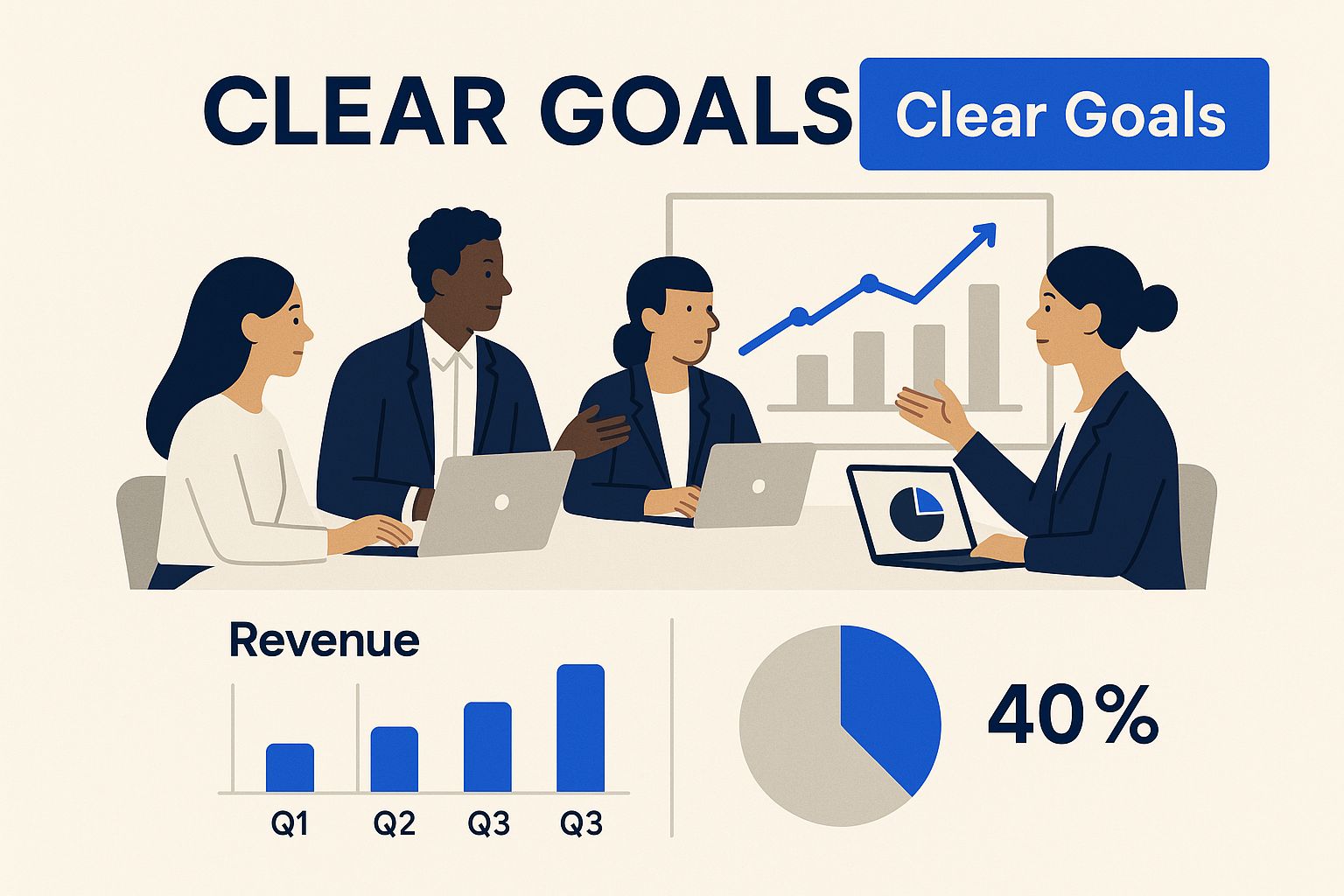
The infographic above shows a team discussing content strategy. It emphasizes the importance of Clear Goals for measuring ROI. This highlights the need to connect your content efforts with specific business objectives for effective tracking. This means looking beyond superficial metrics like page views. Instead, concentrate on indicators that have a direct impact on your bottom line.
Beyond Vanity Metrics: Measuring What Matters
Metrics like social media shares and website traffic can offer some insights. However, they don’t always translate into business success. For example, a blog post with thousands of shares but no leads isn’t helping revenue growth. This is where focusing on key marketing performance indicators becomes essential.
Understanding content marketing ROI requires tracking the right metrics. Think about how your content influences the entire customer journey. Consider the impact from the first moment a customer becomes aware of your brand all the way through to becoming a loyal advocate.
Connecting Content to Revenue Outcomes
To effectively measure content marketing ROI, link your content directly to revenue generation. This involves using attribution models to track content’s impact throughout the sales funnel.
For example, you could analyze how a whitepaper influenced leads. Specifically, track how many of those leads eventually became paying customers. Understanding the long-term value of content is crucial for evaluating ROI. Content should be seen as a valuable asset.
Around 54% of marketers actively measure their content marketing ROI. This shows a growing focus on accountability for marketing investments. This emphasis on ROI helps businesses optimize their content strategies. The goal is to achieve maximum returns. Learn more about content marketing ROI trends here. This signifies the increasing importance of data-driven decisions in content marketing.
Establishing Meaningful Benchmarks
Comparing your content marketing ROI to industry averages can be useful. However, establish benchmarks relevant to your specific business. Consider your industry, business model, and the types of content you create.
For instance, a B2B software company might have different ROI expectations than an e-commerce retailer. Both need to focus on metrics reflecting their unique goals. This targeted approach makes your ROI measurements accurate and useful.
To help understand the various metrics, take a look at the table below:
Essential Content Marketing ROI Metrics Comparison
This table compares different types of content marketing metrics. It looks at their connection to ROI, tracking difficulty, business impact, and recommended tracking frequency.
| Metric Type | ROI Connection | Tracking Difficulty | Business Impact | Recommended Tracking Frequency |
|---|---|---|---|---|
| Lead Generation | Direct – Measures new leads generated from content | Easy | High – Impacts sales pipeline | Weekly/Monthly |
| Sales Conversions | Direct – Measures sales generated from content leads | Easy | High – Impacts revenue directly | Weekly/Monthly |
| Website Traffic | Indirect – Indicates content reach and engagement | Easy | Medium – Contributes to brand awareness and lead generation | Weekly |
| Social Media Engagement | Indirect – Measures audience interaction with content | Easy | Medium – Improves brand visibility and reach | Weekly |
| Customer Lifetime Value (CLTV) | Indirect – Reflects the long-term value generated from content-acquired customers | Medium | High – Impacts long-term profitability | Quarterly/Annually |
| Content Downloads | Direct – Tracks downloads of gated content like ebooks and whitepapers | Easy | Medium – Indicates lead qualification and interest | Weekly/Monthly |
Key insights from this comparison highlight the importance of focusing on direct ROI metrics like lead generation and sales conversions, while also monitoring indirect metrics like website traffic and social media engagement to understand overall content performance. Regular tracking, as suggested in the table, is essential for ongoing optimization and improvement of your content marketing strategy.
High-ROI Content Formats: Where To Invest Your Resources

Not all content delivers the same results. Some formats consistently outperform others. This isn’t about chasing trends. It’s about understanding what works well across different industries and buyer journeys. Analyzing performance data is key to smart decision-making. Let’s explore some of the most effective content formats for maximizing your content marketing ROI.
The Power of Visuals: Video and Infographics
Visual content grabs attention. Videos, for example, are a powerful tool in content marketing. They excel at engaging viewers and sharing information effectively. Infographics present complex data and insights in a concise, visually appealing way. This makes them perfect for social media and attracting backlinks.
Visuals, especially videos, play a crucial role in engaging audiences. 59% of marketers use video in their content strategy. Visual content is 43% more persuasive than text alone. Find more detailed statistics here. This highlights how important visual content is for engagement and influencing audience behavior.
Evergreen Content: Blog Posts and Case Studies
Blog posts are a versatile way to share valuable information, establish thought leadership, and drive organic traffic through search engine optimization (SEO). Case studies offer real-world examples of your product or service in action. This provides compelling evidence of their value and effectiveness. These formats offer long-term value and can generate leads long after they are published.
Interactive Content: Quizzes and Calculators
Interactive content, like quizzes and calculators, engages audiences more deeply. A quiz can help potential customers identify their needs and guide them to the right product or service. A calculator can offer personalized estimates, addressing specific customer concerns and empowering them to make informed decisions.
Gated Content: Ebooks and White Papers
Gated content, such as ebooks and white papers, provides in-depth insights and valuable resources in exchange for contact information. This is a powerful way to generate leads and nurture relationships. These valuable resources demonstrate expertise and position your brand as a trusted source of information. By offering in-depth knowledge, you build trust and credibility, making audiences more likely to engage with your brand.
Choosing the Right Mix: Tailoring Content To Your Audience
These high-ROI formats provide a solid foundation. However, maximizing your ROI depends on understanding your target audience. Consider their preferences, needs, and pain points. Then, tailor your content strategy accordingly. You might create a mix of videos, blog posts, and interactive tools, each catering to a different audience segment or stage of the buyer’s journey. Experiment to find what resonates and drives the highest return. This strategic approach allows you to fine-tune your content marketing and achieve the best possible results.
Building Your ROI-Driven Content Strategy Framework

Turning content marketing from an expense into a source of revenue requires a solid framework. This ensures that every piece of content you create contributes to measurable business results. It’s about focusing on return from the very start. This section will cover the essential parts of building such a framework.
Aligning Content Initiatives With Business Objectives
The key to an ROI-driven content strategy is alignment. Your content initiatives should directly support specific business goals.
For example, if your goal is to raise brand awareness, your content should focus on building thought leadership and reaching more people. But, if your goal is lead generation, your content should focus on gathering contact information and nurturing potential customers.
This focused approach ensures that your content marketing efforts are not wasted. Every piece of content has a purpose and contributes to a larger business goal, ensuring tangible results.
Advanced Audience Segmentation and Competitive Analysis
Truly understanding your target audience is critical. This goes deeper than simple demographics. Advanced audience segmentation allows you to create highly targeted, resonant content for specific customer groups, ultimately improving engagement and conversions.
Analyzing your competitors’ content is also valuable. By identifying content gaps and opportunities, you can differentiate your brand and position your content more strategically. This involves researching what your competitors are doing well, and where they might be missing the mark.
Integrating content marketing into business strategies is almost universal, with 82% of companies using it to engage audiences and generate leads. More detailed statistics are available here. This high adoption rate underscores the importance of a strategic approach.
Performance-Based Topic Selection and Workflow Optimization
Choosing the right topics is essential for content marketing ROI. Data-driven topic selection, informed by keyword research and audience interest, ensures your content is both relevant and engaging. This maximizes its potential to attract and convert leads.
Streamlining your content workflow is also key. This involves establishing clear processes for content creation, editing, and publishing, ensuring quality content and efficient use of resources. A streamlined workflow optimizes your resources and frees up time for more strategic initiatives.
Continuous Refinement Based on Performance Data
An effective content strategy is dynamic, not static. Regularly monitoring and analyzing performance data is vital. This lets you see what’s working, what’s not, and adapt your strategy.
This iterative approach, constantly refining based on data, greatly increases your chances of reaching your content marketing goals. It’s significantly more effective than a static approach, which quickly becomes outdated. Reviewing your content’s performance and making adjustments is crucial for long-term success.
Distribution Strategies That Amplify Your Content Marketing ROI
Effective content distribution is key to maximizing your content marketing ROI. Even the highest quality content won’t perform well if it isn’t seen by the right people. This section explores how to ensure your content investments connect with your target market and drive measurable results. We’ll examine various distribution channels and strategies, offering insights into how to get the most value from your content.
Choosing The Right Channels: A Cost-Benefit Analysis
Distributing your content strategically involves understanding the nuances of different channels. Some channels excel at broad reach, while others are better suited for driving conversions. For example, social media platforms like Instagram and Facebook are ideal for building brand awareness and engaging directly with your audience. However, they may not be as effective as email marketing for encouraging direct sales.
This means conducting a cost-benefit analysis for each channel. Consider factors like the cost of using the channel (paid advertising, management tools, etc.), its potential reach, typical engagement rates, and the likelihood of generating conversions. This analytical approach helps you prioritize your efforts and allocate resources effectively.
Extending Your Reach Without Breaking The Bank
Reaching a wider audience with your content doesn’t always require a substantial budget. Smart repurposing and cross-channel promotion are cost-effective ways to squeeze more value from your existing content.
- Repurposing Content: Transform a blog post into an infographic, a series of social media updates, or a short, engaging video. This allows you to connect with different audience segments using the same core message, maximizing the impact of your content creation efforts.
- Cross-Channel Promotion: Share your blog posts on social media, include links to your website in your email newsletters, and promote your social media presence on your website. This integrated approach amplifies your message across multiple platforms.
Owned, Earned, And Paid Distribution: Finding The Right Balance
A truly successful content distribution strategy typically involves a combination of owned, earned, and paid media.
- Owned Media: This includes channels you directly control, such as your website, blog, and email list. These channels are essential for cultivating a loyal audience and nurturing long-term engagement.
- Earned Media: This refers to the publicity your brand organically generates, like social media shares, mentions, and backlinks. Earned media builds credibility and expands your reach without direct advertising costs.
- Paid Media: This includes advertising on platforms like Google, social media, and other websites. Paid media can quickly boost visibility, making it particularly useful for new content or targeted campaigns.
Balancing these three types of media maximizes visibility while maintaining cost efficiency. It fosters sustainable audience growth, rather than relying solely on temporary traffic spikes.
To help illustrate the effectiveness of different distribution channels, we’ve put together a table summarizing key metrics.
Content Distribution Channel ROI Analysis
This table presents data on different content distribution channels, showing their typical costs, reach potential, engagement rates, and overall ROI effectiveness.
| Distribution Channel | Average Cost | Audience Reach | Engagement Rate | Conversion Potential | Overall ROI Rating |
|---|---|---|---|---|---|
| Social Media (Organic) | Low | Medium | Medium | Low-Medium | Medium |
| Social Media (Paid) | Medium-High | High | Medium-High | Medium-High | Medium-High |
| Email Marketing | Low-Medium | Medium | High | High | High |
| Search Engine Optimization (SEO) | Medium-High | High | Medium-High | High | High |
| Paid Search (PPC) | Medium-High | High | Medium | High | Medium-High |
| Influencer Marketing | Medium-High | Medium-High | Medium-High | Medium-High | Medium |
As you can see, different channels offer varying levels of return. The most effective channels for your business will depend on your specific target audience, industry, and goals. By understanding the economics of each channel, you can create a balanced and impactful content marketing strategy.
Proving Content Marketing ROI to Skeptical Stakeholders
Demonstrating the value of content marketing involves more than just presenting vanity metrics like page views and social media shares. It requires communicating its impact on key business objectives: revenue, leads, and customer acquisition. This means crafting a clear narrative that directly links content efforts to the bottom line.
Building a Compelling ROI Narrative
Instead of simply reporting increased website traffic, highlight how that translates into more qualified leads. For example, did a specific blog post, promoted through a targeted email campaign, lead to a 15% increase in demo requests? This tangible connection resonates with stakeholders focused on business results.
Consider the long-term value of your content. A well-crafted ebook, while requiring an initial investment, can generate leads for months or even years. This “evergreen” content acts as a continuous lead generation engine, providing a sustainable return on investment.
A well-defined content distribution strategy can significantly improve your overall content marketing ROI. Consider your options and implement the best approach for your business needs. This reinforces the importance of a holistic approach to content marketing, encompassing creation, promotion, and measurement.
Visualizing Content’s Business Impact
Data visualization is incredibly effective for communicating complex ROI data. Charts and graphs clearly illustrating the correlation between content efforts and business outcomes, like lead generation and sales conversions, make the value readily apparent.
For instance, a line graph showing the increase in sales leads after launching a new content series provides a compelling visual representation of content effectiveness.
Lead generation is a key benefit of content marketing, with 76% of marketers acknowledging its impact. Furthermore, 46% of B2B marketers plan to increase content marketing budgets in 2025, reflecting positive ROI projections. This trend accelerated during the pandemic, with a 207% surge in content usage. Explore this topic further here. This data underscores the growing recognition of content marketing’s value in driving business growth.
Addressing Common Objections
Stakeholders might have concerns about the time and resources needed for content marketing to yield results. Address these concerns proactively by setting realistic expectations. Explain that content marketing is a long-term strategy. While immediate results are possible, the greatest returns typically accrue over time as content builds authority and attracts organic traffic.
Be transparent about potential challenges and optimization opportunities. This fosters trust and demonstrates a commitment to continuous improvement. By presenting content marketing as a strategic investment with measurable returns, you can secure buy-in and support for your content initiatives.
Ready to elevate your content marketing and drive real business growth? Contact Denver Web Studio today to learn how our expert team can help you create a winning content strategy.