Elevate Your Ecommerce Game with Strategic SEO
This listicle delivers eight actionable ecommerce SEO tips to boost your online store’s visibility and drive conversions. Learn how to optimize product pages, build a strong technical SEO foundation, create compelling product descriptions, leverage user-generated content, and implement advanced schema markup. Discover how to optimize for voice and mobile search, develop a content marketing strategy, and build a strategic internal linking structure. These ecommerce SEO tips will help attract organic traffic and reach your target audience.
1. Optimize Product Pages for Keywords and User Intent
Developing product pages that effectively target relevant keywords while simultaneously meeting user needs is paramount for e-commerce SEO. This critical practice involves thorough keyword research to identify the specific terms potential customers use when searching for products like yours. You then strategically incorporate these keywords into product titles, descriptions, meta tags, and URLs, all while maintaining natural, compelling copy that resonates with your audience and drives conversions. This isn’t just about getting found; it’s about getting found by the right people and guiding them towards a purchase.
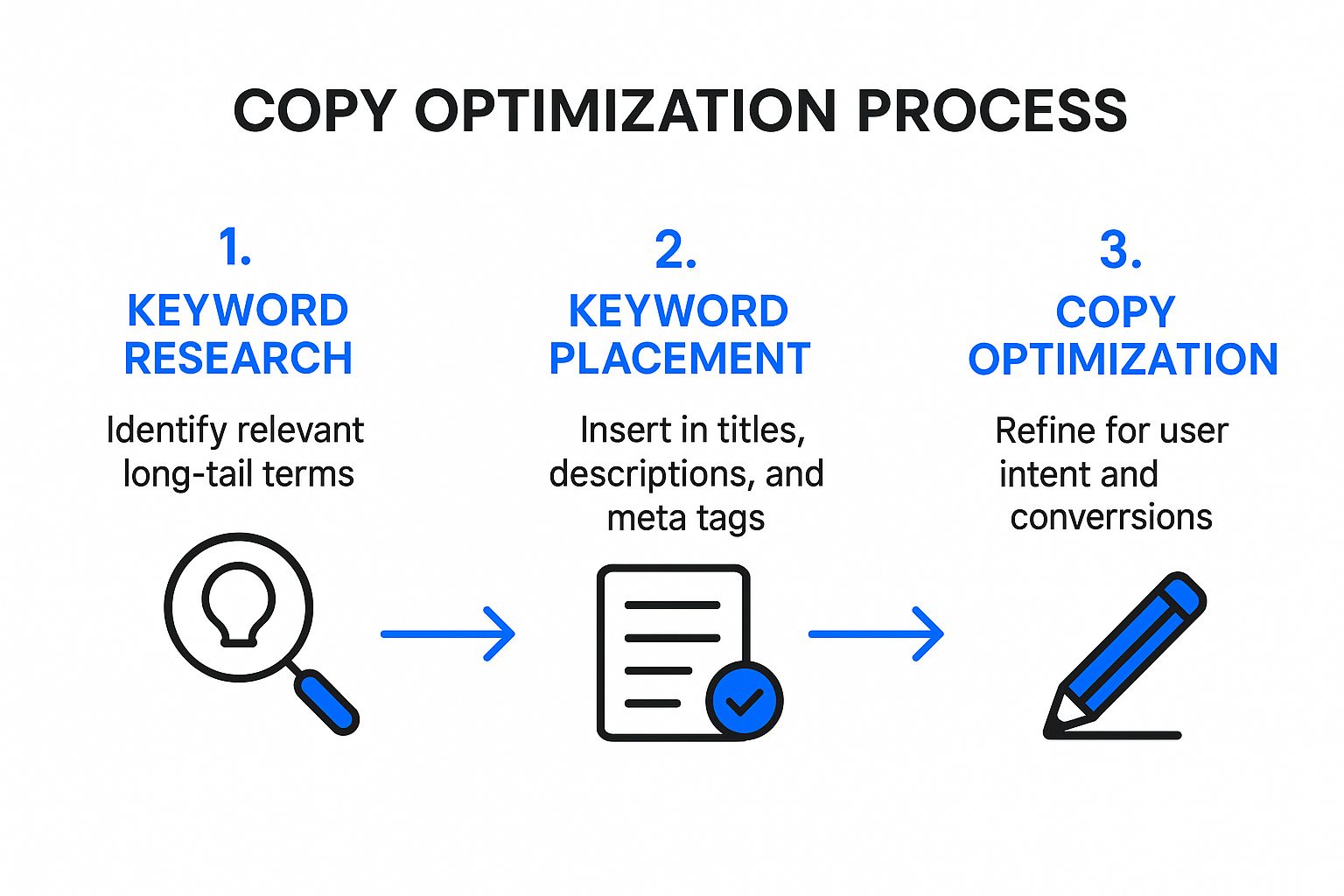
The infographic above visualizes the process of optimizing your product pages for both search engines and users. It starts with keyword research, then moves to on-page optimization and content creation before finally ending with performance monitoring. This cyclical process highlights the ongoing nature of SEO and the need for continuous refinement.
This approach deserves its top spot in our list of e-commerce SEO tips because it directly impacts your most valuable assets: your product pages. By optimizing these pages, you’re not just casting a wide net; you’re precisely targeting potential customers who are actively searching for what you offer. For SMEs and e-commerce brands, this translates to higher visibility, increased organic traffic, and ultimately, more sales.
The Process of Product Page Optimization:
The infographic illustrates a streamlined workflow for product page optimization. The key steps include:
- Keyword Research: Identifying relevant keywords that potential customers use.
- Competitive Analysis: Examining competitor strategies to uncover opportunities.
- On-Page Optimization: Incorporating keywords into titles, descriptions, meta tags, and URLs.
- Content Creation: Crafting compelling product descriptions that highlight benefits and features.
- User Experience (UX): Ensuring a smooth and enjoyable browsing experience for visitors.
- Performance Monitoring: Tracking key metrics like traffic, conversions, and keyword rankings.
The sequential nature of this process is crucial. Thorough keyword research informs your on-page optimization efforts. Compelling content engages users and encourages conversions. Finally, continuous monitoring allows you to adapt to changing search trends and refine your strategy for maximum impact.
Features and Benefits of Optimized Product Pages:
- Strategic keyword placement: Placing keywords in strategic locations like titles, descriptions, and meta content maximizes visibility.
- Long-tail keyword focus: Targeting longer, more specific keywords related to product features or benefits attracts highly qualified leads.
- Optimization for search intent and conversion potential: Crafting content that satisfies user search intent while simultaneously encouraging purchases.
- Unique content: Creating original product descriptions avoids duplicate content penalties and enhances user experience.
Pros:
- Increased visibility in search results for product-specific queries
- Improved relevance signals to search engines
- Significantly increased organic traffic to individual product pages
- Ability to target customers at different stages of the buying journey
Cons:
- Time-consuming to implement across large product catalogs
- Requires ongoing maintenance as search trends change
- Risk of keyword stuffing if not implemented naturally
Examples of Successful Implementation:
- Amazon: Product pages leverage keywords in titles, bullet points, and descriptions.
- Wayfair: Implements detailed product specifications and keyword-rich descriptions while maintaining readability.
- REI: Incorporates relevant keywords alongside rich product information and user reviews.
Actionable Tips for SMEs and E-commerce Brands:
- Keyword Research Tools: Utilize tools like SEMrush, Ahrefs, or Google Keyword Planner to identify high-value keywords.
- Detailed Product Information: Include product specifications, materials, and use cases in descriptions.
- Optimized Meta Data: Ensure meta titles are under 60 characters and meta descriptions under 160 characters for optimal display in search results.
- Unique Content: Create unique descriptions for each product rather than using manufacturer boilerplate.
- Schema Markup: Add schema markup to enhance search engine understanding of product details.
By following these tips and focusing on a user-centric approach to keyword optimization, you can significantly improve your product page visibility, drive more organic traffic, and boost your bottom line.
2. Implement a Robust Technical SEO Foundation
Technical SEO is the bedrock of any successful ecommerce SEO strategy. It’s the unseen force that ensures search engines like Google can efficiently crawl, index, and understand your online store’s content and structure. Without a solid technical foundation, even the best content and marketing efforts can fall flat. This is a crucial element of any comprehensive set of ecommerce seo tips because it directly impacts how easily search engines can access and interpret your site, ultimately affecting your visibility in search results.
Think of your website as a house. Content is the interior design, making it attractive to visitors. Marketing is the inviting front porch, drawing people in. But technical SEO is the foundation, framing, and plumbing – essential for the house to stand strong and function smoothly. It involves several key aspects:
- Site Speed Optimization: Fast-loading pages are crucial for both user experience and search rankings. Optimize images, leverage browser caching, and minimize HTTP requests to improve site speed for both desktop and mobile users.
- Responsive Design: With mobile traffic dominating ecommerce, a responsive design ensures your site adapts seamlessly to any screen size, providing a consistent and user-friendly experience.
- URL Structure: A logical and organized URL structure using categories and subcategories helps both users and search engines navigate your site, understanding the relationship between different pages. For instance,
yourstore.com/clothing/mens/shirtsis much clearer thanyourstore.com/product12345. - XML Sitemap & Canonical Tags: An XML sitemap acts as a roadmap for search engines, guiding them to all important pages. Canonical tags resolve duplicate content issues, signaling the preferred version of a page to search engines.
- HTTPS Security: HTTPS is no longer optional. It’s a ranking factor and essential for building trust with customers, ensuring secure transactions.
Why is Technical SEO so Important for Ecommerce?
A strong technical SEO foundation provides several key benefits:
- Improved User Experience: Faster loading times and mobile-friendliness create a positive user experience, reducing bounce rates and encouraging conversions.
- Enhanced Crawlability & Indexation: A well-optimized site allows search engines to crawl and index more pages, increasing your visibility for relevant keywords.
- Direct Impact on Search Rankings: Google’s Core Web Vitals, a set of metrics measuring user experience, are now ranking factors, making technical SEO directly tied to your search performance.
- Foundation for Other SEO Efforts: Technical SEO lays the groundwork for other optimization efforts like content marketing and link building to succeed.
If you’re using Shopify, you’re in luck! The platform handles a lot of technical SEO automatically. However, ongoing optimization is always beneficial. Ensure your store’s technical foundation is rock-solid for optimal search performance. A comprehensive checklist can help you cover all the crucial elements. For a helpful guide, check out the Shopify SEO Checklist – 8 Essential Steps from ECORN.
Examples of Successful Implementation:
- Shopify: Shopify’s built-in technical SEO features contribute significantly to its merchants’ success.
- Etsy: Despite millions of product pages, Etsy’s robust infrastructure ensures proper indexing.
- Best Buy: Their effective implementation of faceted navigation with proper indexing controls provides a great user experience while maintaining SEO best practices.
Actionable Tips:
- Use Google PageSpeed Insights to identify areas for speed improvement.
- Implement lazy loading for images.
- Aim for a flat site architecture where products are accessible within three clicks from the homepage.
- Regularly crawl your site with tools like Screaming Frog to detect technical issues.
- Implement proper redirects for discontinued products.
- Control crawling of parameter-based URLs and pagination with robots.txt.
Pros and Cons of Investing in Technical SEO:
Pros: Improves user experience, enhances crawlability, directly impacts search rankings, and provides a foundation for other SEO efforts.
Cons: Can require technical expertise and resources, might necessitate site architecture changes, and demands ongoing maintenance.
Technical SEO, while often behind the scenes, plays a crucial role in ecommerce success. By addressing these technical aspects, you can create a seamless user experience, improve search visibility, and ultimately drive more organic traffic to your online store.
3. Create Rich, Unique Product Descriptions
In the competitive world of ecommerce, standing out from the crowd is crucial. One of the most effective ecommerce SEO tips is crafting rich, unique product descriptions. This means moving beyond the generic manufacturer-supplied text and creating compelling, original content for each product page. This approach not only enhances the customer experience but also provides significant SEO benefits. By focusing on benefits, features, and use cases, you can differentiate your store, mitigate duplicate content issues, and improve your search engine rankings for relevant keywords.

This strategy works by providing search engines with more textual content to understand the nuances of your products. Instead of simply indexing the same descriptions found on countless other sites, Google can identify your unique value proposition and rank you accordingly. Furthermore, well-written product descriptions directly address customer needs and pain points, leading to higher conversion rates. By incorporating emotional and persuasive language, you can transform a simple product listing into a compelling narrative that resonates with potential buyers.
Successful examples of this approach abound. Patagonia, known for its commitment to sustainability, crafts unique descriptions that highlight the environmental benefits of their products. Zappos provides detailed shoe descriptions, including crucial information about fit and practical uses. Similarly, B&H Photo goes beyond basic specifications by providing practical application examples for their camera equipment, helping customers envision themselves using the product. These brands understand that rich product descriptions are an investment in both customer satisfaction and SEO.
Actionable Tips for Creating Unique Product Descriptions:
- Prioritize: Start by focusing on your top-selling products and gradually expand to your entire catalog.
- Templates: Develop templates for similar products to streamline the process, but ensure each description retains unique elements.
- Keyword Integration: Naturally incorporate relevant primary and secondary keywords throughout the description. Avoid keyword stuffing.
- Answer Questions: Address common customer questions within the description to preemptively resolve purchase uncertainties.
- Structured Formatting: Use bulleted lists for specifications and key features to improve readability.
- Sensory Language: Incorporate sensory details to help customers imagine using the product – how it feels, smells, or sounds.
Pros and Cons:
- Pros: Differentiates your store, reduces duplicate content, improves SEO, increases conversion rates.
- Cons: Resource-intensive, requires copywriting skills, needs regular updates.
When and Why to Use This Approach:
This approach is particularly beneficial for e-commerce businesses of all sizes, especially SMEs, looking to enhance their online presence and drive sales. It’s especially crucial for businesses operating on platforms like Shopify and WooCommerce where content quality is emphasized. While resource-intensive for large catalogs, prioritizing key products and using templates can mitigate this challenge. The long-term benefits of increased visibility, improved customer engagement, and higher conversion rates make creating rich, unique product descriptions a worthwhile investment for any online retailer. This is a key element in any comprehensive ecommerce SEO strategy, advocated by content marketing experts like Ann Handley and emphasized by platforms like Shopify and BigCommerce that understand the power of high-quality content.
4. Optimize for Voice and Mobile Search
In today’s ecommerce landscape, overlooking mobile and voice search optimization is like leaving money on the table. With the increasing prevalence of smartphones and the rise of voice assistants like Siri, Alexa, and Google Assistant, customers are changing how they search for and purchase products. Optimizing your ecommerce store for these platforms is no longer a luxury, but a necessity for staying competitive and capturing a growing segment of online shoppers. This is especially crucial for SMEs who need to maximize their reach and connect with their target audience effectively.
This optimization strategy involves tailoring your website and content to match how people search using these methods. Instead of short, typed keywords, users are now asking longer, more conversational questions. Think “Where can I buy a red dress near me?” instead of just “red dress.” Therefore, adapting your ecommerce SEO tips needs to reflect this shift.
How it Works:
Optimizing for voice and mobile search involves several key features:
- Mobile-First Indexing Optimization: Google predominantly uses the mobile version of your site for indexing and ranking. This means your mobile site needs to be fast, user-friendly, and offer the same content and functionality as your desktop version.
- Voice Search Keyword Adaptation: Target longer-tail, question-based keywords that reflect how people speak. This includes focusing on question words like who, what, when, where, why, and how.
- Local SEO Integration: If you have a physical storefront, optimizing for “near me” searches is essential. Ensure your Google My Business profile is accurate and up-to-date, and consider using location-based keywords in your content.
- Structured Data Implementation: Using schema markup helps search engines understand the context of your content, making it easier for voice assistants to provide accurate and relevant results. This is particularly helpful for product details, allowing voice assistants to provide specific information like price, availability, and reviews.
- Conversational Content: Create content that answers specific questions and uses natural, conversational language. This can include FAQ sections, blog posts, and product descriptions.
Examples of Successful Implementation:
- Home Depot: Effectively optimizes for how-to queries, providing valuable content that aligns with their product offerings. For instance, they might rank highly for a voice search like, “How do I install a new kitchen faucet?”
- Sephora: Their mobile app includes voice-activated search, allowing users to find products hands-free.
- Target: Implements local inventory search optimized for “near me” voice queries, enabling customers to quickly find nearby stores that carry the products they need.
Pros:
- Captures the growing segment of voice-based shopping queries.
- Improves user experience for mobile shoppers.
- Can help capture featured snippets and position zero placements in search results.
- Prepares your store for future search behavior trends.
Cons:
- Voice search optimization strategies are constantly evolving.
- Tracking voice search performance specifically can be challenging.
- May require significant content restructuring.
Actionable Tips for SMEs:
- Focus on Question-Based Keywords: Research and incorporate question-based keywords related to your products or services. Use tools like AnswerThePublic to discover what questions people are asking.
- Create FAQ Sections: Directly address common customer questions in a dedicated FAQ section on your website.
- Ensure Site Passes Google’s Mobile-Friendly Test: Use Google’s Mobile-Friendly Test tool to identify and fix any mobile usability issues.
- Optimize Page Speed for Mobile Devices: Compress images, leverage browser caching, and minimize HTTP requests to improve mobile page speed.
- Use Schema Markup: Implement schema markup to help voice assistants understand product details, business information, and other relevant data.
- Include Conversational Phrases in Your Content: Write in a natural, conversational tone that reflects how people speak.
By implementing these ecommerce SEO tips and focusing on both mobile and voice search, your business can tap into this expanding market, enhance user experience, and stay ahead of the curve in the ever-evolving world of online search. This is particularly valuable for SMEs looking for tailored web solutions that drive growth and improve their online presence.
5. Leverage User-Generated Content
User-generated content (UGC) is a powerful ecommerce SEO tip that leverages the voices of your customers to boost your online presence. It encompasses any content created by users about your products or brand, including customer reviews, ratings, Q&A sections, user-submitted photos and videos, testimonials, and even community discussions. This authentic content helps search engines understand your product relevance and quality, while simultaneously providing potential customers with the social proof they need to make a purchase. By incorporating UGC, you’re essentially letting your satisfied customers do the selling for you.

This approach deserves a spot on any ecommerce SEO tips list because it addresses several key areas crucial for online success. It provides a constant stream of fresh, relevant content without requiring significant resources from your end. It also introduces natural keyword diversity, as customers often use different terms than you would when describing your products. This organic language helps search engines better understand the context of your offerings and connect them with relevant searches. Furthermore, UGC increases the uniqueness and depth of your product pages, keeping them dynamic and engaging for both search engines and users.
Examples of Successful Implementation:
- Amazon: Their extensive review system and Q&A sections are a prime example of UGC driving significant organic traffic. Potential customers rely heavily on these authentic reviews to inform their purchase decisions.
- Glossier: This beauty brand effectively leverages customer photos on product pages, showcasing how products look on real people. This visual UGC enhances content and provides compelling social proof.
- REI: Customer reviews on REI often include detailed usage scenarios, adding valuable content for other outdoor enthusiasts and boosting the site’s authority for relevant search terms.
Actionable Tips for Leveraging UGC:
- Implement email follow-ups: Request reviews after purchase through automated email sequences.
- Offer incentives: Encourage reviews with discount codes or loyalty points.
- Respond to questions publicly: Answering customer questions in a Q&A section creates valuable content and demonstrates your engagement.
- Implement schema markup for reviews: This enables rich snippets in search results, making your listings more attractive and informative.
- Feature the best UGC prominently: Showcase positive reviews and high-quality photos directly on product pages.
- Manage negative reviews: Establish a system to flag and respond to negative reviews constructively.
Pros and Cons of Utilizing UGC:
Pros:
- Creates regularly updated content without additional resources
- Provides natural keyword diversity through customer language
- Increases content uniqueness and depth
- Builds trust with potential customers
- Improves time on page and engagement metrics
Cons:
- Requires moderation to prevent spam or inappropriate content
- Negative reviews need appropriate management
- May require incentives to generate sufficient content
When and Why to Use This Approach:
UGC is particularly valuable for ecommerce businesses because it directly addresses the trust barrier online shoppers often face. Seeing real people using and enjoying your products provides powerful social proof, encouraging conversions. This approach is essential for both new and established ecommerce businesses looking to improve SEO performance, build customer trust, and drive sales. By leveraging the authentic voices of your customers, you can create a dynamic and engaging online experience that resonates with your target audience and boosts your bottom line. Platforms like Yotpo and the increasing trend of social commerce further facilitate the integration of UGC into your ecommerce strategy.
6. Implement Advanced Schema Markup for Ecommerce SEO Success
Schema markup, also known as structured data, is a powerful yet often underutilized ecommerce SEO tip that can significantly boost your online store’s visibility and performance. It essentially provides search engines with a clear understanding of the content on your product pages, going beyond simple text to define the meaning and relationships between different elements. This enhanced understanding translates into richer search results, improved click-through rates, and ultimately, more sales. For ecommerce businesses, particularly SMEs looking for a competitive edge, schema markup is not just recommended – it’s essential.
Schema markup works by adding specific code to your website’s HTML. This code uses a standardized vocabulary (Schema.org) to label various elements, like product names, prices, availability, reviews, and more. Think of it as giving search engines a detailed blueprint of your product page, allowing them to easily digest and present the most relevant information to potential customers. This often leads to rich snippets, those enhanced search results that display star ratings, pricing information, availability, and other key details directly within the search engine results page (SERP).
Examples of Successful Schema Implementation:
- Walmart: Their implementation of product schema leads to enhanced search listings with pricing and availability clearly displayed, enticing users to click through.
- Home Depot: They cleverly use schema for their DIY project guides, connecting them to relevant products and providing a seamless shopping experience.
- Best Buy: By implementing review schema, Best Buy showcases star ratings directly in search results, building trust and encouraging clicks.
Actionable Tips for Implementing Schema Markup:
- Prioritize Key Schema Types: Start with
Product,Review, andBreadcrumbListschema as these have the biggest impact on ecommerce sites.Offerschema is crucial for pricing and availability. - Include All Required Properties: For each schema type, ensure you include all the necessary properties defined by Schema.org. This maximizes the effectiveness of your markup.
- Accuracy is Key: Schema data must match the visible page content exactly. Inaccurate information can lead to penalties or your rich snippets not being displayed.
- Scalability Through Templates: Implement schema at the template level of your ecommerce platform (e.g., Shopify, WooCommerce). This ensures all your products benefit from schema without manual implementation on every page.
- Validation and Monitoring: Use Google’s Rich Results Test to validate your implementation and ensure it’s working correctly. Regularly monitor rich result performance in Google Search Console to identify any issues or opportunities for improvement.
Pros and Cons of Schema Markup:
Pros:
- Increased SERP Visibility: Rich snippets make your listings stand out, leading to improved visibility.
- Higher Click-Through Rates: Enhanced listings with more information attract more clicks.
- Improved Search Engine Understanding: Schema clarifies product attributes for search engines.
- Potential for Google Shopping Inclusion: Proper product schema can enhance your eligibility for Google Shopping.
- Greater SERP Real Estate: Rich snippets occupy more space in search results.
Cons:
- Technical Challenges: Implementation can be complex, especially for those without coding experience.
- Maintenance: Schema requires ongoing maintenance to ensure accuracy as products and information change.
- No Guarantee of Rich Snippets: Even with perfect implementation, Google doesn’t guarantee the display of rich snippets.
Why Schema Markup Deserves its Place in Your Ecommerce SEO Strategy:
In the competitive world of ecommerce, every advantage counts. Schema markup offers a significant opportunity to enhance your product visibility, improve click-through rates, and ultimately drive more sales. While implementation can be technically challenging, the potential benefits far outweigh the effort, especially for SMEs seeking to compete with larger players. By providing search engines with the information they need to understand and showcase your products effectively, you’re giving your ecommerce store the best possible chance of success.
7. Create SEO-Optimized Content Marketing Strategy
Beyond polished product pages, a robust content marketing strategy is crucial for long-term ecommerce SEO success. This approach shifts from solely focusing on transactional keywords to incorporating informational queries related to your products. By creating valuable content that caters to customer needs at every stage of the buying journey, you not only attract potential buyers earlier but also establish your brand as a trusted authority in your niche. This is especially valuable for SMEs seeking to build brand recognition and compete with larger players.
How It Works:
An SEO-optimized content marketing strategy involves developing a variety of content formats addressing topics relevant to your products. Instead of directly pushing for a sale, the focus is on providing helpful information, answering common questions, and guiding customers towards making informed decisions. This can involve:
- Product Buying Guides: Optimized for keywords related to product research and comparison, these guides help customers navigate the complexities of choosing the right product for their needs.
- How-to Content: Demonstrating product usage through tutorials and guides provides practical value and builds confidence in your products. This is particularly effective for complex products or those requiring specific applications.
- Educational Blog Content: Sharing industry insights and expert knowledge positions your brand as a thought leader and builds trust among potential customers.
- Seasonal and Trend-Focused Content: Capitalizing on current trends and seasonal shopping patterns ensures your content remains relevant and attracts a wider audience.
- Video Content: Optimized for platforms like YouTube and embedded on your website, video content provides an engaging medium for demonstrating products, sharing tutorials, and building brand personality.
Examples of Successful Implementation:
- REI: Their extensive guides for outdoor activities seamlessly integrate relevant product recommendations, offering valuable information while driving sales.
- Sephora: Makeup tutorials and skincare guides draw in potential customers seeking beauty advice and naturally lead them to relevant product pages.
- Wirecutter: Their in-depth product comparison guides, generating affiliate revenue, highlight the effectiveness of providing unbiased, valuable information to consumers.
Actionable Tips for SMEs:
- Keyword Research: Focus on informational keywords related to your products. Think about the questions your target audience is asking during their research phase.
- Content Clusters: Group content around main product categories to create topical depth and improve internal linking opportunities. This signals topical authority to search engines.
- Strategic Internal Linking: Connect informational content to relevant product pages to guide users towards conversion points.
- Optimize for Featured Snippets: Structure content with clear question-and-answer formats to increase chances of appearing in featured snippets, boosting visibility.
- Content Calendar: Plan content aligned with seasonal trends and shopping patterns to maintain freshness and relevance. This is especially important for e-commerce businesses selling seasonal products.
- Regular Updates: Refresh seasonal content annually to maintain freshness signals and ensure accuracy.
Pros and Cons:
Pros:
- Captures top-of-funnel traffic from non-transactional searches.
- Builds topical authority and strengthens your brand’s online presence.
- Creates numerous opportunities for internal linking to product pages.
- Provides valuable content to customers throughout their buying journey, fostering trust and loyalty.
- Supports link building efforts as high-quality informational content attracts more backlinks.
Cons:
- Requires significant content creation resources (time, budget, and expertise).
- Results often take months to materialize, demanding patience and consistent effort.
- Content needs regular updating to maintain relevance and freshness.
Why This Deserves Its Place on the List:
In the crowded ecommerce landscape, content marketing offers a sustainable, long-term strategy to attract, engage, and convert customers. By providing valuable information and building topical authority, SMEs can establish a strong online presence, enhance brand visibility, and ultimately drive sales. This approach goes beyond immediate transactions, focusing on building lasting relationships with customers and establishing a trusted brand identity.
8. Build a Strategic Internal Linking Structure
Internal linking is a crucial yet often overlooked aspect of ecommerce SEO. A well-planned internal linking structure acts as a roadmap for both users and search engines, guiding them through your site and highlighting important relationships between your products, categories, and content. This not only boosts your site’s SEO performance but also enhances user experience, leading to higher conversion rates. This is a must-have for any ecommerce SEO strategy, placing it firmly among the top tips.
For ecommerce businesses, a robust internal linking strategy is essential for distributing “link equity” (the value passed between pages through links) throughout the site. This helps search engines understand which pages are most important and boosts the visibility of deeper pages, such as individual product pages, that might otherwise be harder for search engines to find. For users, it creates a seamless browsing experience, allowing them to easily discover related products and navigate through your catalog. This improves user engagement and reduces bounce rates, signaling to search engines that your site provides valuable and relevant content.
Features of a Strong Internal Linking Structure:
- Category-to-Subcategory Linking Hierarchy: Organize your categories and subcategories in a logical hierarchy, linking them together to establish clear pathways for both users and search engines.
- Related Product Recommendations: Suggest related products on product pages to encourage further browsing and increase average order value.
- Contextual Links Within Product Descriptions: Embed links to related products, categories, or informational content within product descriptions to provide additional context and value to the user.
- Breadcrumb Navigation Implementation: Use breadcrumbs to help users understand their current location within the site hierarchy and easily navigate back to previous levels.
- Featured/Popular Product Highlighting: Showcase your best-selling or featured products through prominent internal links on the homepage and other key pages.
- Recently Viewed Product Functionality: Allow users to easily access products they’ve recently viewed, simplifying their shopping journey.
Pros:
- Distributes link equity throughout the site, boosting the visibility of all pages.
- Improves crawlability and indexation of deep pages, ensuring your entire catalog is discoverable by search engines.
- Reduces bounce rates by providing relevant navigation options and keeping users engaged.
- Helps establish topic clusters and product relationships, improving site architecture and topical relevance.
- Increases average pages per session and time on site, signaling user engagement to search engines.
Cons:
- Can become complex to manage for large catalogs with thousands of products.
- Requires regular audit and maintenance as product inventory changes and new pages are added.
- Excessive internal linking can dilute link value, so it’s important to strike a balance.
Examples of Successful Implementation:
- Amazon: Their extensive related products, “frequently bought together,” and personalized recommendation systems are prime examples of effective internal linking.
- Wayfair: They excel at contextual linking between furniture pieces within collections, allowing users to easily furnish entire rooms with complementary items.
- Sephora: They leverage ingredient-based linking, connecting products with similar formulations to enhance product discovery and cater to specific customer needs.
Actionable Tips for SMEs and E-commerce Businesses:
- Create a logical site hierarchy: Ensure no product is more than three clicks away from the homepage.
- Use descriptive anchor text: Instead of generic phrases like “click here,” use keywords that accurately reflect the linked page’s content. For example, link to a “red leather sofa” category page with the anchor text “red leather sofas” rather than “click here to view sofas.”
- Implement automated related products functionality: Leverage your ecommerce platform’s features or third-party apps to dynamically suggest related products based on categories, tags, or AI-powered recommendations.
- Include contextual links within buying guides and blog posts: Connect informational content to relevant product categories to guide users towards purchase decisions.
- Use breadcrumb navigation with schema markup: Implement breadcrumbs and enhance them with schema markup to improve search engine understanding of your site structure.
- Regularly audit internal links: Identify and fix broken links to maintain a healthy site architecture.
By following these ecommerce seo tips and prioritizing internal linking, you can significantly improve your site’s SEO performance, enhance user experience, and drive more conversions. Thought leaders like Patrick Stox and Kevin Indig have consistently emphasized the importance of strategic internal linking, and advancements in ecommerce personalization technology are making it easier than ever to implement sophisticated internal linking strategies.
8 Essential Ecommerce SEO Tips Comparison
| Tip Title | Implementation Complexity 🔄 | Resource Requirements ⚡ | Expected Outcomes 📊 | Ideal Use Cases 💡 | Key Advantages ⭐ |
|---|---|---|---|---|---|
| Optimize Product Pages for Keywords and User Intent | Medium to High | Moderate to High | Higher organic traffic and improved conversion rates | Large ecommerce catalogs focusing on search relevance | Improves visibility and targets buyer intent |
| Implement a Robust Technical SEO Foundation | High | High | Improved crawlability, rankings, and user experience | Ecommerce sites needing solid technical base | Foundation for all SEO efforts |
| Create Rich, Unique Product Descriptions | Medium | High | Better differentiation, reduced duplicate content, higher conversions | Stores with extensive product catalogs | Unique content boosts SEO and conversions |
| Optimize for Voice and Mobile Search | Medium | Moderate | Captures voice queries, improves mobile UX | Businesses targeting mobile and voice searchers | Prepares for evolving search trends |
| Leverage User-Generated Content | Low to Medium | Moderate | Ongoing fresh content, increased engagement | Sites with active customer base | Builds trust and diversifies keywords |
| Implement Advanced Schema Markup | Medium to High | Moderate to High | Enhanced search listings with rich snippets | Ecommerce sites wanting improved SERP presence | Increases CTR and search result visibility |
| Create SEO-Optimized Content Marketing Strategy | High | High | Increased top-of-funnel traffic, brand authority | Stores aiming for content-driven customer acquisition | Builds topical authority and supports link building |
| Build a Strategic Internal Linking Structure | Medium | Moderate | Improved crawlability, lower bounce rate, better UX | Large ecommerce sites with many product/category pages | Distributes link equity and guides users |
Ready to Transform Your Ecommerce Performance?
Ecommerce SEO is no longer a nice-to-have, but a necessity for online businesses. This article has outlined eight key ecommerce SEO tips, from optimizing product pages and building a strong technical foundation to leveraging user-generated content and implementing advanced schema markup. Mastering these core elements will significantly impact your visibility in search engine results, driving more organic traffic, qualified leads, and ultimately, increased sales. Remember, focusing on these fundamental ecommerce SEO tips sets the stage for sustainable growth, ensuring your business can thrive in the competitive online marketplace. By optimizing for keywords, user intent, and mobile, you’re not just improving search rankings; you’re enhancing the user experience and building a stronger brand presence online.
Looking to improve your online store? Discover how to optimize your ecommerce checkout, increase conversions with Shopify CRO tips, and choose the best ecommerce platform for beginners. Don’t forget to compare Shopify vs WooCommerce to make the right decision for your business.
Taking these actionable steps today will position your ecommerce business for long-term success. However, we understand that navigating the complexities of SEO can be challenging. If you’re ready to take your ecommerce performance to the next level, consider partnering with Denver Web Design Studio. We specialize in helping ecommerce businesses like yours implement effective SEO strategies, from technical optimization and content creation to advanced schema markup and link building, so you can focus on growing your business. Contact us today for a consultation and let us help you unlock the full potential of your online store.