Reciprocal Links: What They Are and How They Affect SEO
Reciprocal links are essentially a two-way street in the world of website connections. They happen when two websites agree to link to one another. Think of it as a virtual handshake: Website A links to Website B, and Website B links back to Website A. This mutual exchange was once a key part of Search Engine Optimization (SEO). However, understanding their current role requires a closer look at how search engines interpret these links today—and how to use them without risking your rankings.
Reciprocal links are essentially a two-way street in the world of website connections. They happen when two websites agree to link to one another. Think of it as a virtual handshake: Website A links to Website B, and Website B links back to Website A. This mutual exchange was once a key part of Search Engine Optimization (SEO). However, understanding their current role requires a closer look.
Reciprocal links have changed along with search engine algorithms. In the early days of the internet, reciprocal linking was a common practice. It helped websites gain credibility and visibility. For example, if Website A linked to Website B, and vice-versa, this exchange could boost search rankings. This was especially true in the early 2000s.
However, as search engine algorithms (especially Google’s) evolved, the value of reciprocal links decreased. Around 2010, Google’s algorithm updates (like Panda and Penguin) began penalizing manipulative linking practices, including excessive reciprocal linking. While not entirely obsolete, their effectiveness has significantly dropped. Learn more about the history of reciprocal links: SEMrush Blog Post on Reciprocal Links
Understanding the Nuances of Reciprocal Links
This change raises an important question: what makes a reciprocal link “good” versus “bad”? The answer lies in the context and relevance of the link. A good reciprocal link occurs naturally between two websites offering related content or services.
For example, a Denver bakery might link to a local florist, as they serve similar audiences and occasions. This type of link exchange feels natural and can be beneficial for both businesses.
Conversely, a “bad” reciprocal link often feels forced and irrelevant. It’s usually motivated by manipulating search rankings. This might involve unrelated websites exchanging links solely for SEO purposes. This can trigger penalties from search engines, harming visibility.
Why Context and Relevance Matter
The effectiveness of a reciprocal link depends heavily on its context. Imagine a website about organic gardening linking to a website selling car parts. This connection lacks relevance and seems unnatural. This could raise red flags for search engines like Google.
In contrast, if the gardening website links to a local nursery or a blog about sustainable living, these connections make sense. They enhance user experience and demonstrate relevant themes.
Additionally, anchor text—the clickable words used for the link—plays a crucial role. Descriptive anchor text that accurately represents the linked page adds value. Generic anchor text like “click here” offers little context and can appear spammy.
Choosing the right link partners and focusing on relevance are key. This strategic approach helps businesses use reciprocal links effectively and build a solid online presence.
The Real SEO Impact of Reciprocal Links
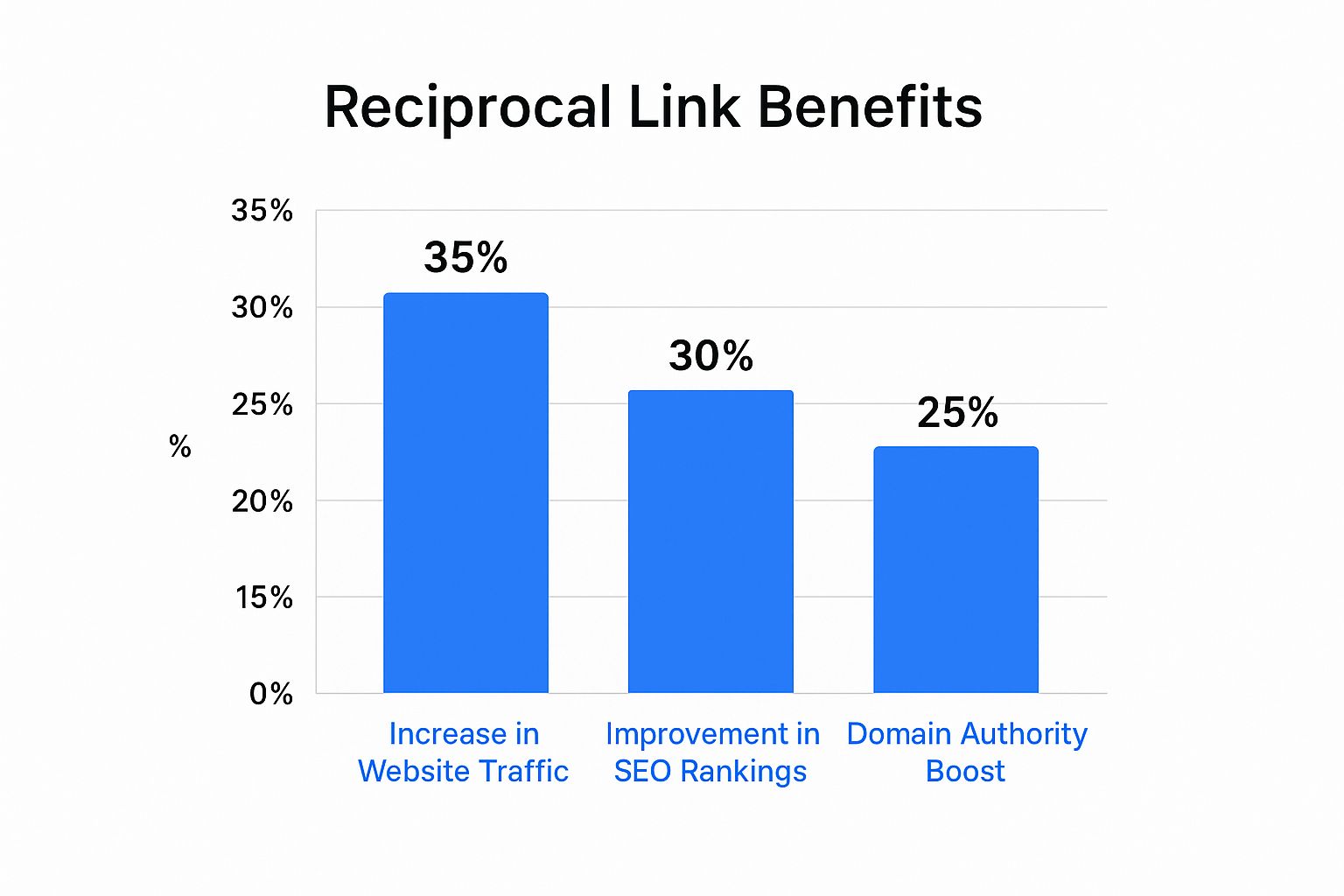
This infographic illustrates the potential upside of reciprocal links, showing a possible 35% increase in website traffic, a 30% improvement in SEO rankings, and a 25% domain authority boost. While these figures are enticing, understanding the complexities of reciprocal linking in the current SEO environment is key. These links can offer benefits, but realizing their full potential requires a strategic approach focused on relevance and user value.
How do search engines interpret these link exchanges? The relationship between reciprocal links and SEO is intricate due to how search algorithms currently function. Search engines, like Google, analyze link patterns to gauge a website’s authority and trustworthiness.
This evaluation extends beyond simply counting links. Factors such as the relevance of linking websites, the anchor text used, and the overall link profile play a significant role. So, while strategic reciprocal linking can be beneficial, it’s crucial to be aware of the potential downsides if misused.
Navigating the Benefits and Risks
Used correctly, reciprocal links can be advantageous. They can increase website traffic, particularly if the partner site has a substantial and engaged audience. They also offer opportunities to build relationships with other businesses or websites within your niche.
However, avoid excessive or irrelevant reciprocal linking. Overdoing it can raise red flags with search engines. A high percentage of reciprocal backlinks from low-quality sites could negatively impact your rankings. Focusing on the quality and relevance of your link partners is paramount for success.
Statistically, the SEO value of reciprocal links has always yielded mixed results. SEO professionals generally agree that one-way backlinks are more valuable than reciprocal links. A one-way link, where one site links to another without reciprocation, appears more organic and carries greater SEO weight.
Reciprocal links, in contrast, are viewed with more scrutiny. They can appear manipulative, especially if they seem unnatural or excessive. According to SEO best practices, reciprocal links should be used sparingly and based on relevance, not purely for SEO gain.
A good rule of thumb is to consider user value. If a reciprocal link offers genuine value and relevance to users, it might offer some medium-level SEO benefit. However, if the practice becomes spammy or too frequent, it can harm your rankings. Current guidelines advise against excessive reciprocal linking, which is generally considered to be around 20-30% of your total backlinks if it appears manipulative. Learn more about reciprocal links here.
To help clarify the differences, let’s look at a comparison:
The table below, “Reciprocal Links vs. One-Way Backlinks,” compares the characteristics and SEO value of these two link types, helping you understand their importance in link building strategies.
| Factor | Reciprocal Links | One-Way Backlinks |
|---|---|---|
| SEO Value | Medium (if relevant) | High |
| Natural Appearance | Can appear manipulative if excessive | More natural and organic |
| Traffic Potential | Can increase traffic from partner site | Can increase traffic from diverse sources |
| Risk | Potential for negative impact if misused | Lower risk if from quality sources |
| Relationship Building | Facilitates partnerships | May not directly lead to relationships |
| Best Practice | Use sparingly, prioritize relevance | Prioritize acquisition from authoritative sources |
As this table highlights, one-way backlinks are generally favored for their stronger SEO impact and more natural appearance. While reciprocal links can offer benefits like traffic and relationship building, they must be implemented cautiously.
Focusing on Quality Over Quantity
While the infographic showcases potential advantages, remember that quality outweighs quantity in SEO. The context and relevance of each link are paramount. Prioritizing these factors is crucial to harnessing the potential of reciprocal links while minimizing risks. Building natural, beneficial connections is the key to sustainable SEO growth. Ultimately, user experience and relevance should be at the heart of your reciprocal linking strategy.
The Double-Edged Sword of Link Exchanges

Reciprocal links, a common strategy in website promotion, offer a mix of potential benefits and risks. Understanding both sides of this equation is key to using them effectively as part of your Search Engine Optimization (SEO) strategy. This delicate balance requires careful consideration and strategic implementation.
Potential Benefits of Reciprocal Links
A primary advantage of reciprocal links is the potential to boost website traffic. Partnering with relevant sites that have a large and engaged audience can introduce your business to a new pool of potential customers. Imagine a Denver-based yoga studio linking with a local health food store. Both businesses could tap into each other’s customer base, leading to increased visibility and potential new clients.
Furthermore, reciprocal links can build valuable relationships within your industry. These connections can pave the way for collaborative opportunities, joint ventures, and resource sharing. Building a strong network can solidify your presence online and within your local community.
The Risks of Reciprocal Link Exchanges
However, it’s important to acknowledge the potential downsides. A major risk is incurring penalties from search engines like Google if the links appear manipulative. This often occurs when reciprocal links are excessive, irrelevant to the content, or part of a larger, artificial link scheme. Such penalties can dramatically impact your search rankings, making it harder for potential customers to find you.
Another concern is the potential negative association with low-quality websites. Linking with sites that have poor content, engage in spammy practices, or have a questionable reputation can damage your own site’s credibility. This can erode user trust and negatively impact your brand image. Careful vetting of potential link partners is crucial.
Finding the Balance: Quality Over Quantity
The decision of whether or not to implement reciprocal links involves understanding the potential effects on your website’s traffic and credibility. When done naturally, based on genuine relationships and content relevance, they can indeed boost traffic and build credibility. However, without careful management, reciprocal links can lead to penalties from search engines.
Historically, around the mid-2000s, reciprocal linking was a prominent SEO tactic. Some estimates suggest that up to 50% of backlinks were reciprocal at one point. However, with algorithm updates and the evolution of SEO, their effectiveness and prevalence have diminished. Today, SEO specialists recommend a judicious approach, focusing on quality over quantity.
For example, if a website has 100 backlinks, exceeding 20-30 reciprocal links might raise red flags with search engines, potentially impacting page ranking. Explore this topic further. You can also learn more about building a robust backlink profile by understanding how many backlinks you need to rank.
The key takeaway is to be strategic. Prioritize genuine relationships with high-quality, relevant websites that provide value to your audience. Avoid excessive link exchanges and always prioritize quality over quantity. This approach allows you to leverage the potential benefits of reciprocal links while minimizing the associated risks.
Crafting Reciprocal Link Strategies That Actually Work

Building a successful website involves many strategies, and reciprocal links are often overlooked. Instead of relying on generic advice, let’s explore how effective reciprocal linking requires a nuanced approach. This includes finding the right partners and crafting outreach that truly connects. This section will guide you through building valuable, audience-focused relationships while adhering to search engine guidelines.
Identifying Potential Partners
Finding the right partners is the first step. Think about businesses that offer complementary services or content, rather than focusing solely on SEO metrics. For example, a Denver-based web design agency, like Denver Web Design Studio, might partner with local photographers, content writers, or SEO specialists. This creates a network of related businesses offering value to each other’s audiences.
Consider local organizations or community groups. Connecting with relevant non-profits or industry associations expands your reach and builds valuable connections. This broadens your network beyond direct competitors and establishes your business within the community.
Crafting Effective Outreach
After identifying potential partners, reaching out effectively is crucial. Personalize your message and explain the mutual benefits of a partnership. Avoid generic templates. Instead, highlight specific areas of overlap and how the partnership can benefit both audiences. This shows genuine interest and increases the chances of a positive response.
Make the value proposition clear. Explain how the partnership will benefit your partner’s audience and business. This could include increased visibility, access to new resources, or cross-promotional opportunities. A clear value proposition makes the partnership more appealing.
Structuring the Link Exchange
When implementing reciprocal links, focus on natural integration within your content. Avoid inserting links abruptly; place them within contextually relevant content that adds value for the reader. This benefits the user experience and aligns with search engine best practices.
Diversify your anchor text. Instead of using the same keyword repeatedly, vary the anchor text to accurately describe the linked page. For instance, instead of always using “web design Denver,” use variations like “Denver website development,” “local web design services,” or “Colorado web designers.” This maintains a natural link profile and avoids over-optimization.
The following table, “Reciprocal Link Implementation Checklist,” outlines the crucial steps and considerations for effective and safe implementation. It provides a quick reference for ensuring your reciprocal linking strategy is both beneficial and sustainable.
| Step | Key Considerations | Potential Red Flags |
|---|---|---|
| Partner Selection | Relevance to your niche, audience overlap, authority, and quality of content | Unrelated industries, low-quality sites, spammy partners |
| Outreach | Personalized messages, clear value proposition, focus on mutual benefit | Generic templates, solely SEO-focused requests, lack of personalization |
| Link Placement | Natural integration within content, relevant context, adds value for the reader | Abrupt insertion, irrelevant context, forced placement |
| Anchor Text | Descriptive, varied, accurately represents linked page | Over-optimized keywords, repetitive anchor text, generic phrases |
| Monitoring | Track referral traffic, analyze link performance, conduct regular audits | Ignoring link performance, neglecting audits, failing to identify problematic links |
This checklist emphasizes the importance of a thoughtful and strategic approach. By considering these key elements, you can avoid common pitfalls and maximize the benefits of reciprocal linking.
By following these strategies, you can use reciprocal links effectively as part of your overall SEO strategy. This can drive traffic, build relationships, and enhance your online presence.
Beyond the Exchange: Superior Link Building Alternatives
Savvy SEO professionals know that reciprocal links, while potentially part of a broader strategy, aren’t the most effective way to build a strong online presence. Relying solely on link exchanges can significantly limit your website’s potential. To truly maximize online growth, explore these more powerful and sustainable alternatives. These tactics are designed to send stronger authority signals to search engines and offer long-term benefits without the risks associated with reciprocal linking.
Creating Content That Attracts Inbound Links
One of the most effective ways to build a robust link profile is by creating content that other websites naturally want to link to. This “inbound” strategy focuses on developing valuable, informative, and engaging resources.
High-quality blog posts, original research studies, and interactive tools are all excellent examples of link-attracting content. These resources organically draw links because they provide genuine value to readers. This method establishes your website as a trusted authority within your niche.
Building Relationships for Editorially-Given Mentions
Cultivating relationships with other businesses, influencers, and journalists in your field is another essential component of effective link building. These connections often result in editorially-given mentions, which are links naturally incorporated within articles and blog posts.
For example, a local Denver business could partner with a community blogger to develop engaging content. This collaboration could naturally lead to a valuable backlink from a trusted local source. Earned media like this holds significant weight with search engines because it’s built on genuine relationships and relevant content.
Leveraging Data-Driven Assets to Generate Citations
Data-driven content, such as original research reports and industry surveys, is particularly effective in generating backlinks. Other websites often cite these resources as credible sources of information.
Imagine a Denver marketing agency publishing data about local consumer behavior. Their research might be cited in various industry publications, naturally attracting backlinks and establishing the agency as a thought leader. This type of content adds real value to the online community and encourages natural link acquisition.
Adapting Strategies for Maximum ROI
Different link-building strategies offer varying levels of return on investment (ROI) for different websites. E-commerce sites, for instance, might find success with product reviews and affiliate marketing, while service-based businesses in Denver could prioritize local SEO strategies and directory submissions.
If you’re seeking superior link-building methods beyond reciprocal exchanges, consider focusing on high-quality content creation and proactive outreach, similar to the strategies outlined in this helpful resource on link building for ecommerce websites. Tailoring your approach to your specific business needs and available resources is vital for maximizing the impact of your link-building efforts. Carefully analyzing your website’s current performance and pinpointing areas for improvement will allow you to create a truly targeted and successful link-building strategy.
Measuring What Actually Matters with Reciprocal Links
After implementing your reciprocal link strategy, the next crucial step is measuring its effectiveness. This isn’t about simply counting links. It’s about understanding how they influence your key performance indicators (KPIs). This requires shifting focus away from vanity metrics and diving into the data that truly reflects your site’s health and growth.
Beyond Link Counts: Tracking Meaningful Engagement
The number of reciprocal links can seem important, but it’s a superficial metric. What truly matters is the quality of those links and the engagement they generate.
This means tracking metrics like:
- Referral traffic: How many visitors are coming from your partner sites?
- Bounce rate: What percentage of those visitors leave immediately?
- Time on site: How long do visitors from reciprocal links stay on your site?
This data provides a more complete picture of how these links contribute to your site’s overall performance. For example, high referral traffic with a low bounce rate suggests the link is bringing in engaged users. Conversely, high referral traffic paired with a high bounce rate indicates a disconnect between the linking sites and their audiences.
Regular Audits: Identifying Problematic Patterns
Regular link audits are essential for a healthy backlink profile. This involves systematically reviewing your reciprocal links to identify any problematic patterns or low-quality connections.
Look for links from sites with:
- Spammy content
- Low domain authority
- Irrelevant topics
This proactive approach helps address potential issues before they negatively impact your search rankings. Additionally, regular audits help refine your strategy based on performance data.
Data-Driven Decisions: Maintaining or Removing Links
Your audit findings inform decisions about maintaining or removing specific reciprocal links. If a link isn’t driving quality traffic or potentially harms your SEO, removing it is often best. This might involve contacting the partner site and politely requesting removal.
However, maintain reciprocal links performing well and bringing valuable traffic. This data-driven approach ensures your strategy is continuously optimized for maximum effectiveness. If you’re looking for superior link-building alternatives, consider high-quality content and proactive outreach, similar to the tips discussed in this article about link building for ecommerce website.
Refining Your Approach: Continuous Improvement
Successful websites don’t rely on static SEO strategies. They continuously refine their approach based on performance data. This iterative process involves analyzing link data, making necessary adjustments, and monitoring the results. Treat reciprocal linking as a dynamic part of your overall SEO strategy to ensure it consistently contributes to your website’s growth. This might involve adjusting your partner selection criteria, your outreach methods, or experimenting with different link placement strategies.
Are you ready to transform your website into a high-performing, lead-generating machine? Denver Web Design Studio specializes in creating custom web designs and implementing effective SEO strategies, including smart reciprocal linking, to help businesses in Denver thrive. Contact us today to learn more.